
Outliers
The Story of Success
by Malcolm Gladwell
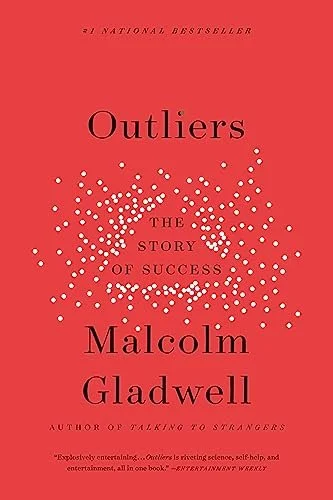
“The explosively entertaining Outliers might be Gladwell’s best and most useful work yet...There are both brilliant yarns and life lessons here: Outliers is riveting science, self-help, and entertainment, all in one book.”
The Myth of the Self-Made Success: Why Talent Is Overrated
We love the story of the lone genius. You know the one: the college dropout who builds a tech empire in his garage through sheer grit and brilliance; the starving artist who practices until their fingers bleed and finally gets discovered. It’s the American Dream distilled into a biography. We tell ourselves that if we just work hard enough and want it bad enough, we can achieve anything.
But Malcolm Gladwell, in his groundbreaking book Outliers, argues that this story is fundamentally flawed. It’s not that hard work and talent don’t matter—they do. But they aren't enough. By focusing so heavily on the individual, we miss the massive, hidden forces that actually determine who succeeds and who fails. Success, Gladwell reveals, is not a solo climb; it is a product of history, community, opportunity, and legacy.
Understanding this doesn't diminish success; it demystifies it. It shifts your focus from "Do I have enough raw talent?" to "Am I in an environment that allows my talent to bloom?"
What You'll Learn
The 10,000-Hour Rule: Why mastery is a function of time and specific opportunity, not just genetics.
The "Matthew Effect": How small, arbitrary advantages (like your birth month) compound over time into massive dominance.
The IQ Threshold: Why being a genius doesn't guarantee success, and what actually does.
Cultural Legacy: How the traditions of your ancestors—even from centuries ago—impact how you communicate and work today.
The Hockey Stick and the Calendar
Gladwell opens with a puzzle that will change how you look at "meritocracy" forever. If you look at the rosters of elite Canadian youth hockey teams, a shocking percentage of players are born in January, February, and March. Almost no one is born in November or December.
Is there an astrological reason for this? Of course not. The cutoff date for age-class hockey in Canada is January 1st. A boy turning ten on January 2nd is playing alongside a boy who turns ten on December 30th. At that age, a 12-month gap in physical maturity is massive. The January kid is bigger, stronger, and faster.
Because he looks more "talented," he gets picked for the all-star team. He gets better coaching. He plays twice as many games. By the time he is 14, he really is better. But it didn't start with talent; it started with a calendar quirk.
This is the Matthew Effect (named after the biblical verse: "For unto every one that hath shall be given, and he shall have abundance"). Success is often the result of "accumulative advantage."
The Business Takeaway: In your own company, are you rewarding "early bloomers" and ignoring those with potential who just need a bit more runway? Are your promotion cycles inadvertently favoring people who happened to get on the "hot" project by luck?
The 10,000-Hour Rule (and the Luck to Get It)
You’ve likely heard of the 10,000-Hour Rule—the idea that it takes roughly ten years or 10,000 hours of deliberate practice to achieve mastery in any field. But Gladwell’s insight isn’t just about the number; it’s about the opportunity to hit that number.
Take Bill Gates. We know he’s brilliant. But lots of people are brilliant. Gates was an outlier because, in 1968, he attended a private school in Seattle that had a computer terminal. Most colleges didn't even have one. He could program in real-time while others were using punch cards. By the time he dropped out of Harvard to start Microsoft, he had been programming virtually non-stop for seven years. He had his 10,000 hours before most competitors had 500.
The same applies to the Beatles. Before they invaded America, they played in strip clubs in Hamburg, Germany. They were forced to play for eight hours a night, seven days a week. Most bands played an hour a week. By the time they hit the big time, they had performed live more than most bands do in a lifetime.
The lesson? High achievers don't just work hard; they are the beneficiaries of unique circumstances that allow them to work hard.
Trouble with Geniuses: Why IQ Isn't Everything
We often assume that the smarter you are, the more successful you will be. Gladwell introduces us to Christopher Langan, a man with an IQ of 195 (higher than Einstein’s). Yet, Langan spent much of his life working as a bouncer and struggling to get his theories published.
Compare him to Robert Oppenheimer, the father of the atomic bomb. Oppenheimer was brilliant, but he also once tried to poison his tutor at Cambridge. Instead of being expelled, he used his social savvy to talk his way out of it and into probation.
This illustrates two key concepts:
Threshold Theory: Intelligence matters, but only up to a point. Once you have an IQ around 120, additional points don't translate to much more real-world success. You are "smart enough."
Practical Intelligence: This is "knowing what to say to whom, knowing when to say it, and knowing how to say it for maximum effect." It is a learned skill, often coming from one's upbringing. Oppenheimer had it (wealthy, encouraged to speak up); Langan didn't (poor, estranged from authority).
The Micro-Story: Think of that one brilliant engineer on your team who can solve any coding problem but can't get budget approval because they insult the finance director. That is a lack of practical intelligence. Meanwhile, the project manager who is "average" at the technical side but navigates the office politics seamlessly gets the promotion.
Key Terms at a Glance
The Matthew Effect: The phenomenon where early advantages (even arbitrary ones like birth dates) compound over time, leading to outsized success for a select few.
10,000-Hour Rule: The principle that greatness requires an enormous amount of time spent in deliberate practice. The key differentiator is often the opportunity to accrue these hours.
Threshold Theory: The idea that qualities like IQ only correlate with success up to a certain level (a threshold). Beyond that point, other factors (creativity, social skills) become the deciding factors.
Practical Intelligence: "Street smarts" or social savvy—the ability to read situations and influence others to get what you want.
Mitigated Speech: A linguistic habit where a speaker downplays or sugars-coats what they mean to be polite. In high-stakes situations (like a cockpit), this can be fatal.
Power Distance Index (PDI): A measure of how much a culture respects and defers to authority figures. High PDI cultures struggle with subordinates challenging superiors.
Cultural Legacy: The Cockpit Culture
Perhaps the most gripping section of the book analyzes why Korean Air had a terrible safety record in the late 1990s. It wasn't bad planes or bad pilots. It was culture.
Korea has a high Power Distance Index (PDI). In this culture, you show deep deference to authority. Gladwell analyzes black-box recordings where copilots knew something was wrong but were too culturally conditioned to bluntly correct the captain. They used "mitigated speech"—hints and suggestions—rather than direct commands. The captain, tired or stressed, missed the hints, and the planes crashed.
When Korean Air acknowledged this, they didn't fire the pilots; they retrained the culture. They forced pilots to speak English (a language without the same built-in hierarchy honorifics) in the cockpit to break the cultural script. The safety record turned around completely.
This applies directly to business. If you are a leader, do you have a "High PDI" office? Are your junior employees terrified to tell you that your strategy is going to crash the company?
Rice Paddies and Math Tests
Gladwell concludes by looking at why Asian students statistically outperform Western students in math. It’s not genetics. It might be the rice paddies.
Rice farming is grueling, exacting, and complex. It requires 3,000 hours of labor a year per hectare. It rewards effort directly: the harder you work, the more rice you get. Contrast this with Western wheat farming, where you plant the seed and wait for rain.
This ancestral history created a culture that values struggle and persistence. Math is not about innate ability; it’s about not giving up when the problem gets hard. Western students often quit a math problem after 30 seconds if they don't get it. Students from "rice cultures" persist far longer. Success is a function of persistence, a legacy handed down from the rice paddy.
Quick Start Guide: Applying the Outlier Mindset
You cannot change where you were born or your IQ. But you can engineer your environment to create outlier-like results.
1. Audit for "Relative Age" Bias
Look at your hiring and promotion data. are you inadvertently filtering out people because they lack a specific credential that is essentially just a "birth date" advantage?
Action: Try "blind" resume reviews or skills-based hiring to remove pedigree bias.
2. Create Safety for "Mitigated Speech"
If you are the boss, you are the pilot. Your team is the copilot. If they are too polite to tell you the project is failing, you will crash.
Action: Institute a "Red Flag Rule." Explicitly tell your team: "If you see a risk, you have permission to be rude and direct. I will not be offended; I will thank you."
3. The Saturday Morning Opportunity
The Beatles had Hamburg; Gates had the computer lab. What is the equivalent for your team?
Action: Give your high-potentials access to "play." Let them shadow the CEO, give them access to expensive software, or let them lead a low-risk experimental project. Give them the hours.
4. Teach Practical Intelligence
Don't just train technical skills. Mentor your team on how to navigate meetings, how to ask for a raise, and how to disagree agreeably.
Action: Debrief after client meetings not just on what was decided, but how the interaction went. "Did you notice how he leaned back when we mentioned price? Here is how we handle that next time."
5. Adopt the "Rice Paddy" Work Ethic
Stop praising "smart." Start praising "persistence."
Action: When a team member solves a hard problem, don't say, "You're a genius." Say, "I admire how you stuck with that when it got frustrating."
Final Reflections
Outliers fundamentally rewrites the definition of success. It asks us to stop looking at the successful person as a solitary giant and start looking at the world that produced them. It is a call to humility for the successful (you didn't do it alone) and a call to action for leaders (we must build better systems). When we understand that success is a result of accumulative advantage, opportunity, and cultural legacy, we realize that our job is not just to be the outlier, but to build a world where more outliers can be created.
Business Floss is reader-supported. When you use our links we may earn an affiliate commission that helps us keep the site running. Thank you for your support!