
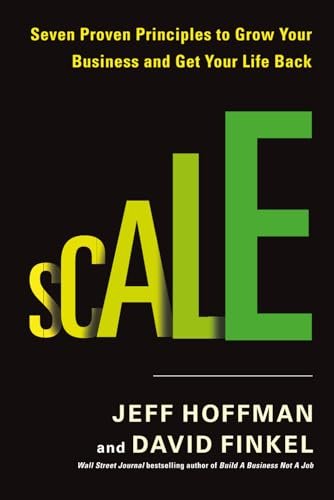
Scale
Seven Proven Principles to Grow Your Business and Get Your Life Back
by Jeff Hoffman & David Finkel
“Hoffman and Finkel have hit a grand slam with Scale. Each of the chapters is worth its weight in gold and jam-packed with immediately actionable guidance.”
Building a Business That Outlives Your Effort: The Journey to Freedom
Most entrepreneurs start their journey with a dream of freedom—the ability to set their own hours, make their own decisions, and build something of lasting value. Yet, for many, that dream eventually curdles into a high-stakes, 80-hour-a-week trap. Instead of owning a business, they own a demanding job where they are the primary producer, the chief problem solver, and the ultimate bottleneck. If the owner takes a week off, the revenue stops, the clients complain, and the "machine" grinds to a halt.
In their book Scale: Seven Proven Principles to Grow Your Business and Get Your Life Back, Jeff Hoffman and David Finkel address this specific paradox. They argue that the goal of scaling isn't just to make the company bigger; it is to make the company independent. Drawing from their experiences building multi-billion dollar enterprises like Priceline.com, they provide a roadmap to transition from a "Level One" startup to a "Level Three" owner-independent business. This is the definitive guide for anyone who wants to grow their revenue while simultaneously reclaiming their personal time.
What You'll Learn
The Maturity Model: Discover the three distinct levels of business and why most founders get stuck in the "Self-Employment Trap."
Systemic Freedom: How to transform your personal expertise into "Expert Systems" that allow your team to produce elite results without your intervention.
The Five Pillars of Scale: A holistic framework for strengthening Sales, Operations, Finance, Team, and Leadership in parallel.
Strategic Time Management: Techniques to reclaim eight to ten hours every week for high-leverage "Architect" work.
Predictable Expansion: How to identify and break the "Limiting Factors" that are currently holding your revenue hostage.
The Three Levels of Business Maturity
Every company moves through a predictable lifecycle, but many founders unknowingly anchor themselves at a stage that prevents true scaling. Hoffman and Finkel define these as "Levels." At Level One, you are in the "Launch" phase. It’s chaotic, hands-on, and entirely dependent on your individual hustle. You are the one baking the bread, coding the software, or selling the service.
Level Two is where most small businesses live—and where most entrepreneurs burn out. This is the "Owner-Reliant" stage. You have a team, and you may even have significant revenue, but you are still the central hub of every wheel. If a decision needs to be made, it goes through you. If a client is unhappy, they call you. You have created a job for yourself that is far more demanding than any corporate role you ever left behind.
The ultimate goal is Level Three: the "Owner-Independent" business. This is a company that has its own "Operating System." It functions, grows, and creates profit regardless of whether the owner shows up on a Tuesday morning. Reaching Level Three is the only way to build a truly valuable asset—something that can eventually be sold or passed down because it doesn't require your specific genius to survive.
Core Concepts Defined
Level Three Business: A company that can function and grow without the daily involvement of the founder.
The Self-Employment Trap: A state where the owner is the primary producer and the ultimate bottleneck for all strategic and tactical decisions.
The 80% Rule: The principle that a system-driven team performing at 80% of your personal quality is the necessary price of freedom and scale.
Owner-Independence: A metric of success based on how many consecutive days the business can run profitably without the owner's input.
The Architecture of Freedom: Building Expert Systems
The bridge between being a "Level Two" boss and a "Level Three" owner is built out of systems. Most founders resist systems because they believe their work is too "creative" or "complex" to be documented. However, Hoffman and Finkel argue that if you can’t describe what you do as a process, you don't know what you’re doing—you’re just reacting.
To scale, you must build "Expert Systems." These aren't just thick manuals that sit on a shelf; they are living documents that capture your high-level expertise and make it accessible to your team. Think of it like a franchise. A teenager can run a McDonald's not because they are a culinary genius, but because the system is so robust that it compensates for a lack of experience.
When you build a system for lead generation, customer onboarding, or financial reporting, you are essentially "cloning" your brain. This allows you to delegate not just the tasks, but the responsibility for the outcome. Instead of managing people, you begin to manage the systems that manage the people.
Mastering the Five Pillars of a Scalable Organization
Scaling is not a linear process; it is a multi-dimensional one. If you focus solely on growing your sales without scaling your operations, your customer service will suffer, your reputation will tank, and the business will collapse under its own weight. Hoffman and Finkel identify five core pillars that must be strengthened in tandem.
Sales and Marketing is the first pillar. To scale, you must move away from "founder-led sales." If the only way the company gets a new client is through your personal network or your personal pitch, you are stuck. You need a lead-generation machine that works while you sleep. This involves identifying your "Deep Needs" customer and building a repeatable funnel that doesn't rely on your charisma.
The second pillar, Operations, is about consistency. This is where your Expert Systems live. Every customer should have the same high-quality experience every single time, regardless of which employee handles their account. The third pillar, Finance, is often the most neglected. Scaling requires capital and visibility. You need robust "controls"—scorecards and financial reports—that allow you to spot a problem in your cash flow before it becomes a crisis.
Finally, the Team and Executive Leadership pillars focus on culture and strategy. You must hire "system-followers" rather than just "lone wolves." As the leader, your primary job is to scan the horizon. You should be spending at least 20% of your time looking ahead to "Tomorrow's Marketplace," identifying threats and opportunities before they arrive.
Key Terms at a Glance
High-Value Activities (HVAs): Tasks that directly contribute to the long-term growth and scalability of the business.
Low-Value Activities (LVAs): Routine administrative or operational tasks that should be delegated, automated, or eliminated.
The 1-Page Strategic Plan: A simplified, 90-day roadmap that keeps the entire team aligned on the "Big Rocks" (major goals).
Limiting Factors: The specific bottlenecks (e.g., lack of leads, poor fulfillment) that are currently preventing the business from growing to the next level.
Reclaiming the "Owner's Time"
Perhaps the most practical advice in Scale is the framework for reclaiming your calendar. Most entrepreneurs are so busy "firefighting" that they never have time to build the systems they need to prevent the fires. Hoffman and Finkel introduce the "Focus, Push, and Admin" day system to break this cycle.
A Focus Day is a sacred block of time—ideally four to eight hours—where you turn off all notifications and work exclusively on "Architect" tasks. This is when you write that SOP, design that new marketing funnel, or analyze your financial trends. If you don't fight for this time, it will be swallowed by "Push Days" (the daily grind of meetings and emails) or "Admin" (the low-value paperwork).
Consider the story of a graphic design agency owner who felt like he was drowning in small client requests. By carving out one Focus Day a week, he was finally able to build an automated client portal. That one system reduced his email volume by 40% and freed up enough time for him to land two enterprise-level accounts. He didn't work more hours; he shifted his hours from "Player" work to "Architect" work.
Breaking the Limiting Factors
Every business has a "Limiting Factor"—the one thing that, if solved, would allow everything else to move faster. In a startup, the limiting factor is often "Leads." Once you have too many leads, the factor shifts to "Fulfillment." Once you have great fulfillment, it might shift to "Cash Flow" or "Talent."
Scaling is a continuous process of identifying and breaking these factors. If you try to fix everything at once, you will fix nothing. A "Level Three" leader is someone who can look at the chaos and say, "The only thing that matters right now is our churn rate," and then focus the team's energy on building a system to solve that specific problem. By systematically knocking down these obstacles, you create a path of least resistance for your company's growth.
Quick Start Guide: Your First 30 Days to Scale
Conduct the "What If" Audit: Ask yourself, "If I were incapacitated for 30 days, what are the first three things that would break?" These are your priority "Expert Systems."
Schedule Your First "Focus Day": Block out four hours next week. Inform your team that you are "off the grid." Use this time only for high-value system building.
Identify Your Limiting Factor: Determine the single biggest bottleneck in your business right now. Is it sales, staff, or process? Commit to solving just this one thing over the next 90 days.
Create One SOP This Week: Don't aim for perfection. Record a Loom video of yourself performing a recurring task and write a simple five-step checklist. Hand it off to a team member immediately.
Draft Your 1-Page Strategic Plan: Identify your "Big Three" goals for the next quarter. Ensure every member of your team knows exactly what they are and how their work contributes to them.
Final Reflections
Scale is a powerful manifesto for any entrepreneur who feels like they are being consumed by their own success. Jeff Hoffman and David Finkel successfully bridge the gap between "hustle culture" and "corporate structure," providing a human-centric way to build a world-class organization. The core takeaway is that a business is only truly successful when it no longer requires the founder’s daily heroism. By embracing the three levels of maturity, building robust expert systems, and ruthlessly prioritizing high-value activities, you can transform your company from a source of stress into a source of freedom. Master these seven principles, and you won’t just build a bigger business—you’ll finally get your life back.
Business Floss is reader-supported. When you use our links we may earn an affiliate commission that helps us keep the site running. Thank you for your support!


