
Lean Marketing
More leads. More profit. Less marketing.
by Allan Dib
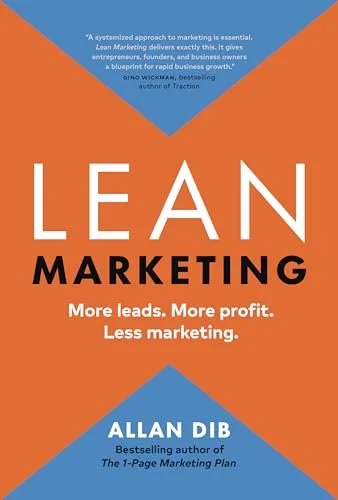
“A systemized approach to marketing is essential. Lean Marketing delivers exactly this. It gives entrepreneurs, founders, and business owners a blueprint for rapid business growth.”
Ditch the Bloat: How to Build a Marketing Machine That Actually Pays for Itself
Have you ever looked at your monthly credit card statement and seen a recurring charge for a "brand awareness" campaign that feels more like a donation than an investment? Many business owners treat marketing like a mysterious black box. They pour money into social media ads, SEO agencies, and flashy creative work, hoping that if they spend enough, growth will eventually happen. But hope is not a strategy. In fact, most businesses are suffering from "Marketing Bloat"—a condition where they do too much of what doesn't work and too little of what actually drives profit.
In his book Lean Marketing, Allan Dib—the mastermind behind the global bestseller The 1-Page Marketing Plan—argues that you don't need a massive budget to dominate your niche. You need a system. Influenced by the "Lean" principles that revolutionized manufacturing, Dib teaches you how to ruthlessly eliminate waste and focus exclusively on the high-leverage activities that generate leads and maximize lifetime value. This isn't about being cheap; it's about being surgical. It's about shifting your mindset from seeing marketing as an expense to seeing it as a profit center.
What You'll Learn
The ROI Mindset: How to stop "spraying and praying" and start treating every marketing dollar like a disciplined employee.
The 80/20 of Impact: Identifying the "Vital Few" marketing channels that produce the majority of your revenue.
The Lean Funnel: A three-phase framework (Before, During, and After) to automate the journey from stranger to raving fan.
Lead Magnet Mastery: How to create offers that your ideal prospects feel "stupid" saying no to.
Speed Over Perfection: Why a "good enough" campaign launched today beats a "perfect" campaign that never goes live.
The Marketing Money Pit: Why More Isn't Always Better
Imagine a small boutique consulting firm that spends $3,000 every month on a social media manager. The manager posts pretty graphics and uses trending hashtags. The "likes" go up, the "reach" looks impressive on a chart, but the phone stays silent. This is the hallmark of "bloated" marketing. The owner is paying for activity, not results.
Allan Dib argues that the primary reason marketing fails is a lack of focus on Direct Response. Most small-to-medium businesses try to emulate the "Brand Marketing" of giants like Nike or Apple. But Nike has billions to spend on "feeling" and "vibe." You likely don't. A lean marketer understands that every single ad must have a measurable call to action. If you can't track it, you shouldn't be doing it.
The lean philosophy is built on the Pareto Principle: 80% of your results come from 20% of your efforts. In a bloated marketing department, the team is busy managing the 80% of tasks that produce almost no revenue. A lean marketer identifies the 20%—the specific headlines, the certain lead sources, the high-converting emails—and doubles down on them while cutting the rest.
Core Lean Concepts at a Glance
Direct Response Marketing: Marketing designed to evoke an immediate response and compel prospects to take a specific action (like downloading a guide or booking a call).
Customer Acquisition Cost (CAC): The total cost (ad spend, labor, tools) required to convince a potential customer to buy a product or service.
Lifetime Value (LTV): The total net profit a business can expect from a single customer account throughout the entire relationship.
The Lean Metric: The goal of achieving an LTV to CAC ratio of at least 3:1. If you spend $1 to get $3 back, your marketing is a machine, not a bill.
The Three Phases of the Lean Journey
Dib breaks the marketing process into a logical, three-stage "operating system." By viewing marketing as a linear journey, you can identify exactly where your "leak" is occurring.
Phase 1: The "Before" (Attraction)
In the Before phase, you are dealing with people who have never heard of you. The goal here is to find your "Target Market," craft a "Compelling Message," and reach them through "Advertising Channels."
A micro-story: A local HVAC company was struggling to get leads. They were running generic ads that said "We fix ACs." It was boring and invisible. Following lean principles, they changed their message to a specific "10-Point Winter Safety Audit" for $49. They stopped targeting "everyone" and started targeting homeowners in 15-year-old neighborhoods. Their lead volume tripled because they moved from a broad, bloated message to a narrow, high-relevance offer.
Phase 2: The "During" (Conversion)
This is where most businesses fail. They get a lead, but then they let it go cold. The "During" phase is about "Lead Capture," "Lead Nurturing," and "Sales Conversion." Dib emphasizes that most people aren't ready to buy the first time they see you. A lean system uses a "Lead Magnet"—a valuable piece of information—to capture an email address so you can build trust over time.
Think of it like dating. Bloated marketing is asking for marriage on the first date (the "Buy Now" button). Lean marketing is asking for a coffee date (the "Download our Free Guide" button) to see if there's a fit.
Phase 3: The "After" (Multiplication)
The most expensive thing you will ever do is acquire a new customer. The most profitable thing you will ever do is sell to an existing one. The "After" phase focuses on "Delivering a World-Class Experience," "Increasing Customer Lifetime Value," and "Orchestrating Referrals."
Dib points out that many businesses ignore their customers once the check clears. A lean marketer knows that a 5% increase in customer retention can increase profits by 25% to 95%. They use automated follow-ups, upsells, and referral programs to turn one sale into a lifetime of revenue.
Speed Over Perfection: The Lean Experimentation Mindset
One of the biggest obstacles to marketing success is the "Launch Mentality"—the idea that you have to spend months preparing a campaign before it hits the market. Dib pushes for the Minimum Viable Campaign.
In the lean world, data is the only truth. Your opinion of an ad doesn't matter; only the market's response does. Instead of spending $10,000 on a massive campaign, spend $500 to test three different headlines on Facebook. See which one gets the clicks. Once you have a winner, then you pour in the budget.
This approach prevents "The Big Flop." It allows you to fail fast and fail small, so you can succeed big. Marketing shouldn't be a gamble; it should be a series of controlled experiments where you are constantly looking for the "winners" to scale.
The Lean Marketer's Toolkit
The 1-Page Marketing Plan: A simplified visual document that maps out your entire strategy on a single sheet.
Lead Magnets: Educational content (PDFs, webinars, quizzes) given in exchange for contact info.
CRM (Customer Relationship Management): The "brain" of your marketing that ensures no lead is forgotten.
A/B Testing: The process of testing two versions of a webpage or ad to see which performs better.
Nurture Sequences: Automated emails that provide value to prospects over weeks or months.
Quick Start Guide: Your 30-Day Lean Sprint
Day 1-7: The Audit. Look at every dollar you spent on marketing in the last 90 days. If you can’t prove a specific lead or sale came from that expense, put it on the "chopping block."
Day 8-14: Define the "Vital Few." Identify the top 20% of your customers. What do they have in common? Use this data to refine your "Target Market" profile.
Day 15-21: Create the Coffee Date. Build a simple Lead Magnet. It could be a "Top 10 Mistakes" checklist or a "Price Guide." Put this on your website in exchange for an email.
Day 22-30: Launch a Lean Experiment. Spend a small amount (e.g., $100-$500) on a direct response ad. Focus on the problem your target market has, not the features of your product. Measure the clicks and leads.
Final Reflections
Lean Marketing is a refreshing, no-nonsense guide for the professional who is tired of the marketing "dog and pony show." Allan Dib strips away the jargon and complex theories to reveal a truth that every business leader needs to hear: marketing is a process, not an event. By focusing on the "Vital Few," embracing the three phases of the customer journey, and prioritizing speed over perfection, you can build a marketing engine that doesn't just spend money, but creates it. The goal isn't to be the loudest in the room; it's to be the most effective. Master these lean principles, and you'll find that you can grow your business faster with much less noise.
Business Floss is reader-supported. When you use our links we may earn an affiliate commission that helps us keep the site running. Thank you for your support!


