
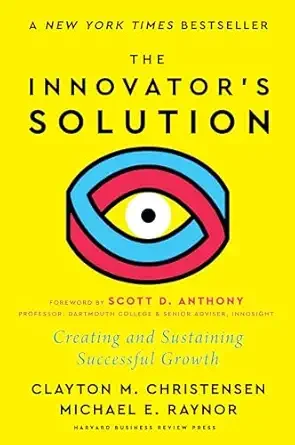
The Innovator’s Solution
Creating and Sustaining Successful Growth
by Clayton M. Christensen & Michael E. Raynor
The 60-Second Take
In The Innovator's Solution, Clayton M. Christensen and Michael E. Raynor move from diagnosing market disruption to actively harnessing it. Building on the theories that toppled established corporate giants, the authors offer a practical playbook for creating sustainable growth. By mastering the "Jobs to Be Done" framework, identifying asymmetric motivation, and knowing whose capital to accept, leaders can predict industry shifts and launch successful new ventures before their core markets evaporate.
The Cure for the Disruption Disease
In 1997, Clayton Christensen published The Innovator's Dilemma, a book that terrified corporate boardrooms around the world. It proved that great companies do not fail because they are lazy or incompetent. They fail precisely because they do everything right. They listen to their best customers, invest heavily in improving their core products, and ruthlessly protect their profit margins. This perfectly rational behavior leaves a gaping blind spot at the bottom of the market, allowing small, seemingly harmless disruptors to enter, improve, and eventually destroy the incumbent.
The first book was a brilliant diagnosis of a fatal corporate disease. But a diagnosis without a prescription is just a death sentence.
The Innovator's Solution, co-authored with Michael E. Raynor, provides the prescription. The authors argue that innovation is not a random, unpredictable gamble dependent on creative geniuses. It is a highly structured process. If you understand the mechanical laws of how markets evolve, you can systematically build businesses that disrupt others rather than waiting to be disrupted yourself.
What You'll Learn
The critical distinction between sustaining, low-end, and new-market innovation
Why categorizing customers by demographics causes products to fail
How the Jobs to Be Done framework reveals your true competition
The trap of asymmetric motivation and why incumbents happily surrender their markets
The difference between "good money" and "bad money" when funding a new venture
Sustaining Versus Disruptive Innovation
To build a growth engine, you first have to understand what kind of innovation you are actually attempting. Christensen and Raynor divide all innovations into two broad categories: sustaining and disruptive.
Sustaining innovations make good products better in the eyes of an incumbent's existing customers. This might be a laptop with a faster processor, a razor with a fifth blade, or a car with better fuel efficiency. The iron law of sustaining innovation is that the incumbent almost always wins. They have more money, better engineers, and established distribution channels. If a startup tries to beat a giant with a sustaining innovation, the giant will simply copy the feature and crush them.
Disruptive innovations, on the other hand, do not attempt to bring better products to established customers. They bring inferior, simpler, or cheaper products to a completely different market. The authors split disruption into two specific strategies:
Low-end disruption: This targets customers who are "overserved" by the current market. These are people who do not need all the fancy features of the flagship product and are thrilled to buy a "good enough" alternative for a fraction of the price. Think of discount airlines entering a market dominated by luxury carriers.
New-market disruption: This targets "non-consumers." These are people who previously lacked the money or the technical skill to buy the product at all. The original personal computers were a new-market disruption. They were practically useless compared to the massive mainframe computers of the era, but they were sold to hobbyists and teenagers who could never afford a mainframe anyway.
If you want to build a massively successful new business, you must choose a disruptive path. You either target the overserved, or you target the non-consumer.
The Jobs to Be Done Framework
Most companies decide what to build by looking at demographic data. They slice the market into segments—"men ages 18 to 35 with a college degree"—and try to design a product for that imaginary average person. The authors argue this is entirely the wrong way to look at the world.
Customers do not buy products based on their demographic profile. They "hire" products to get a specific job done in their lives.
A famous example from Christensen’s research involves a fast-food chain trying to increase milkshake sales. They tried making the shakes thicker, sweeter, and cheaper, but sales remained flat. When researchers finally interviewed the morning customers, they realized the buyers were commuters facing a long, boring drive to work. They needed something that could be consumed with one hand, would last for a twenty-minute drive, and would keep them full until noon. They were not hiring the milkshake because of its flavor profile; they were hiring it to cure the boredom of the commute.
When you define the market by the "Job to Be Done," your competition changes completely. The milkshake was not competing against other milkshakes. It was competing against bagels, bananas, and donuts. Bagels were too messy for the car, and bananas were eaten too quickly to cure the boredom. By understanding the actual job, the chain knew exactly how to improve the product: make it even thicker so it lasts the entire commute.
Asymmetric Motivation: Why the Giants Flee
When a small startup enters the bottom of a market with a cheap, disruptive product, why doesn't the massive incumbent just use their billions of dollars to crush them immediately?
The authors explain this phenomenon through asymmetric motivation. When a startup enters the low end of the market, the profit margins are terrible. The incumbent's executives look at that low-end market and realize it is a distraction from their highly profitable, premium customers. Therefore, the incumbent is highly motivated to abandon the low end of the market and move upmarket where the margins are richer. The startup is highly motivated to capture the low end because, to them, any revenue is good revenue.
This asymmetry acts as a shield for the disruptor. The incumbent willingly cedes the territory. But the startup does not stay at the bottom forever. Once they secure the low end, they slowly improve their product, marching steadily upmarket. By the time their product is good enough to steal the incumbent's best customers, it is too late for the giant to fight back.
Good Money Versus Bad Money
If a large corporation wants to launch its own disruptive startup internally, it usually fails because of how it funds the project. Capital dictates strategy.
The authors draw a sharp distinction between good money and bad money. Bad money is impatient for growth but patient for profit. If a massive corporation gives an internal team ten million dollars and demands that the new product generate fifty million in revenue by year two to "move the needle" for the parent company, the team is forced to target massive, existing markets. They are forced into a sustaining innovation battle, which they will lose.
Good money is the exact opposite. It is patient for growth but fiercely impatient for profit. Disruptive ideas take time to find the right market, so the capital must be patient regarding top-line revenue. However, the capital must demand immediate profitability to prove that the fundamental business model actually works. If you force a disruptive team to become profitable early on a small scale, you validate the model before pouring gasoline on the fire.
The Innovator's Solution at a Glance
Sustaining innovation. Making a product better for existing, high-end customers. Incumbents win these battles.
Low-end disruption. Entering the market with a "good enough," cheap product targeting customers who are overserved and overcharged by the incumbents.
New-market disruption. Creating a simple, affordable product that allows entirely new populations (non-consumers) to solve a problem they previously could not.
Jobs to Be Done. The theory that people do not buy products based on demographics; they hire products to fulfill a specific situational need.
Asymmetric motivation. The natural corporate instinct to abandon low-margin tiers of the market to upstarts, unknowingly clearing the path for their own disruption.
A Quick Start Guide to Disrupting Your Market
Find the non-consumers. Look at your industry and identify the population that lacks the wealth or skill to participate. Build a simple product specifically for them.
Stop relying on demographics. Discard the customer profiles based on age and income. Interview your customers to find out what specific situational "job" they are hiring your product to do.
Target the overserved. Identify the features in your industry that companies are fiercely competing over but that customers no longer actually care about. Strip those features away to dramatically lower the price.
Demand early profit, not early scale. If you are launching a new venture, keep the overhead incredibly low and focus entirely on finding a profitable business model before you try to scale the revenue.
Keep the disruptive team separate. If you are an established company launching a disruptive product, you must physically and financially separate that team from the core business, or the core business's metrics will suffocate the new idea.
Who Should Read The Innovator's Solution (and Who Can Skip It)
Read it if you are a corporate executive or strategist tasked with finding new growth engines inside a mature, slow-moving organization.
Read it if you are a startup founder looking for a wedge into an industry currently dominated by heavily funded, entrenched giants.
Read it if you are a product manager who wants a more accurate, psychological framework (Jobs to Be Done) for conducting user research.
Skip it if your primary focus is running a solo lifestyle business or a local service company where massive market disruption is not the goal.
Skip it if you prefer fast, breezy business parables. This book is exceptionally dense, heavily academic, and requires a commitment to process its frameworks.
Final Reflections
The Innovator's Solution is not a book about brainstorming or creative thinking. It is a rigorous, mechanical textbook on market dynamics. Christensen and Raynor succeed brilliantly in removing the mysticism from innovation. They prove that you do not need to be a visionary genius to change an industry; you just need to understand where the incumbents are structurally incapable of fighting you. While it requires significantly more mental effort to read than the average modern business book, the frameworks it introduces—particularly the Jobs to Be Done theory—have become the undisputed foundation of modern product strategy.
The Bottom Line
Explosive growth does not come from fighting established giants for their best customers; it comes from targeting the overserved or the complete non-consumers and solving the exact job they are desperately trying to get done.
Frequently Asked Questions
What is the difference between The Innovator's Dilemma and The Innovator's Solution?
The Innovator's Dilemma (published first) diagnosed the problem: why great companies fail when confronted with disruptive technology. The Innovator's Solution provides the actionable treatment plan, offering a framework for how companies can intentionally become the disruptor and generate sustainable new growth.
What exactly is a "Job to Be Done"?
It is the fundamental problem a customer needs to resolve in a specific situation. For example, people do not want a quarter-inch drill bit; they want a quarter-inch hole. When you design a product to perfectly execute the "job" rather than just adding random features, customer loyalty skyrockets.
Can a startup use sustaining innovation?
Yes, but the odds of success are incredibly low. If a startup brings a sustaining innovation to market (a slightly better product targeting the same customers), the massive incumbent will typically just acquire the startup or copy the feature, using their superior distribution networks to win the market.
Business Floss is reader-supported. When you use our links we may earn an affiliate commission that helps us keep the site running. Thank you for your support!


