
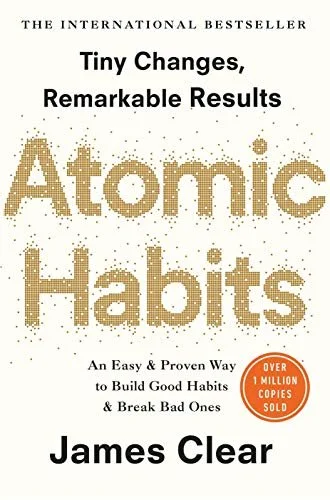
Atomic Habits
An Easy & Proven Way to Build Good Habits & Break Bad Ones
by James Clear
The 60-Second Take
Atomic Habits is James Clear's implementation manual for behavior change. Its two central claims are that small improvements compound in ways people systematically underestimate, and that lasting change works through identity rather than outcomes. Around those sits the Four Laws of Behavior Change — make it obvious, attractive, easy, and satisfying — with each law mapped to a stage of the habit loop and each reversible for breaking bad habits. The book's strength is its density of specific, immediately usable tactics.
Your Systems Are Already Producing Results, Just Not the Ones You Wrote Down
Everyone entering a competition wants to win it. Everyone starting a diet wants it to work. Goals are the thing that successful and unsuccessful people have in common, which makes them a poor explanation for the difference between them.
James Clear's formulation is that you don't rise to the level of your goals, you fall to the level of your systems — the set of behaviors that happen by default, without a decision being made each time.
Atomic Habits, published in 2018 and one of the best-selling books of its decade, is his manual for changing those defaults. It's deliberately practical: the underlying behavioral science is mostly borrowed and well established, and Clear's contribution is turning it into tactics specific enough to act on this afternoon. This summary covers the compounding argument, the identity reframe, and the four laws.
What You'll Learn
Why small improvements compound and why the middle period feels like failure
The three layers of behavior change, and why identity is the durable one
The Four Laws and their inversions for breaking habits
Specific tactics: habit stacking, environment design, the two-minute rule
Why never missing twice matters more than never missing
Compounding and the Valley of Disappointment
Clear's opening argument is arithmetic. A one percent daily improvement, compounded across a year, produces a result many times better than the starting point. A one percent daily decline produces near-total erosion. The specific numbers are a metaphor rather than a measurement, and the underlying point holds: habits are compound interest applied to behavior.
The corollary matters more than the maths. Because results lag effort, there's an extended period during which you're doing the work and seeing nothing — Clear calls it the valley of disappointment, and it's where most attempts are abandoned. His image is an ice cube in a room warming one degree at a time: nothing happens through twenty-five, twenty-six, twenty-seven degrees, and then it melts. The earlier degrees weren't wasted; they were the condition for the last one.
That framing does genuine work for anyone in the unrewarding middle of something.
Identity, Not Outcomes
The reframe most readers find valuable comes from three layers of behavior change.
Outcomes are what you get: the weight lost, the book written, the revenue achieved. Processes are what you do: the routines and systems. Identity is what you believe about yourself.
Most people work from the outside in, starting with an outcome and reverse-engineering behavior. Clear argues the durable direction is the reverse: decide who you want to be, and let each action serve as evidence.
The practical difference shows up under pressure. Someone pursuing the goal of quitting smoking, offered a cigarette, says "no thanks, I'm trying to quit" — which identifies them as a smoker exercising restraint, and restraint runs out. Someone operating from identity says "no thanks, I'm not a smoker."
Clear's mechanism is that every action is a vote for a type of person. You don't need unanimity; you need the majority of votes. This also explains why small consistent actions matter beyond their direct effect: two minutes of writing produces almost nothing on the page and provides real evidence that you're someone who writes.
The Four Laws
The operational core maps to the habit loop of cue, craving, response, and reward.
1. Make it obvious (cue). Habits require a trigger, and most people's are invisible to them. The tactics: an implementation intention, which specifies when and where — "I will meditate for one minute at 7am in the kitchen" — since a vague intention has no cue at all. Habit stacking, which uses an existing habit as the trigger: "After I pour my coffee, I will..." And environment design, which Clear rates above motivation entirely. The book on the pillow, the guitar on its stand, the fruit on the counter. Cues you can see win.
2. Make it attractive (craving). Temptation bundling pairs something you should do with something you want to do, so the podcast is only available at the gym. Clear also emphasizes the effect of the people around you: we adopt the habits of the group we belong to, so joining a culture where the behavior is already normal does more than any amount of individual resolve.
3. Make it easy (response). Drawing on the law of least effort — given similar rewards, we take the path requiring less work — the goal is reducing friction for good habits and adding it for bad ones. The signature tactic is the two-minute rule: scale a new habit down until it takes less than two minutes to start. Read one page. Put on running shoes. The point isn't the two minutes; it's that starting is the hard part, and a habit you can't start can't compound.
4. Make it satisfying (reward). Behavior that's immediately rewarded gets repeated, and most worthwhile habits have delayed payoffs. So attach something immediate: a tracked mark on a calendar, which is satisfying in itself and creates a streak worth not breaking.
Each law inverts for breaking a habit: make it invisible, unattractive, difficult, and unsatisfying. Delete the app, unsubscribe, add friction, make the cost visible.
Staying With It
Two later ideas address the harder problem of persistence.
Never miss twice. Missing once is an accident; missing twice is the start of a new pattern. Clear's point is that perfectionism ends more habits than laziness does, since the belief that a broken streak means failure makes the second miss feel inevitable.
The Goldilocks rule. Motivation is highest when working at the edge of current ability — hard enough to be interesting, achievable enough to succeed. Habits that stay easy become boring, which is a more common cause of abandonment than difficulty.
Clear also names the downside of habits, which is unusual for the genre. Automaticity means you stop paying attention, and stopping paying attention means errors get baked in. His answer is periodic deliberate review — checking whether the habit is still serving its purpose and whether the execution has drifted.
Atomic Habits at a Glance
Systems over goals. Goals are shared by everyone competing; systems are what differ.
Identity-based change. Deciding who you're becoming, with each action as a vote for that identity.
The valley of disappointment. The period where effort has accumulated and results haven't yet appeared.
The Four Laws. Make it obvious, attractive, easy, and satisfying, with inversions for breaking habits.
Habit stacking. Anchoring a new habit to an existing one: after X, I will Y.
The two-minute rule. Scaling a habit down so starting takes under two minutes.
Never miss twice. Treating a single lapse as an accident rather than the end of the streak.
A Quick Start Guide to Building a Habit
Write the identity, not the outcome. State who you're becoming rather than what you want to achieve.
Stack it onto something existing. Use the formula: after [current habit], I will [new habit].
Cut it to two minutes. Reduce the habit until starting is trivial, and let the size come later.
Change one thing in your environment. Make the cue visible, or remove the cue for something you want to stop.
Track it and never miss twice. Mark the calendar, and treat the day after a miss as the only one that matters.
Who Should Read Atomic Habits (and Who Can Skip It)
Read it if you know what you should be doing and can't get it to stick, which is the exact gap the book targets.
Read it if you want tactics rather than explanation. It's the most implementable book in its category by a distance.
Read it if you've tried habit change through willpower and discipline, since the environment and friction arguments explain why that keeps failing.
Skip it if you want the underlying science. Clear synthesizes existing behavioral research rather than contributing to it, and the primary sources go deeper.
Skip it if you've absorbed the four laws from the enormous secondary coverage. The framework is short and the book's value is in the density of examples around it.
Skip it if your obstacle is direction rather than execution. This tells you how to build a habit, not which one is worth building.
Final Reflections
The identity argument is the most valuable thing here, and it's the part most easily lost among the tactics. Reframing habit change from "what do I want to achieve" to "who am I becoming" changes what a bad day means: under a goal, missing a session is falling behind, while under an identity, it's one vote among many. That's a meaningful difference in whether people continue.
The four laws are a genuinely good organizing structure, largely because they're mapped to the stages of the habit loop rather than being an arbitrary list, and because each inverts cleanly for breaking a habit. Combined with the specificity of the tactics — stacking, the two-minute rule, environment design — the book delivers on being usable, which is not common in this category.
Its honest limitation is that it's a synthesis. The behavioral science is largely established work by others, some of the timelines and mechanisms are presented more cleanly than the research supports, and readers wanting nuance about how habits actually form will need to go elsewhere. What Clear has done is packaging, and packaging is genuinely valuable when the underlying knowledge has been sitting unused in journals. Take the tactics, and don't mistake the tidiness for settled science.
The Bottom Line
You fall to the level of your systems, not your goals. Decide who you're becoming, make the behavior obvious and easy enough that starting is trivial, and treat a single missed day as an accident rather than a verdict.
Frequently Asked Questions
What are the Four Laws of Behavior Change?
Make it obvious, make it attractive, make it easy, and make it satisfying — corresponding to the cue, craving, response, and reward stages of the habit loop. To break a habit, invert each: make it invisible, unattractive, difficult, and unsatisfying.
What are identity-based habits?
Building habits from a decision about who you want to be rather than what you want to achieve. Clear argues each action is a vote for that identity, which makes the change self-reinforcing and less dependent on sustained willpower toward a distant outcome.
How is this different from The Power of Habit?
Duhigg's book explains the mechanism of habits and extends it to organizations and society, working largely through narrative. Clear's is an implementation manual: less explanation, far more specific tactics. Read Duhigg to understand habits, Clear to build one.
Business Floss is reader-supported. When you use our links we may earn an affiliate commission that helps us keep the site running. Thank you for your support!


