
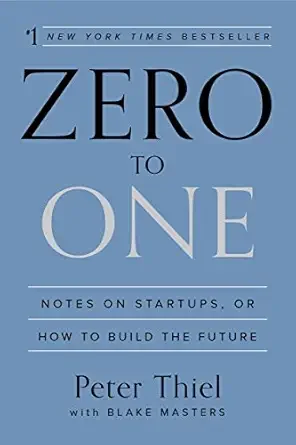
Zero To One
Notes on Startups, or How to Build the Future
by Peter Thiel
The 60-Second Take
In Zero to One, PayPal co-founder and venture capitalist Peter Thiel challenges almost every accepted dogma of the Silicon Valley startup ecosystem. Blending philosophy with ruthless business strategy, he argues that the greatest companies do not copy existing models; they create entirely new markets. By pursuing secrets, rejecting the cult of extreme iteration, and deliberately building creative monopolies, founders can escape the margin-destroying trap of competition and invent the future.
Competition Is for Losers
If you open a standard economics textbook, you will find a glowing endorsement of perfect competition. The theory states that when multiple companies fight for the same customers, prices drop, efficiency rises, and society wins. While that might be true for the consumer buying a cup of coffee, Peter Thiel argues that it is an absolute nightmare for the business owner selling it.
Zero to One, co-authored with Blake Masters and based on a class Thiel taught at Stanford, is a fiercely contrarian manifesto on how to build a valuable company. Thiel, a billionaire investor and the co-founder of PayPal and Palantir, points out a glaring hypocrisy in the business world: the companies that praise competition the loudest are usually the ones that have successfully eliminated it. Google does not have to worry about a price war in the search engine market. US airlines, however, are trapped in brutal, margin-crushing competition every single day.
Thiel proposes that if you want to build a truly great enterprise, you should not aim for a slight edge over your rivals. You should aim for a monopoly. You achieve this not by engaging in illegal, rent-seeking behavior, but by creating something so completely new and fundamentally superior that no other firm can even attempt to copy you.
What You'll Learn
The critical difference between horizontal (1 to n) and vertical (0 to 1) progress
Why "creative monopolies" drive innovation while perfect competition destroys profit
The four mandatory characteristics of a highly defensible, monopolistic business
How to dominate a tiny, highly specific niche before attempting to scale
Why the modern obsession with being a "lean startup" is an excuse for not having a vision
The Two Types of Progress
The title of the book refers to the two distinct ways the human race makes progress.
The first is horizontal, or extensive progress. This means copying things that already work. If you take one typewriter and build one hundred identical typewriters, you have made horizontal progress. You have gone from 1 to n. This kind of progress is highly predictable, and at a macroeconomic level, it is the definition of globalization. You are simply taking a model that works in one place and expanding it everywhere else.
The second is vertical, or intensive progress. This means doing something nobody has ever done before. If you have a typewriter and you invent the first digital word processor, you have made vertical progress. You have gone from 0 to 1. This is the realm of technology.
Thiel argues that you cannot build a massive, paradigm-shifting business by going from 1 to n. Opening the thousandth coffee shop in a city is a horizontal move. You will face immediate, crushing competition, and your profits will trend toward zero. To build a uniquely valuable company, you must go from 0 to 1. You must invent a miracle.
The Monopoly Mandate
The most provocative argument in the book is the defense of monopolies. Thiel is not defending the corrupt, government-protected monopolies of the Gilded Age. He is defending "creative monopolies." These are companies that introduce a product so radically superior to the status quo that they effectively own their entire market.
In the real world, businesses exist on a spectrum between perfect competition and pure monopoly. In perfect competition, no one makes any real money because someone will always undercut your price. Your focus is entirely on daily survival. A creative monopoly, on the other hand, generates massive profit margins. Because they are not fighting a daily war for survival, they can actually afford to care about their employees, invest heavily in long-term research, and plan for a future decades away.
Google is a creative monopoly. They essentially own the search market. Because of that monopoly cash flow, they can afford to fund experimental projects like self-driving cars and life-extension research. Competition, Thiel insists, is an ideology that blinds us to opportunity. We get so obsessed with beating the rival next to us that we lose sight of what actually matters. If you want to create lasting value, you must escape competition entirely.
The Architecture of a Monopoly
You do not build a monopoly by accident. You must engineer it. Thiel outlines four specific characteristics that a company must possess to capture and hold a market.
First, you need proprietary technology. Your solution must be an order of magnitude better than the closest substitute. Thiel uses the rule of 10x. If your product is only twenty percent better than the incumbent, users will not endure the friction of switching to it. PayPal was at least ten times faster and easier for eBay sellers to use than mailing physical checks, which guaranteed their initial dominance.
Second, you need network effects. A product becomes more useful as more people use it. Facebook is the classic example; it is useless if you are the only person on it, but indispensable when all your friends are there.
Third, you need economies of scale. A good startup should have the potential for massive scale built into its initial design. Software companies are beautiful because the marginal cost of producing another copy of the software is practically zero. Service businesses, like yoga studios, struggle with scale because adding more customers requires adding more expensive instructors and real estate.
Fourth, you need branding. Creating a strong brand is a powerful way to claim a monopoly, but Thiel warns against relying on brand alone without the underlying proprietary technology. Apple has a massive brand, but that brand is built on a foundation of complex, tightly integrated hardware and software ecosystems.
Start Small and Find a Secret
One of the most common mistakes ambitious founders make is trying to capture a massive market on day one. Thiel advises the exact opposite. Every great monopoly starts by dominating a ridiculously small market.
Amazon did not start by trying to sell everything to everyone. Jeff Bezos started by selling only books, a market he could systematically conquer. Once he monopolized books, he expanded to CDs, and then slowly out from there. PayPal started by targeting a few thousand "PowerSellers" on eBay. If you can dominate a small, highly concentrated group of users who desperately need your solution, scaling becomes a matter of adjacent expansion. If you launch broadly to the entire world, you will bleed cash and fail to gain traction anywhere.
To find this initial wedge, you have to look for secrets. Thiel famously asks a contrarian interview question: What important truth do very few people agree with you on? If you just follow the accepted wisdom of the crowd, you will end up building what everyone else is building, leading straight back to competition. You have to believe that there are still hard, unsolved problems in the world—secrets that nature or society has hidden. Airbnb found a secret: people were willing to sleep in the spare bedrooms of complete strangers. Uber found a secret: everyone carried a supercomputer in their pocket that could instantly dispatch a private driver. Great companies are built on truths that the rest of the world has not yet noticed.
The Fallacy of the Lean Startup
Thiel reserves significant criticism for the "Lean Startup" methodology, which dominates modern tech culture. The lean approach tells founders to make no grand plans, build a minimum viable product, throw it into the market, and pivot constantly based on customer feedback.
Thiel calls this "indefinite optimism." It is the belief that the future will be better, but you have absolutely no idea how it will happen, so you just iterate and hope for the best. He advocates for "definite optimism." You must have a bold, concrete vision of what the future should look like, and you must build a rigid plan to force that future into existence.
You cannot iterate your way from zero to one. Small, data-driven tweaks to a mediocre product will never result in a paradigm shift. Steve Jobs did not hold focus groups to incrementally improve the physical keyboard on the Blackberry; he had a definite, uncompromising vision for a touchscreen device, and he executed it. A bad plan is better than no plan, and iterating blindly is simply a refusal to take a stand.
Zero to One at a Glance
Zero to One vs. One to N. Vertical progress is inventing something new; horizontal progress is copying what already works.
Competition is for losers. Perfect competition destroys margins. Your goal is to build a creative monopoly that dominates its niche.
The 10x Rule. Proprietary technology must be at least ten times better than the closest substitute to overcome the friction of user adoption.
Start small to monopolize. Target a tiny, specific market of users who desperately need your product before attempting to scale globally.
Definite Optimism. Do not rely on constant, lean pivoting. You must have a strong, uncompromising vision for the future and a rigid plan to build it.
Sales matter. Engineers notoriously underestimate distribution. If you do not have a strong plan to sell the product, the product will fail regardless of how brilliant it is.
A Quick Start Guide to Building a Defensible Business
Answer the contrarian question. Write down your answer to: "What important truth do very few people agree with me on?" Build your business model around that secret.
Shrink your initial target market. Stop trying to sell to a demographic as broad as "millennials." Identify a hyperspecific group of a few thousand people and focus entirely on monopolizing them.
Audit your 10x advantage. Look at your product objectively. If it is only slightly faster or cheaper than the incumbent, you are in a pricing war. Figure out how to make it ten times better.
Draft a definite plan. Stop relying entirely on customer feedback to dictate your roadmap. Write down your ultimate, uncompromising vision for the product and the specific steps to get there.
Prioritize distribution. Do not assume a great product will sell itself. Dedicate just as much architectural thinking to your sales and marketing channels as you do to your engineering.
Who Should Read Zero to One (and Who Can Skip It)
Read it if you are a tech founder or investor trying to figure out how to build a company that creates massive, generational wealth rather than a quick flip.
Read it if you are exhausted by the traditional business school advice that demands you constantly benchmark yourself against your competitors.
Read it if you want a high-level, philosophical approach to economics and innovation written with zero corporate jargon.
Skip it if you are looking for a tactical manual on how to open a traditional, local business like a dry cleaner or a restaurant. This is explicitly a book about scalable technology.
Skip it if you want a cheerful, collaborative approach to management. Thiel’s writing is exceptionally blunt, unapologetically capitalistic, and heavily biased toward engineering dominance.
Final Reflections
Zero to One is a short book, but it punches significantly above its weight class because it refuses to be polite. Peter Thiel’s willingness to attack the sacred cows of Silicon Valley—particularly the Lean Startup methodology and the blind worship of competition—makes this an incredibly refreshing read. It forces founders to ask themselves if they are actually building something valuable, or if they are just playing a status game against their rivals. While some of his sweeping generalizations about history and philosophy can feel a bit reductive, his core business logic is sharp and undeniable. It is a mandatory, sobering reminder that you cannot change the world by building a slightly better version of something that already exists.
The Bottom Line
Stop fighting an exhausting, margin-crushing war against competitors in crowded markets; true massive value is created only when you find a secret, build a radically superior product, and establish a creative monopoly in an entirely new space.
Frequently Asked Questions
What exactly does "Zero to One" mean?
It refers to the act of creating something entirely new. Going from 1 to n means copying an existing model and scaling it. Going from 0 to 1 means inventing a paradigm-shifting technology that did not previously exist.
Does Peter Thiel actually believe monopolies are good?
Yes, but with a specific definition. He is strictly against illegal monopolies or companies that maintain dominance through government lobbying and regulation. He defends "creative monopolies"—companies that earn their dominance purely because their product is so radically superior to anything else on the market that consumers naturally flock to it.
Why does he criticize the Lean Startup model?
Thiel believes that the Lean Startup approach, which relies on building a Minimum Viable Product (MVP) and constantly pivoting based on user feedback, is a symptom of "indefinite optimism." He argues it allows founders to escape the hard work of creating a grand, concrete vision for the future. You cannot test your way into a revolutionary breakthrough; you have to plan it.
Business Floss is reader-supported. When you use our links we may earn an affiliate commission that helps us keep the site running. Thank you for your support!


