
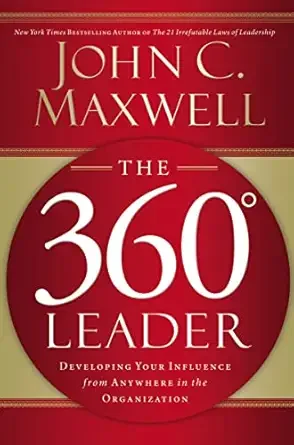
The 360 Degree Leader
Developing Your Influence from Anywhere in the Organization
by John C. Maxwell
The 60-Second Take
In The 360 Degree Leader, leadership expert John C. Maxwell dismantles the illusion that influence requires a corner office. He argues that the vast majority of leadership happens in the messy middle of an organization. By mastering the distinct skills of leading up to your boss, leading across to your peers, and leading down to your team, you can multiply your impact regardless of your current job title.
Leadership Is a Choice, Not a Position
We are conditioned to treat leadership as a destination. You do the grunt work, you climb the corporate ladder, and eventually, somebody hands you a title. At that exact moment, the rules change and you are finally allowed to lead.
John C. Maxwell spent decades observing corporate structures and realized this assumption is destroying careers. If you wait until you are at the top to lead, you will never actually get there. The people who reach the top are the ones who figured out how to lead from the middle.
In The 360 Degree Leader, Maxwell exposes the reality of corporate influence: 99 percent of all leadership occurs not at the peak of the pyramid, but in the complicated, frustrating middle. Being in the middle means you have a boss demanding results from you, peers competing for resources with you, and a team relying on you for direction. You are caught in a perpetual squeeze. This book is a tactical manual for escaping that squeeze. It provides a blueprint for expanding your influence in every possible direction—upward to your superiors, laterally to your colleagues, and downward to your subordinates.
What You'll Learn
Why waiting for a formal title is the fastest way to kill your career momentum
The seven myths that trap people in the middle of the pack
The tension and frustration challenges unique to middle management
How to effectively "lead up" by lightening your boss's load
The art of "leading across" by avoiding turf wars and championing the best ideas
How to "lead down" by treating your team as individuals rather than assets
Shattering the Myths of the Middle
Before you can expand your influence, you have to fix your mindset. Maxwell notes that most middle managers are paralyzed by a specific set of excuses. He categorizes these as the myths of leading from the middle, and the most dangerous one is the Position Myth.
The Position Myth is the belief that you cannot lead if you are not at the top. It equates leadership entirely with authority. If you believe this, your daily behavior becomes passive. You sit quietly in meetings, biting your tongue when you spot a problem, because it is "not your place" to fix it. You wait for instructions.
Closely related is the Destination Myth: the idea that when you finally arrive at the top, you will magically learn how to lead. The reality is that a promotion only changes your title. It does not change your character, your communication skills, or your emotional intelligence. If you are a disorganized, defensive employee, you will simply become a disorganized, defensive executive.
Maxwell insists that leadership is action, not position. It is the ability to positively influence the people around you to achieve a common goal. You can do that from the mailroom or the boardroom. Once you accept that your current position is not a constraint, you can begin the actual work of 360-degree leadership.
Leading Up: The Hardest Direction
The most counterintuitive concept in the book is the idea of leading up. How do you lead the person who signs your paycheck, controls your schedule, and holds the power to fire you?
You do it by adding extraordinary value. Most employees act as a drain on their boss. They walk into the office with a list of complaints, a pile of unresolved problems, and an expectation that the leader will fix everything. A 360-degree leader does the exact opposite. They lighten the leader's load.
When you go to your boss, you should rarely bring a problem without also bringing a well-thought-out proposed solution. Your job is to anticipate the obstacles your boss is about to face and quietly clear them out of the way. If your boss is terrible at managing details but great at casting vision, you do not complain about their lack of organization. You step in and manage the details for them. You complement their weaknesses rather than exposing them.
Leading up also requires an understanding of the Tension Challenge. Middle managers are constantly caught between the demands of upper management and the realities of the frontline workers. When upper management hands down an unpopular policy, the weak manager complains to their team, saying, "I know this is stupid, but the boss is making us do it." This destroys trust in both directions. The 360-degree leader champions the leader's vision. You take the policy, find the strategic value in it, and translate it to your team in a way that builds alignment rather than resentment. You push back in private, but you support in public.
Leading Across: The Peer-to-Peer Battle
Leading your peers is arguably the trickiest dynamic to navigate. You have absolutely no formal authority over them, and in many cases, you are quietly competing with them for the same promotions and budget allocations. If you try to assert dominance over a peer, they will immediately rebel.
To lead across, you have to abandon the idea of competition and focus entirely on collaboration. Maxwell advises leaders to avoid office politics and turf wars at all costs. When you are in a meeting with your peers, your goal should not be to prove that your department is the smartest. Your goal is to let the best idea win, even if that idea belongs to your biggest rival. When you publicly support a peer’s brilliant idea, you instantly gain their respect.
You also have to break out of your silo. In most companies, the marketing team only talks to marketing, and the engineering team only talks to engineering. A 360-degree leader expands their circle of acquaintances. You go out of your way to eat lunch with people in different departments. You learn how their processes work and ask how your team can make their lives easier. By building a massive network of lateral relationships, you become the glue that holds the middle of the organization together. When a cross-departmental crisis inevitably hits, people will turn to you for direction because you already built the relational bridges.
Leading Down: Developing Your People
The most traditional form of leadership is leading down to the people who report directly to you. However, Maxwell argues that most middle managers do this poorly because they view their team strictly as a mechanism for getting their own work done. They assign tasks, check boxes, and move on.
True 360-degree leaders do not just manage assets; they develop people. To do this, you have to leave your office. Maxwell uses a memorable phrase here: "Walk slowly through the halls." If you are always sprinting from meeting to meeting, your team will never interrupt you with their concerns or ideas. You have to intentionally slow down. Stop by their desks. Ask about their weekend. Ask what obstacles are preventing them from doing their best work. You have to be visible and accessible.
When you interact with your team, you must place people in their strength zones. A terrible manager tries to fix everyone's weaknesses, resulting in a team of mediocre generalists. A great manager identifies what each person does brilliantly and shifts their responsibilities so they spend 80 percent of their day doing exactly that.
Finally, Maxwell urges leaders to see everyone as a "10." Human beings possess an incredible tendency to rise or fall to the level of expectations placed upon them. If you treat an employee like a low-performing nuisance, they will deliver low-performing work. If you actively look for their potential and treat them as if they are already a highly capable expert, they will stretch themselves to meet your belief in them.
The 360 Degree Leader at a Glance
The Position Myth. The false belief that you cannot lead without a title. Leadership is influence, which can be exercised from anywhere.
The Tension Challenge. The inherent stress of sitting in the middle, caught between the demands of executives and the needs of frontline workers.
Leading Up. Anticipating your boss's needs, complementing their weaknesses, and bringing solutions instead of just highlighting problems.
Leading Across. Earning the respect of your peers by abandoning turf wars, collaborating across departments, and letting the best idea win.
Leading Down. Developing your direct reports by walking slowly through the halls, maximizing their strengths, and expecting the best from them.
A Quick Start Guide to Leading from the Middle
Bring a solution. The next time you have to report a problem to your boss, refuse to walk into their office until you have drafted at least one viable way to fix it.
Walk slowly through the halls. Block out fifteen minutes on your calendar tomorrow purely to wander your department and have informal, unhurried conversations with your team.
Expand your circle. Identify one peer in a completely different department whose work affects yours. Invite them to coffee to learn about their daily challenges.
Champion the best idea. In your next team meeting, intentionally and publicly praise a good idea presented by a peer you normally compete with.
Find the strength zones. Look at the tasks assigned to your direct reports. Ask yourself if they are spending the majority of their day doing what they are naturally best at.
Who Should Read The 360 Degree Leader (and Who Can Skip It)
Read it if you are a middle manager feeling crushed between the unrealistic demands of your executives and the daily complaints of your team.
Read it if you are an individual contributor who feels completely ignored and wants a tactical plan for getting your boss to listen to your ideas.
Read it if you are preparing for your first management role and want to build the relational habits required to actually succeed in it.
Skip it if you are looking for highly analytical, data-driven frameworks for enterprise-level corporate strategy.
Skip it if you dislike folksy, maxim-heavy writing. Maxwell relies heavily on memorable acronyms, numbered lists, and motivational anecdotes rather than clinical research.
Final Reflections
The 360 Degree Leader succeeds because it addresses the exact demographic that most business books ignore. The market is flooded with advice for CEOs and entry-level hustlers, but the reality is that the vast majority of the workforce lives in the middle. Maxwell's tone is accessible, encouraging, and relentless in demanding personal accountability. He systematically strips away the excuse of "my boss won't let me do this." While the sheer volume of his numbered lists can occasionally blur together, the core philosophy is ironclad. It forces the reader to shift their paradigm from victimhood to extreme ownership, proving that waiting for permission is a choice, not a requirement.
The Bottom Line
Influence is not handed down along with a promotion; it is earned actively by adding value to your boss, collaborating with your peers, and developing your team from exactly where you are right now.
Frequently Asked Questions
What does 360-degree leadership actually mean? It is the ability to exert positive influence in all directions within an organization: upward to the people above you, across to the peers beside you, and downward to the people who report to you.
Can you really lead up to a terrible boss? Yes, though it is incredibly difficult. Maxwell suggests that you lead up to a bad boss by figuring out exactly what their weaknesses are and quietly filling those gaps yourself. You add so much value that you become indispensable, allowing you to gradually influence their decisions. However, if the boss is abusive or deeply unethical, the best leadership decision is often to leave.
Does leading across mean I have to be friends with everyone? No. You do not have to be best friends with your peers, but you do have to be a reliable colleague. Leading across is about mutual respect, dropping your ego, and prioritizing the overall health of the company over the success of your specific department.
Business Floss is reader-supported. When you use our links we may earn an affiliate commission that helps us keep the site running. Thank you for your support!


