
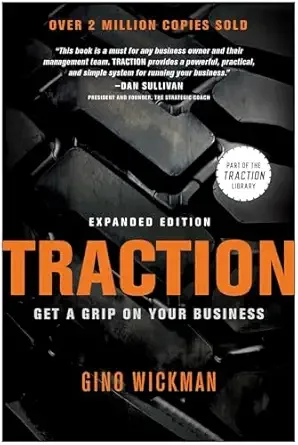
Traction
Get a Grip on Your Business
by Gino Wickman
The 60-Second Take
In Traction, Gino Wickman introduces the Entrepreneurial Operating System (EOS), a highly practical method for overcoming the chaos that plagues growing companies. By mastering six key components—Vision, People, Data, Issues, Process, and Traction—leadership teams can align their goals, solve recurring problems, and build exceptionally healthy cultures. It is an instruction manual for founders who want to stop putting out fires and finally take control of their business.
You Cannot Scale a Business on Founder Hustle Alone
Most entrepreneurs start a company because they want freedom and control. Fast forward five years, and the reality is often the exact opposite. The founder is exhausted, the team is fractured, profits have plateaued, and every day is a chaotic sprint to manage crises. They have hit a growth ceiling. In Traction, Gino Wickman explains that hitting this ceiling is a guaranteed phase of business evolution. The sheer force of will that gets a company to its first million in revenue will absolutely not get it to ten million. To break through, you have to transition from running on adrenaline to running on a system.
Wickman calls his framework the Entrepreneurial Operating System (EOS). It strips away dense corporate jargon and replaces it with a set of blunt, highly effective tools designed to bring focus, accountability, and sanity back to the leadership team. Since its publication, the book has spawned an entire industry of EOS implementers, becoming the default management playbook for mid-market businesses. This summary breaks down the core mechanics of the system and how to implement it.
What You'll Learn
The six components of the Entrepreneurial Operating System
How to replace fifty-page business plans with the two-page Vision/Traction Organizer
The critical difference between a Visionary and an Integrator
How to evaluate your team using the GWC framework
Why you need a weekly Scorecard to manage by objective numbers rather than emotion
The strict mechanics of the Level 10 Meeting to solve problems permanently
The Six Key Components of EOS
The central philosophy of EOS is that a business is composed of six interlinking parts. When companies struggle, the leadership team usually wastes time treating a hundred different symptoms. Wickman argues that if you strengthen these six root components, the symptoms will naturally disappear.
The first component is Vision, which means getting everyone in the organization 100 percent aligned on where you are going and how you plan to get there. The second is People, because you cannot achieve a great vision without surrounding yourself with individuals who share your core values. The third is Data, which forces the company to run on objective metrics rather than egos and assumptions. The fourth is Issues, creating a culture that drags problems out into the light and solves them forever. The fifth is Process, systematizing the core functions of the business so they are executed consistently. The final component is Traction, the discipline and accountability required to actually execute the vision.
Wickman is adamant that you cannot implement EOS halfway. Having a great vision means nothing if you lack the traction to execute it, and having great people means nothing if your processes are a chaotic mess. It is an interlocking system.
The Vision/Traction Organizer (V/TO)
Most companies have a vision statement. It is usually a confusing, paragraphs-long corporate platitude sitting in a drawer that no employee can recite. EOS replaces this with the Vision/Traction Organizer (V/TO). It is a highly constrained, two-page document that forces the leadership team to answer eight specific questions.
You must define your core values, your core focus (what you actually do best), your ten-year target, your marketing strategy, and your three-year picture. From there, you distill the timeline down to a one-year plan. Then, you break that single year into 90-day "Rocks."
A Rock is one of the three to seven most important priorities the company must accomplish this quarter. The term comes from the analogy of filling a glass jar: if you put the sand and water (the daily emails and minor tasks) in first, the big rocks will not fit. If you put the big rocks in first, the sand easily fills the spaces around them. By establishing 90-day Rocks, the entire organization knows exactly what to prioritize, completely eliminating the distraction of shiny new ideas. If a new initiative is not one of the quarter's Rocks, it gets ignored.
Right People, Right Seats
Jim Collins famously said you need to get the right people on the bus. Wickman expands this requirement: you need the right people, and they must be sitting in the exact right seats.
"Right people" means they match your core values perfectly. "Right seats" means they are operating in a role where their unique talents shine. To evaluate this, Wickman uses the GWC tool: Get it, Want it, and Capacity to do it. Does the person truly understand the nature of the role? Do they genuinely want the job, or are they just taking it for the salary? Do they have the mental, physical, and emotional capacity to execute it well? If the answer to any of those three questions is no, they are in the wrong seat and will eventually fail.
This section also introduces the crucial dynamic between the Visionary and the Integrator. Visionaries are typically the founders: creative, big-picture thinkers who generate ten ideas a day, most of which are impractical. Integrators are the operators: the grounded leaders who execute the vision, manage the details, and act as the glue for the team. A Visionary without an Integrator creates absolute chaos; an Integrator without a Visionary creates stagnation. You must have both, and they must respect each other's distinct lanes.
Data, Issues, and the Level 10 Meeting
Entrepreneurs love to run on gut feelings. EOS forces them to run on Data. You must develop a weekly Scorecard containing a handful of leading indicators—metrics that predict future performance, like sales calls made, cash flow, or customer complaints received. If you are stranded on a desert island, this single piece of paper should tell you exactly how healthy your business is at a glance.
When the Scorecard shows a number is off-track, it is moved to the Issues list. Instead of discussing a problem for an hour and moving on without a resolution, EOS teams use the IDS framework: Identify, Discuss, and Solve. You identify the actual root cause (not the symptom), you discuss it without politics or ego, and you make a hard decision to solve it permanently, assigning a specific action item to one person.
The forum for this problem-solving is the Level 10 Meeting. This is a strict, 90-minute weekly meeting for the leadership team. It starts on time, ends on time, and follows the exact same agenda every single week. The vast majority of those 90 minutes are dedicated exclusively to IDS-ing the biggest issues facing the company. At the end of the meeting, attendees rate it from one to ten. If it is not a ten, they determine how to make it better next week.
Traction at a Glance
EOS. The Entrepreneurial Operating System, a holistic framework for managing and scaling a mid-sized business.
The V/TO. A concise, two-page document that clarifies the company's long-term vision and exact short-term goals.
Rocks. The 3 to 7 most critical priorities for the company or an individual over a 90-day period.
GWC. The ultimate test for the right seat: does the employee Get it, Want it, and have the Capacity to do it?
Visionary vs. Integrator. The necessary tension between the big-picture founder and the detail-oriented, operational executor.
Level 10 Meeting. A highly structured, 90-minute weekly leadership meeting focused primarily on solving root issues.
A Quick Start Guide to Gaining Traction
Determine your core values. Write down the three to five fundamental values that define your company culture, and use them to hire, fire, and reward people.
Set your 90-day Rocks. Look at your one-year goal and choose the three most important things the company must achieve in the next 90 days to stay on track.
Build your weekly Scorecard. Identify the 5 to 15 leading indicators that give you a pulse on the business, and review them every single week.
Run a Level 10 Meeting. Implement a strict weekly leadership meeting. Dedicate 60 minutes of it entirely to identifying, discussing, and solving issues.
Evaluate your seats. Run your key employees through the GWC test. If they do not Get it, Want it, and have the Capacity to do it, move them to a new role or let them go.
Who Should Read Traction (and Who Can Skip It)
Read it if you are a founder or owner of a business with 10 to 250 employees and feel entirely trapped by your company's operational chaos.
Read it if your leadership team spends more time arguing in circles about strategy than executing actual decisions.
Read it if you want a highly prescriptive, no-nonsense manual for corporate plumbing rather than high-level philosophical musings on leadership.
Skip it if you are a solopreneur or freelancer; this system is explicitly designed for organizations with a multi-person leadership team.
Skip it if you are an executive in a massive Fortune 500 company. EOS is tailored for mid-sized entrepreneurial ventures, and massive corporate bureaucracies are generally too entrenched to adopt it wholesale.
Final Reflections
Traction is not a book about disruptive innovation or finding your deeper purpose. It is a book about the mechanics of execution. Gino Wickman’s genius is not in inventing entirely new business concepts out of thin air, but in packaging proven management principles into an interlocking, idiot-proof system. The book can occasionally feel dry, and the insistence on using highly specific trademarked terminology can feel a bit cult-like to outsiders. However, that rigidity is exactly why the system works. It forces chaotic, visionary founders to submit to structure. For businesses trapped in the frustrating cycle of rapid growth and operational breakdown, this book is arguably the most valuable manual on the market.
The Bottom Line
Vision without execution is just hallucination, and the Entrepreneurial Operating System bridges that gap by forcing leadership teams to align their goals, track objective data, and systematically solve problems every single week.
Frequently Asked Questions
What does EOS stand for?
It stands for the Entrepreneurial Operating System. It is the comprehensive set of concepts and tools Wickman designed to help leadership teams clarify, simplify, and achieve their vision.
Is EOS only for tech startups?
No. It is entirely industry-agnostic. The system is successfully used by plumbing companies, marketing agencies, real estate firms, and manufacturers. The operational challenges of managing people, tracking data, and solving issues are identical regardless of what product you sell.
What is the difference between Traction and Scaling Up?
Both are highly respected business operating systems (and both draw inspiration from the Rockefeller Habits). Traction is generally considered more accessible and rigid, making it perfect for chaotic businesses transitioning from small to mid-sized. Scaling Up (by Verne Harnish) is more complex and highly strategic, often favored by slightly larger mid-market firms with more sophisticated leadership teams.
Business Floss is reader-supported. When you use our links we may earn an affiliate commission that helps us keep the site running. Thank you for your support!


