
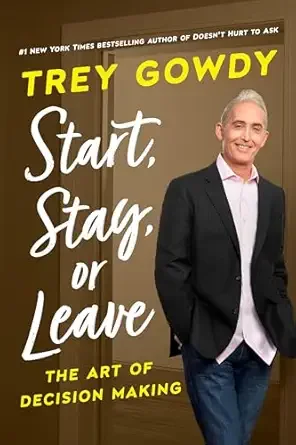
Start, Stay, or Leave
The Art of Decision Making
by Trey Gowdy
The 60-Second Take
In Start, Stay, or Leave, former prosecutor and congressman Trey Gowdy offers a practical framework for navigating life's heaviest decisions. Blending personal memoir with courtroom logic, he argues that every choice boils down to one of three actions. By learning to weigh logic against emotion, distinguish between a career and a calling, and prioritize the fear of regret over the fear of failure, you can make hard choices with clarity and walk away on your own terms.
You Are the Jury of Your Own Life
Trey Gowdy has made a habit of walking away from highly coveted positions. He built a formidable reputation as a federal prosecutor, only to leave the courtroom for politics. He then spent four terms in the United States House of Representatives, rising to prominent committee chairmanships, before abruptly announcing he was not seeking re-election. He walked away from Washington at the height of his political power to return to private practice and television.
To outside observers, his career trajectory looked erratic, perhaps even foolish. But for Gowdy, every pivot was the result of a highly deliberate, rational process.
In Start, Stay, or Leave, Gowdy takes the analytical tools he used to build legal cases and applies them to the emotional chaos of personal choice. He argues that life is a constant, unavoidable series of decisions, and that most of our anxiety comes from overcomplicating them. Every relationship, every career path, and every geographic move eventually forces you to choose between three fundamental actions. You must start, you must stay, or you must leave. This book is a practical manual for figuring out which action to take, and just as importantly, how to take it without looking back.
What You'll Learn
How to evaluate the three primary options in any major life transition
The critical distinctions between a job, a career, and a calling
Why treating "doing nothing" as a safe harbor is a logical fallacy
How to balance cold logic with human emotion when making a choice
The art of cross-examining your own ideas before acting
Why leaving is not the same as quitting, and how to exit gracefully
The Anatomy of a Decision
Gowdy’s framework is aggressively simple, but executing it requires deep self-awareness. Life is not static. You are always in the process of starting, staying, or leaving.
Starting is the phase of vision and risk. It requires the courage to step into the unknown and the humility to be a beginner again. Whether it is a new degree, a new business, or a new relationship, starting is inherently frightening because it guarantees friction.
Staying is the phase of commitment and endurance. When you are in the middle of a pursuit, the initial excitement fades, and you are left with the daily grind. Staying requires patience and loyalty. However, Gowdy warns that staying is also the most dangerous of the three phases because it easily disguises complacency. We often believe that making no decision is a neutral act. Gowdy stresses that doing nothing is an active choice. By refusing to leave or start something new, you are actively choosing to stay exactly where you are, absorbing all the opportunity costs associated with that choice.
Leaving is the phase of closure. It is the hardest choice for ambitious people to make because it feels identical to quitting. Gowdy argues that leaving is an essential survival skill. You cannot start the next chapter of your life if you refuse to close the current one. Knowing when a season has run its course is a hallmark of maturity.
Distinguishing Jobs, Careers, and Callings
One of the most profound causes of modern unhappiness is our inability to categorize our work correctly. Gowdy argues that much of our professional anxiety disappears when we properly identify whether we are in a job, a career, or a calling.
A job is a purely transactional arrangement. You provide labor, and an employer provides a paycheck to cover your bills. A job does not owe you spiritual fulfillment or a sense of identity. A career is a progression. It offers a trajectory of increasing status, responsibility, and compensation. A calling is entirely different. It is a pursuit so deeply aligned with your core purpose that you would likely do it for free.
Conflict arises when we expect one category to fulfill the duties of another. If you demand that your entry-level job provide the emotional fulfillment of a calling, you will be perpetually miserable and resentful. If you treat a true calling as merely a job, you will inevitably compromise your values for a paycheck. Gowdy left Congress because he realized politics was a career, but the justice system—the courtroom—was his actual calling. When you realize you are in the wrong category, it makes the decision to leave significantly easier.
Fear of Regret Over Fear of Failure
When we stare down a major life choice, fear is usually the loudest voice in the room. The fear of failure paralyzes us. We worry about losing money, looking foolish in front of our peers, or having to admit we made a mistake.
Gowdy points out that the fear of failure is shortsighted. Failure is an event. It stings, it bruises your ego, but it is survivable. You can recover from a failed business or a broken relationship. What you cannot recover from is the passage of time. Therefore, the metric you should use to make decisions is not the fear of failure, but the fear of regret.
Regret is permanent. It is the lingering ache of wondering what might have happened if you had simply tried. Gowdy advises readers to project themselves to the end of their lives and look backward. When you act as the jury deciding the verdict on your own life, you will rarely convict yourself for taking a bold swing and missing. You will absolutely convict yourself for letting fear keep you sitting safely in the gallery while the trial happened without you.
Cross-Examining Your Own Logic
Because Gowdy spent his life in courtrooms, his advice on evaluating evidence is uniquely sharp. When we face a tough choice, we naturally seek advice from friends and family. The problem is that our friends love us, which means they usually act as our defense attorneys. They validate our feelings, agree with our grievances, and tell us what we want to hear.
Validation is comforting, but it is useless for decision-making. To make a bulletproof choice, you need a prosecutor. You need someone to cross-examine your logic.
Gowdy advises finding a trusted, objective friend and asking them to intentionally poke holes in your plan. If you want to leave your job to start a bakery, your friend should aggressively question your financial runway, your lack of baking experience, and your tolerance for seventy-hour work weeks. If your decision cannot survive a friendly cross-examination, it will absolutely not survive the reality of the open market. Emotion is allowed to inform your decision, but logic must ultimately drive it.
The Art of Leaving Well
Eventually, the time comes to leave. Whether it is a geographic move or a career shift, how you exit is just as important as why you exit.
Gowdy insists that you should always strive to leave on your own terms, rather than waiting until you are forced out by circumstance or exhaustion. Leaving gracefully is an art form. It requires suppressing the urge to burn bridges or issue dramatic parting shots. The professional world is shockingly small, and the people you leave behind today may be the gatekeepers you need tomorrow.
When you leave, you should not be running away from something terrible; you should be walking purposefully toward something better. A well-executed exit honors the time you spent staying, preserves your reputation, and cleanly clears the slate so you can focus entirely on your next start.
Start, Stay, or Leave at a Glance
The illusion of neutrality. Refusing to make a decision is actually an active, consequential decision to stay.
Categorize your work. Understand the strict boundaries between a job (pays bills), a career (builds status), and a calling (provides purpose).
Failure vs. Regret. Failure is temporary and educational; regret is permanent and agonizing. Base your choices on avoiding the latter.
Invite cross-examination. Do not seek advice from people who only validate you. Find someone who will aggressively test your assumptions.
Exit gracefully. Leave before you are pushed, do not burn bridges, and move toward a new goal rather than simply fleeing a bad situation.
A Quick Start Guide to Making Your Next Move
Name the fear. Write down exactly what you are afraid of losing if you make a change. Then write down what you will regret if you do nothing. Compare the two weights.
Define your category. Look at your current professional role. Be honest with yourself: is it a job, a career, or a calling? Adjust your expectations of fulfillment accordingly.
Find your prosecutor. Bring your proposed plan to a smart, objective peer and give them explicit permission to tear it apart. Listen without getting defensive.
Remove emotion from the driver's seat. Acknowledge how you feel about the situation, but force yourself to build a purely logical, evidence-based argument for your choice.
Draft an exit strategy. If you decide to leave, plan exactly how you will communicate it. Write a resignation or departure message that is gracious, professional, and entirely free of bitterness.
Who Should Read Start, Stay, or Leave (and Who Can Skip It)
Read it if you are paralyzed by a major life transition, like a career change, a cross-country move, or a shift in a long-term relationship.
Read it if you appreciate a highly pragmatic, straightforward approach to life advice built on logic rather than sheer emotional intuition.
Read it if you enjoy political and legal memoirs; Gowdy uses his experiences in the courtroom and the Capitol as the primary vehicles for his lessons.
Skip it if you are highly averse to reading anything written by political figures. While the book focuses on personal development, the anecdotes are deeply rooted in Gowdy's conservative Washington background.
Skip it if you are looking for deep, clinical psychological research on human decision-making. This is a framework based entirely on the author's personal philosophy and lived experience.
Final Reflections
Start, Stay, or Leave is a refreshing departure from the hyper-academic decision-making books that flood the business market. Trey Gowdy writes exactly like he speaks: measured, deliberate, and occasionally blunt. He does not offer a magic formula that guarantees you will never make a mistake. Instead, he offers a framework for ensuring that when you do make a choice, you make it for the right reasons. The book's greatest strength is its ability to reframe the pain of transitioning. By showing that doing nothing is actually a deliberate choice to stay, Gowdy strips away our excuses and forces us to take ownership of our trajectory.
The Bottom Line
Every phase of life forces you to either start anew, stay committed, or walk away, and making the right choice requires valuing the pain of long-term regret over the temporary sting of failure.
Frequently Asked Questions
What is the main premise of Start, Stay, or Leave? The book argues that life is a continuous loop of deciding whether to initiate something new, endure your current situation, or exit gracefully. By applying logical, courtroom-style evaluation to your fears and motivations, you can navigate these transitions without being paralyzed by indecision.
Is the book heavily political? No. While Trey Gowdy is a former Republican congressman and uses his time in Washington to illustrate his points, the book itself is a personal development manual. It focuses on universal themes of career shifts, relationships, and risk assessment rather than partisan ideology.
What is the difference between a job and a calling?
According to Gowdy, a job is a transactional necessity designed to pay your bills. A calling is a deep, purpose-driven pursuit that aligns perfectly with your identity and values. Confusing the two often leads to severe dissatisfaction.
Business Floss is reader-supported. When you use our links we may earn an affiliate commission that helps us keep the site running. Thank you for your support!


