
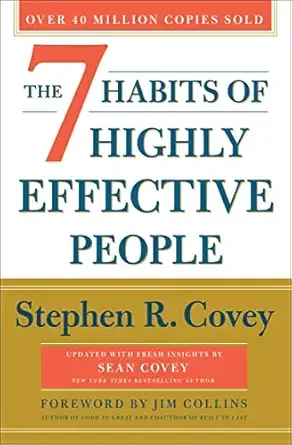
The 7 Habits of Highly Effective People
by Stephen R. Covey
The 60-Second Take
In The 7 Habits of Highly Effective People, Stephen R. Covey dismantles the quick-fix culture of modern self-help by shifting the focus from personality to character. Moving readers through a maturity continuum from dependence to interdependence, he provides a timeless framework for personal and professional effectiveness. Master these seven principles, from proactivity to empathetic listening, and you will build lasting success rooted in fairness, integrity, and human dignity.
The Problem with Quick-Fix Self-Help
If you read success literature written in the last fifty years, you will notice a distinct pattern. Most of it focuses on what Stephen R. Covey calls the "Personality Ethic." It teaches public image, public relations, negotiation tactics, and psychological hacks. It treats success as a matter of looking the right way and saying the right words.
When Covey researched two hundred years of success literature to write The 7 Habits of Highly Effective People, he realized that the earlier works were vastly different. Books from Benjamin Franklin's era focused on the "Character Ethic." They taught integrity, humility, courage, and justice. They argued that true effectiveness comes from the inside out. You cannot sustainably fake being a good leader, a good partner, or a good human being with a few communication tricks. If your underlying character is flawed, people will eventually sense the manipulation.
First published in 1989, Covey's book became a global phenomenon precisely because it ignored the hacks and returned to the roots of character. It does not promise overnight success. Instead, it offers a rigorous, sequential framework for fundamentally changing how you see the world, how you manage yourself, and how you interact with others.
What You'll Learn
The fundamental difference between the Character Ethic and the Personality Ethic
How to balance producing results with maintaining your capacity to produce (the P/PC balance)
The maturity continuum that moves you from dependence to true interdependence
How to escape the trap of urgency and focus on Quadrant II activities
The exact mechanics of the seven habits and how they build upon one another
Paradigms and the P/PC Balance
Before you can change your habits, you have to change how you see the world. Covey calls these lenses "paradigms." A paradigm is like a map of a city. If you have the wrong map, no amount of positive thinking or behavioral tweaking will get you to your destination. You have to experience a paradigm shift—a fundamental change in perspective—before you can achieve meaningful growth.
The most critical paradigm shift Covey introduces is the definition of effectiveness itself, which he illustrates with Aesop's fable of the goose that laid the golden eggs. A poor farmer discovers his goose lays a solid gold egg every day. He becomes rich, but he also becomes greedy and impatient. He kills the goose to get all the gold out at once, only to find nothing inside. He has destroyed the very thing that produced his wealth.
Covey argues that true effectiveness is a balance between Production (the golden eggs) and Production Capability (the health of the goose). This is the P/PC balance. If you focus only on Production, you burn yourself out, ruin relationships, and destroy your equipment. If you focus only on Production Capability—going to school forever but never working, or jogging ten hours a day but ignoring your job—you produce nothing. Every habit in the book is designed to maintain this delicate balance.
The Private Victory: Mastering Yourself
The core framework of the book is the maturity continuum. We all begin life as completely dependent. The first goal of growth is to achieve independence—the realization that you are responsible for yourself. Covey calls this phase the "Private Victory," and it is achieved through the first three habits. You cannot lead others until you can lead yourself.
Habit 1: Be Proactive
Being proactive does not just mean taking initiative; it means recognizing that your behavior is a function of your decisions, not your conditions. Covey introduces the concept of two circles. The Circle of Concern encompasses everything you care about: the economy, the weather, what people think of you. The Circle of Influence is the much smaller subset of things you can actually control: your attitude, your work ethic, your responses. Reactive people focus on their Circle of Concern. They complain about things they cannot change, which empowers those external forces to control them. Proactive people focus strictly on their Circle of Influence. By working only on what they can control, their influence naturally expands.
Habit 2: Begin with the End in Mind
Covey asks you to visualize a funeral. You walk inside, look at the casket, and realize it is your own. You are attending your funeral three years from today. Four people will speak: a family member, a friend, a colleague, and someone from your community. What do you want them to say about you?
This jarring thought experiment is the essence of the second habit. All things are created twice: first in the mind, and then in reality. If you do not actively design your own life’s purpose, you are defaulting to scripts written by your parents, your peers, or society. Covey advocates writing a personal mission statement—a constitution by which you evaluate every major decision—to ensure your daily actions align with your ultimate destination.
Habit 3: Put First Things First
While Habit 2 is mental creation, Habit 3 is physical creation. It is the exercise of independent will to manage your time around your values. Here, Covey introduces the famous Time Management Matrix, which divides activities by urgency and importance into four quadrants.
Quadrant I is urgent and important (crises, deadlines). Quadrant III is urgent but not important (most emails, interruptions). Quadrant IV is neither (mindless scrolling).
The magic happens in Quadrant II: things that are important but not urgent. This includes relationship building, long-term planning, preventative maintenance, and exercise. Because these things are never loudly demanding your attention, they are the first things we sacrifice. Highly effective people starve Quadrants III and IV so they can spend maximum time in Quadrant II, which shrinks the number of crises that pop up in Quadrant I.
The Public Victory: Mastering Relationships
Once you achieve the Private Victory of independence, you realize that independence is actually not the ultimate goal. The highest level of human existence is interdependence—the understanding that working together yields vastly better results than working alone. You cannot achieve the "Public Victory" of interdependence without a massive reserve of trust, which Covey calls the Emotional Bank Account. You make deposits through kindness, keeping promises, and apologizing. You make withdrawals through disrespect and broken commitments. The next three habits require a highly funded account.
Habit 4: Think Win/Win
Win/Win is not a technique; it is a philosophy of human interaction. Most people are deeply scripted in the Win/Lose paradigm—if I get the promotion, you do not. This is rooted in a scarcity mentality, the belief that there is only one pie and if you get a big piece, I get a small one.
Think Win/Win operates on an abundance mentality. It is the belief that there is plenty out there for everybody, and that success does not have to come at the expense of others. If a truly mutually beneficial agreement cannot be reached, the best option is "No Deal," which frees both parties to walk away without damaging the relationship.
Habit 5: Seek First to Understand, Then to Be Understood
If you only take one relational skill away from the book, make it this one. Most people do not listen with the intent to understand; they listen with the intent to reply. While the other person is talking, they are preparing their own autobiographical response—evaluating, probing, advising, or interpreting based entirely on their own experiences.
Covey insists on empathic listening. This means getting inside the other person's frame of reference. You listen to understand their paradigm and how they feel, entirely suspending your own judgment. Only when the other person feels completely, accurately understood will they drop their defenses and become open to hearing your perspective. You have to diagnose before you prescribe.
Habit 6: Synergize
Synergy is the culmination of all the previous habits. It simply means that the whole is greater than the sum of its parts. One plus one equals three, or ten, or a hundred. Synergy happens when people with high Emotional Bank Accounts, a Win/Win motive, and empathic listening skills pool their differences to create a third alternative—a solution far better than what either party originally proposed. It requires you to genuinely value differences. If two people have the exact same opinion, one of them is unnecessary.
The Habit of Renewal
The first six habits demand a massive amount of personal energy. To sustain them, you must protect your Production Capability.
Habit 7: Sharpen the Saw
Imagine coming upon a man furiously sawing down a tree. He is exhausted and making no progress because the saw is completely dull. You suggest he take a break to sharpen the blade, but he replies, "I don't have time to sharpen the saw, I'm too busy sawing!"
Habit 7 is taking the time to sharpen the saw. It is the habit of daily self-renewal across four dimensions: physical (exercise, nutrition), mental (reading, planning), spiritual (meditation, nature, clarifying values), and social/emotional (service, empathy, synergy). This habit preserves and enhances your greatest asset: yourself.
The 7 Habits at a Glance
Be Proactive. Focus entirely on your Circle of Influence; you are responsible for your own choices.
Begin with the End in Mind. Define your core values and ultimate destination before taking action.
Put First Things First. Prioritize important, non-urgent Quadrant II work over immediate, trivial fires.
Think Win/Win. Seek mutually beneficial agreements rooted in an abundance mentality.
Seek First to Understand. Listen to deeply comprehend the other person, not just to prepare your reply.
Synergize. Value differences and combine strengths to create third alternatives.
Sharpen the Saw. Continuously renew your physical, mental, emotional, and spiritual health.
A Quick Start Guide to Quadrant II Thinking
Map your current matrix. For three days, track exactly how you spend your time in fifteen-minute increments.
Identify the true urgencies. Look at your list and brutally categorize them into the four quadrants. Notice how much time you spend reacting to Quadrant III interruptions.
Define your roles. Write down your key life roles (e.g., manager, spouse, parent, individual).
Schedule the big rocks first. Before the week begins, identify one crucial Quadrant II goal for each role. Put those directly onto your calendar before any meetings or emails can crowd them out.
Learn to say no. To protect your Quadrant II time, you must become comfortable politely smiling and saying no to the urgent but unimportant requests of others.
Who Should Read The 7 Habits of Highly Effective People (and Who Can Skip It)
Read it if you feel constantly busy but entirely unproductive, and want a fundamental reset on how you manage your life and priorities.
Read it if you are stepping into a leadership role for the first time; the transition from independence to interdependence is the exact definition of management.
Read it if your relationships are suffering from miscommunication and you want a rigorous framework for building trust.
Skip it if you are looking for specific corporate case studies, sales techniques, or immediate business playbooks.
Skip it if you are completely allergic to slightly moralistic, earnest language. The book’s tone is heavily rooted in traditional character values, which can feel dated to readers looking for modern, cynical pragmatism.
Final Reflections
The 7 Habits of Highly Effective People is not really a book about productivity. It is a philosophy of life disguised as a business book. Its enduring brilliance lies in Covey's refusal to offer shortcuts. He demands that the reader do the grueling, invisible work of character development before attempting to influence the world. The concepts he codified—the time matrix, empathic listening, the abundance mentality—have become so ingrained in modern culture that we often forget where they originated. Reading the source material is a humbling reminder that true effectiveness is never a quick fix; it is a lifelong practice.
The Bottom Line
Lasting success cannot be hacked through superficial personality traits; it requires a deep, inside-out transformation of character that moves you from relying on others to leading yourself, and ultimately to collaborating effectively with the world.
Frequently Asked Questions
What are the 7 habits in order?
Be Proactive, 2. Begin with the End in Mind, 3. Put First Things First, 4. Think Win/Win, 5. Seek First to Understand, Then to Be Understood, 6. Synergize, 7. Sharpen the Saw.
What is the difference between independence and interdependence?
Independence is the attitude of "I"—I can do it, I am responsible, I am self-reliant. Interdependence is the attitude of "we"—we can cooperate, we can combine our talents, we can create something greater together. Covey argues you must achieve independence before you can effectively participate in interdependence.
Is The 7 Habits still relevant today?
Yes. In an era dominated by rapid technological change, social media posturing, and endless digital distraction, Covey's focus on timeless, unchanging principles (like integrity, deep listening, and prioritization) is arguably more valuable now than when it was written.
Business Floss is reader-supported. When you use our links we may earn an affiliate commission that helps us keep the site running. Thank you for your support!


