
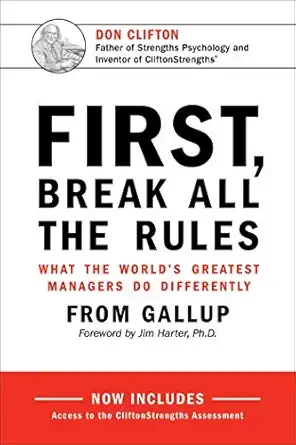
First, Break All The Rules
What the World’s Greatest Managers Do Differently
by Marcus Buckingham & Curt Coffman
The 60-Second Take
First, Break All the Rules distills decades of Gallup research, drawing on interviews with over a million employees and eighty thousand managers, into an account of what the best managers actually do. Its central instrument is the Q12, twelve questions whose answers vary more between teams than between companies, which locates engagement with the immediate manager. Its central argument is four keys: select for talent rather than experience, define outcomes rather than steps, build on strengths rather than fixing weaknesses, and find the right fit rather than the next promotion.
The Variation Was Between Teams, Not Between Companies
Gallup set out to answer a question that sounds simple and turns out not to be: what does a strong workplace actually consist of? The research program ran for decades and eventually covered interviews with more than a million employees and around eighty thousand managers across hundreds of organizations, spanning roles from sales to school leadership.
The output was twelve questions. But the finding that made the research matter was where the answers varied. Scores differed enormously between teams inside the same company, operating under identical pay structures, benefits, policies, and mission statements. Which meant the primary determinant of whether people were engaged was not the organization. It was the person they reported to.
First, Break All the Rules, published in 1999 by Marcus Buckingham and Curt Coffman, is the account of what the managers with the best scores did differently, and it produced the line that has since become received wisdom: people leave managers, not companies. This summary covers the twelve questions and the four keys.
What You'll Learn
What the Q12 measures and why the first questions matter most
Why great managers select for talent rather than for experience or intelligence
The difference between defining outcomes and defining steps, and when steps are right
Why fixing weaknesses is a poor use of managerial effort
What "the right fit" means when it isn't a promotion
The Twelve Questions
The Q12 measures the conditions under which talented people do their best work and stay. The questions cover, in substance: knowing what's expected; having the materials and equipment to do the work; having the opportunity to do what you do best every day; receiving recognition for good work; having someone at work who seems to care about you as a person; having someone who encourages your development; feeling that your opinions count; feeling that the mission makes your work important; believing colleagues are committed to quality; having a good friend at work; having someone discuss your progress; and having had opportunities to learn and grow.
Two features make the instrument useful rather than merely another survey.
First, the questions are ordered. Buckingham and Coffman describe a climb, where the earliest questions are base camp and must be answered strongly before the later ones matter. A team that doesn't know what's expected of it will not be helped by a compelling mission statement. This makes the Q12 diagnostic rather than a scorecard, because a low score tells you where in the sequence you're failing.
Second, the questions are almost entirely within a line manager's control. Nothing here requires a budget approval or an HR program. Knowing what's expected, having the right equipment, receiving recognition, and being asked for an opinion are all things a manager does or fails to do.
The first question is the one worth taking most seriously. An uncomfortable proportion of managers believe expectations are settled because they were discussed once during onboarding. Asking three people what's expected of them and comparing the answers is the cheapest management diagnostic available.
The Four Keys
Each of the four keys is framed as a rejection of conventional advice.
Select for talent, not experience or intelligence. The authors define talent as a recurring pattern of thought, feeling, or behavior that can be productively applied, and they group these into striving, thinking, and relating categories. Their claim is that experience and skills can be taught and talents largely cannot, so hiring for the teachable attributes while ignoring the untrainable ones is backwards. The nurse who lacks natural empathy can be trained in every procedure and will still be the wrong nurse.
Define the right outcomes, not the right steps. Because people achieve results through different routes, prescribing the method destroys the very variation that produces performance. The authors' phrasing is that the most efficient path from talent to performance is helping someone find their own path of least resistance. They're careful about the exceptions: required steps are appropriate where accuracy or safety demand them, and where an industry or regulatory standard applies. Their sharpest observation is that steps prevent dissatisfaction and cannot produce satisfaction, which is why process compliance never generates a delighted customer.
Focus on strengths, not weaknesses. Conventional development identifies gaps and invests in closing them. The authors argue this produces expensive mediocrity, and that the same effort applied to an existing strength produces far more. Weaknesses get managed around: through complementary partnerships, through support systems, or through changing the role. The exception they acknowledge is a weakness that's fatal to the job itself, which is a selection problem rather than a development one.
Find the right fit, not the next rung. This is the most structurally challenging key. Most organizations have exactly one reward for excellence, which is promotion, usually into management. That reliably converts outstanding individual contributors into mediocre managers and destroys value twice. The authors' alternative is to make it possible to grow in prestige and pay within a role, through broad pay bands and by creating genuine heroes in every function rather than only at the top of the hierarchy.
What the Research Does and Doesn't Show
The book's authority rests on the scale of Gallup's data, and it's worth being precise about what that data supports.
The findings are correlational. Teams with strong Q12 scores show better performance on productivity, retention, and customer measures. That's a real and consistently replicated association, and it doesn't by itself establish that engagement produces performance rather than the reverse, or that both follow from something else, such as a well-run unit with a sensible workload. The authors write as though causation runs from engagement to results; the honest position is that it plausibly runs in both directions.
The treatment of talent as a fixed recurring pattern also sits uneasily against later work on development and growth mindset. The book's position is that talents are essentially set by adulthood, which is a stronger claim than the evidence comfortably supports and which some readers will find limiting when applied to their own team.
And Gallup has a commercial interest in the instrument, which doesn't invalidate the research and is worth knowing.
The other fair criticism is novelty. Several reviewers have noted that much of what's presented as rule-breaking, particularly around outcomes over process and building on strengths, was already standard in good management practice, and that the framing of conventional wisdom is something of a straw man. The book's contribution is the evidence base and the compression, not the discovery.
First, Break All the Rules at a Glance
The Q12. Twelve questions measuring workplace strength, whose scores vary more between teams than between companies.
Base camp first. The early questions must be answered strongly before the later ones have any effect.
Talent. A recurring pattern of thought, feeling, or behavior, which the authors treat as largely untrainable.
Outcomes over steps. Define the result and let people find their own route, except where accuracy, safety, or standards require otherwise.
Manage around weaknesses. Invest in strengths and design around gaps rather than trying to close them.
Right fit over promotion. Create ways to grow within a role instead of promoting excellent contributors out of what they're good at.
A Quick Start Guide to Managing Like This
Test expectation clarity. Ask three direct reports what's expected of them this quarter and compare the answers to yours.
Audit your job specs for talent. Separate what can be taught from what can't, and hire for the second.
Convert one process into an outcome. Take a task you've prescribed step by step and specify the result instead, keeping steps only where safety or standards require them.
Reallocate your development effort. Move the time you're spending on someone's weakest area into their strongest and compare the return.
Create a non-promotion reward. Find a way for an excellent contributor to gain status and pay without leaving the work they're best at.
Who Should Read First, Break All the Rules (and Who Can Skip It)
Read it if you're a line manager and want a small set of things you control that measurably affect your team, which is the book's core value.
Read it if you run HR or talent and are designing career paths, since the critique of promotion-as-only-reward is directly actionable.
Read it if you want research-backed management rather than assertion, with the caveats about correlation in mind.
Skip it if you've absorbed the strengths-based literature. Buckingham developed these ideas further in later books, and the core will be familiar.
Skip it if dated examples bother you. The book is from 1999 and the case material reflects it, though the underlying findings have held up.
Skip it if you want depth on any one key. Each gets a chapter, and readers wanting a full treatment of selection or development will need to go elsewhere.
Final Reflections
The single most valuable finding here is the location of the variation. Companies invest enormously in engagement at the organizational level, in policies, perks, and values statements, and the data says the difference is made one team at a time by the person in front of you. That reframes engagement from a corporate program into a management practice, which is both more demanding and more tractable.
The right-fit key is the most underused. Nearly every organization still promotes its best individual contributors into management as the only available recognition, loses a strong performer, and gains a reluctant manager. The alternative costs nothing but a rethink of pay bands and status.
The reservations are worth carrying rather than dismissing. The evidence is correlational, the treatment of talent as essentially fixed is stronger than the research supports, and the conventional wisdom the book breaks was in places already conventional. Read it for the Q12 as a diagnostic and for the four keys as a set of managerial defaults, and hold the underlying theory of talent more loosely than the authors do.
The Bottom Line
Engagement is made or destroyed by the immediate manager, not the company. Start with whether your people actually know what's expected, then define outcomes rather than methods and spend your development effort where they're already strong.
Frequently Asked Questions
What is the Q12?
Gallup's twelve-question instrument for measuring workplace strength, covering clarity of expectations, resources, recognition, development, and belonging. Its significance is that scores vary more between teams within a company than between companies, which locates engagement with the direct manager.
What are the four keys of great managers?
Select for talent rather than experience or intelligence; define the right outcomes rather than the right steps; focus on strengths rather than fixing weaknesses; and find the right fit for a person rather than promoting them up a ladder.
Why shouldn't managers focus on weaknesses?
Because the authors' research suggests effort invested in an existing strength yields far more than the same effort spent closing a gap. Weaknesses should be managed around through partnerships, systems, or role design, unless the weakness is fatal to the job itself.
Business Floss is reader-supported. When you use our links we may earn an affiliate commission that helps us keep the site running. Thank you for your support!


