
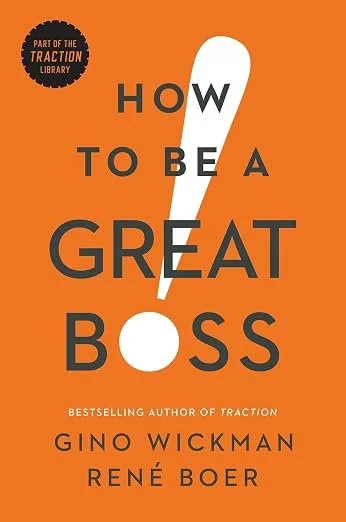
How to Be a Great Boss
by Gino Wickman and René Boer
The 60-Second Take
How to Be a Great Boss is the EOS book aimed at individual managers rather than leadership teams. Gino Wickman and René Boer cover delegation, hiring and assessing people, and ten specific practices split between leading and managing. Short, prescriptive, and genuinely practical, though its people-rating tools deserve more caution than the book gives them.
Accountability Isn't a Trait. It's an Equation.
Ask a frustrated manager what's wrong and you'll often hear that the team lacks accountability. It's stated as a fact about the people, which conveniently locates the problem outside the person describing it.
Gino Wickman and René Boer refuse that framing with a small formula they call LMA: leadership plus management equals accountability. Accountability is an output. If it's absent, one of the two inputs is missing, and both are the boss's job.
That reframe carries the book. How to Be a Great Boss is the entry in the EOS library written for individual managers rather than leadership teams, and it's the one that fills a real gap the others leave. Traction and Get a Grip are aimed at running a company. This one is aimed at the person with six direct reports who has never been taught how to do that.
It's also very short, deliberately so, and every tool in it has a trademark attached. Both facts tell you something about what you're getting.
What You'll Learn
Why accountability is a result rather than a character trait
How the Delegate and Elevate quadrants find the work you should stop doing
The GWC test for whether someone is right for a seat
Five leadership practices and five management practices, and why the split matters
How a quarterly conversation replaces the annual review nobody benefits from
Delegate and Elevate
The book starts with time, on the reasoning that a boss with no capacity cannot do any of what follows.
The exercise is to list everything you do in a week, then sort each item into four quadrants: things you love and are great at, things you like and are good at, things you don't like but are good at, and things you don't like and aren't good at.
The bottom two quadrants are the delegation list. The subtlety is in the third one, which is where most managers get stuck: work you're competent at but don't enjoy feels like your job precisely because you're good at it, and that competence is exactly why it's hard to hand over. Being good at something isn't an argument for continuing to do it.
The authors are clear that this only works if there's someone capable to delegate to, which is why the next chapter is about people. Handing work to someone who can't carry it means you'll take it back within a month and conclude that delegation doesn't work.
Getting the Right People in the Right Seats
Two separate tests, and conflating them is a common and expensive error.
Right person means alignment with the company's core values. The People Analyzer rates each person against each value with a plus, a plus-minus, or a minus, and sets a bar for what's acceptable.
Right seat means GWC: do they get it, do they want it, do they have the capacity to do it. All three have to be yes, and the failure modes differ. Someone who doesn't get the role needs a different seat, not more training. Someone who doesn't want it can't be motivated into wanting it indefinitely. Capacity covers time and ability, and it's the one most often mistaken for effort.
The practical value is that it separates two conversations managers habitually merge. A person can be a great cultural fit in the wrong seat, which is a reassignment problem, not a performance problem. The book closes with the four common people issues and a three-strike process for working through them.
The Ten Practices
The heart of the book is two lists of five.
The five leadership practices are the direction side. Give clear direction, meaning a vision the person can actually repeat back. Provide the necessary tools, which includes training, technology, and time, and which the authors note is where most stated commitment to people quietly fails. Let go of the vine, meaning genuine ownership rather than delegation with surveillance attached. Act with the greater good in mind, so decisions visibly serve the organization rather than the manager. And take a Clarity Break, meaning scheduled time to think rather than execute, which is presented as a practice rather than a luxury.
The five management practices are the operating side. Keep expectations clear, covering roles, responsibilities, measurables, and values. Communicate well, which the book operationalizes by having the other person say back what they heard rather than assuming transmission occurred. Maintain a Meeting Pulse, meaning a weekly team meeting at the same time on the same agenda covering priorities, numbers, and issues. Have quarterly conversations. And reward and recognize, consistently rather than occasionally.
The split is the useful part. Most managers are naturally strong on one side and weak on the other, and the list makes the gap visible rather than leaving it as a vague sense that something isn't landing.
The Quarterly Conversation
The replacement for the annual review, and one of the more practical ideas in the EOS toolkit.
The structure is 5-5-5: review the person's five core roles, their five priorities for the quarter, and the company's five core values, with an honest read on each. It runs quarterly, takes an hour, and has no compensation attached.
That last detail matters more than it appears. Once a conversation determines pay, both parties are negotiating rather than talking, and useful feedback becomes something to defend against. Separating the developmental conversation from the money conversation is what makes the developmental one possible. Doing it four times a year also means nothing accumulates for eleven months before anyone mentions it.
Being a Great Boss at a Glance
LMA. Leadership plus management equals accountability, so missing accountability points at a missing input.
Delegate and Elevate. Four quadrants of work, with the goal of operating in the top two.
Right person, right seat. Core values determine the person, GWC determines the seat, and they're separate judgments.
Five leadership practices. Direction, tools, ownership, greater good, and time to think.
Five management practices. Clear expectations, real communication, a weekly meeting pulse, quarterly conversations, and recognition.
5-5-5. Five roles, five priorities, five core values, reviewed quarterly with no pay attached.
A Quick Start Guide to Becoming a Better Boss
Run the delegation exercise on last week. Sort every task into the four quadrants and identify what's sitting in the bottom two.
Score each report on GWC. Any no tells you which conversation to have, and it usually isn't the one you were dreading.
Identify your weaker side. Leadership or management. Whichever list feels less natural is where your accountability gap is coming from.
Fix the weekly meeting. Same day, same time, same agenda, ending on time. Consistency does more here than content.
Schedule one quarterly conversation. No compensation discussion. Roles, priorities, values, and an honest read on each.
Who Should Read How to Be a Great Boss (and Who Can Skip It)
Read it if you were promoted into management without training, which is most managers, and want a short list of things to actually do.
Read it if your team is frustrating you and you suspect the problem might partly be upstream of them.
Read it if your company runs EOS. This is the manager-level companion, and it fills a gap Traction and Get a Grip genuinely leave open.
Skip it if you want depth or nuance. It's brief and prescriptive by design, and readers who want the reasoning behind the practices will find it asserted rather than argued.
Skip it if you manage highly autonomous specialists or creative teams. The meeting cadence and measurables assume work that decomposes into weekly numbers, and plenty doesn't.
Final Reflections
For a short book this earns its length. LMA is a genuinely good reframe, the delegation quadrants surface work people didn't realize they were clinging to, and separating right-person from right-seat prevents a category of bad decision that costs companies good employees. The quarterly conversation with pay deliberately excluded is better practice than most performance management systems in use.
Two things to hold. This is the third EOS book on many reading lists, and while it's more differentiated than the overlap between Traction and Get a Grip, the core tools recur across all of them. If you've read either, expect familiar material with a manager's framing rather than new content.
More substantially, the people-rating tools deserve more caution than the book supplies. The People Analyzer produces a grid of humans scored against values, and GWC produces a verdict on whether someone belongs in their role. Used well, both force honesty that managers avoid. Used badly, they supply an official-looking justification for a decision the manager had already made, and they're wide open to the bias of whoever holds the pen. Neither tool asks whether the person was set up to succeed, whether the expectations were ever made clear, or whether the manager is the reason for the low score. The book's own LMA formula implies exactly that question, and then the assessment tools never ask it.
Use the framework. Apply the ratings to yourself first.
The Bottom Line
Your team's accountability is a report card on your leadership and your management. Find which of the two you've been skipping.
Frequently Asked Questions
What does LMA stand for?
Leadership, Management, and Accountability. The formula holds that accountability is the product of leadership and management rather than a personal quality, so if a team isn't accountable, the boss is missing one of those two inputs.
What is GWC?
Get it, Want it, Capacity to do it. All three must be true for someone to be in the right seat, and each failure calls for a different response: someone who doesn't get the role needs a different one, someone who doesn't want it can't be persuaded indefinitely, and capacity covers both time and ability.
Do I need to read Traction first?
No. This one works on its own for an individual manager, and it's the most standalone book in the EOS library. Reading Traction helps if your whole company is adopting the system, since some tools here assume a company vision document exists.
Business Floss is reader-supported. When you use our links we may earn an affiliate commission that helps us keep the site running. Thank you for your support!