
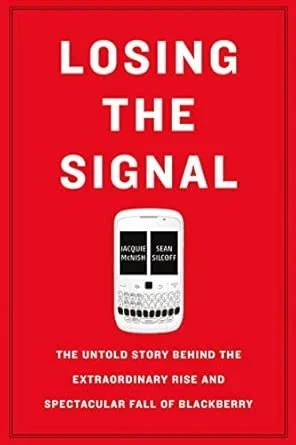
Losing The Signal
The Untold Story Behind the Extraordinary Rise and Spectacular Fall of Blackberry
by Jacquie McNish and Sean Silcoff
The 60-Second Take
Losing the Signal is Jacquie McNish and Sean Silcoff's inside account of Research In Motion, the Waterloo company that turned a pocket email device into the tool of choice for presidents and CEOs, then watched its grip on the U.S. smartphone market slip from half to almost nothing. Drawing on interviews with executives, directors, and rivals, the two Globe and Mail journalists trace the partnership between engineer Mike Lazaridis and dealmaker Jim Balsillie, the carrier relationships that made BlackBerry thrive, and the distractions, rushed products, and leadership rifts that left it unprepared when Apple and Google rewrote the rules.
The iPhone Feature That Worried BlackBerry Most Was the Browser
In January 2007, Mike Lazaridis was on his treadmill at home when a news report showed Steve Jobs unveiling the iPhone. The next day, he pulled his co-CEO Jim Balsillie in front of a computer to watch the webcast. What struck him most was the full web browser, a feature carriers had refused to let BlackBerry offer. Balsillie saw the commercial angle right away: Apple had secured a deal from AT&T that Research In Motion had never been given.
Then, as the authors tell it, RIM's leaders gave the iPhone little more thought for months.
That scene sits at the heart of Losing the Signal: The Untold Story Behind the Extraordinary Rise and Spectacular Fall of BlackBerry, published in 2015 by Globe and Mail journalists Jacquie McNish and Sean Silcoff. Built on access to senior executives, directors, and competitors, the book won the National Business Book Award and later became the basis for the 2023 film BlackBerry. It tells how a company that started above a bagel store in Waterloo, Ontario, came to control about half of the U.S. smartphone market in 2009, and how that share fell below one percent within a few years. There was no fraud and no single catastrophic call, just a run of distractions, rushed products, and a partnership coming apart as the industry changed. This summary covers the rise, the hidden dependency behind BlackBerry's advantage, and the lessons that carry over to any business.
What You'll Learn
How a bookish engineer and an aggressive dealmaker built a global company from a small Canadian city
Why BlackBerry's real customer, in many ways, was the wireless carrier
How a patent fight, a stock options probe, and an NHL obsession drained attention at the worst time
What the Storm and PlayBook launches reveal about responding to a competitor under pressure
Why a co-CEO structure that powered growth slowed the company down in a crisis
Lazaridis and Balsillie: An Unlikely Partnership
Lazaridis cofounded RIM in 1984. He was the quiet technologist, an engineer who loved hard problems and believed great products would sell themselves. Balsillie, a Harvard Business School graduate with a combative streak, joined in 1992 and became co-CEO. The two divided the company along natural lines: Lazaridis ran engineering and product, while Balsillie handled sales, finance, and the tough negotiations with carriers and partners.
For years the pairing worked beautifully. Lazaridis gave RIM technical credibility, and Balsillie gave it commercial muscle. Lazaridis could imagine a device that put email in your pocket; Balsillie could persuade skeptical carriers and corporate IT departments to bet on it.
The product they built was not a phone at first. It was a pocket email device with push delivery and a thumb keyboard that people found almost impossible to put down. It spread from executives to their teams and into governments. Yet at the very moment the company was ranked the world's fastest-growing firm, the cracks the rest of the book explores were already forming.
Why Carriers Loved BlackBerry (and Why That Became a Trap)
The book's most useful strategic idea is where BlackBerry's advantage actually came from. RIM's engineers grew up working within tight limits on bandwidth and battery life, and they got very good at it. BlackBerry devices compressed data and used networks sparingly. That made them a delight for wireless carriers, who could add subscribers without straining capacity, and carriers in turn pushed BlackBerry hard. The device was excellent, but the channel relationship was just as much a part of the moat.
The catch was that carriers also set the rules. They decided what features could run on their networks, and RIM, valuing those relationships, worked inside the limits rather than challenging them. When Lazaridis watched the iPhone launch, his first frustration was that carriers had never allowed BlackBerry a full browser. He also predicted, correctly, that the iPhone would put heavy strain on AT&T's network.
Being right did not save him. Consumers wanted the experience badly enough that carriers found ways to accommodate it, and the efficiency that had made BlackBerry indispensable stopped mattering as much. RIM had treated a partner's constraints as permanent features of the market. Apple, with enough leverage, simply negotiated different terms.
There is a familiar echo here of the dynamic Clayton Christensen describes in The Innovator's Dilemma: serving your most valuable customers well can blind you to what new ones want. RIM's corporate and carrier customers prized security, keyboards, and network thrift, while consumers wanted apps, browsing, and media. Eventually employees brought those consumer phones to work, and the enterprise base eroded from within.
Attention Spent Elsewhere: Patents, Options, and Hockey
The book is strongest when it shows how much leadership attention went to problems that had nothing to do with phones.
The NTP patent war. A small patent-holding company, NTP, sued RIM in 2001 and won a jury verdict that threatened to shut down BlackBerry service in the United States. After years of appeals, RIM settled in March 2006 for $612.5 million. The money hurt, but the years of uncertainty and executive time arguably hurt more.
The stock options investigation. The Ontario Securities Commission investigated RIM over improperly backdated employee stock options, a process that pulled in both co-CEOs and dented their standing with the board and investors.
Balsillie's NHL pursuit. For years, Balsillie tried to buy a National Hockey League team and move it to Hamilton, Ontario, culminating in a bitter fight with the league over the bankrupt Phoenix Coyotes. It consumed his energy during the very years the smartphone market was being remade.
None of these alone would have sunk the company. Together, landing during the same stretch that Apple and Google entered the market, they meant the two people best positioned to steer a response were often focused elsewhere. In a crisis, the scarcest resource is rarely money. It is the attention of the people who make the big decisions.
Rushed Responses: The Storm and the PlayBook
When RIM did respond, it often did so in a hurry and on someone else's timeline.
AT&T's exclusive iPhone deal left Verizon wanting an answer of its own, and Verizon and RIM joined forces on the Storm, an all-touchscreen BlackBerry that was little more than a prototype in 2007. Lazaridis championed a clickable screen that physically depressed under your finger, convinced it beat Apple's approach. The Storm launched in November 2008 and sold well at first, then the problems surfaced. According to the book, Verizon's chief marketing officer told Balsillie that virtually every one of the roughly one million Storms shipped in 2008 needed replacing. The episode damaged RIM's most important U.S. carrier relationship and its reputation with consumers.
The pattern repeated with the PlayBook tablet. RIM acquired QNX Software Systems in 2010 and used its operating system as the foundation for a next-generation platform, a serious technical bet. But the PlayBook's botched 2011 launch became another public stumble. The book's prologue captures the mood of that period, opening with Balsillie flying to Dubai to deliver a keynote in 2011 just as BlackBerry's network suffered a major outage.
The QNX-based BlackBerry 10 phones eventually arrived in 2013, years after customers and developers had settled on iOS and Android. The lesson is about timing and foundations: copying a competitor's form on a compressed schedule, without the platform underneath, can cost more credibility than it wins back.
When Two CEOs Pull in Different Directions
Running through every chapter is the slow breakdown of the partnership itself. The co-CEO arrangement had worked because each man owned a clear domain. Under pressure, the boundaries blurred. Answering Apple required both of them, and they did not always agree. Staff felt pulled between two camps, and internal feuds slowed the response just as speed mattered most.
In January 2012, both men stepped down as co-CEOs, and Thorsten Heins, a RIM executive who had joined from Siemens, took over. The book treats the handoff as the end of the founders' era rather than a turnaround story; the later years receive comparatively little space.
Shared leadership doesn't always fail, but a structure built on complementary strengths needs a clear way to resolve disagreement, and that gets tested hardest when the company can least afford a stalemate.
BlackBerry's Decline at a Glance
Moat versus permission. An advantage that depends on a partner's rules lasts only as long as the partner keeps those rules.
Right about the product, wrong about the market. Lazaridis correctly spotted the iPhone's network demands; what he misjudged was how far customers and carriers would go to get it.
The distraction tax. Litigation, regulatory probes, and side pursuits cost leadership attention, which compounds faster than legal bills.
Form without foundation. Imitating a rival's design on a deadline, without the underlying platform, can deepen the hole.
A Quick Start Guide to Avoiding BlackBerry's Mistakes
Map your borrowed advantages. List the parts of your edge that depend on a partner, platform, or regulator, and ask what would happen if each one changed its rules tomorrow.
Separate the technical critique from the customer verdict. When a rival launches something flawed, ask what customers are willing to trade for it before concluding it will fail.
Audit where leadership time is going. During any period of competitive change, track how many executive hours go to side issues and protect time for the core threat.
Respond on your own timeline when possible. Before rushing a counter-product for a partner's deadline, confirm you have the platform and quality to back it up.
Define how co-leaders break ties. If authority is shared, agree in advance on how disagreements get resolved and who has the final call in each domain.
Who Should Read Losing the Signal (and Who Can Skip It)
Read it if you work in strategy or corporate development and want a detailed case study in how a dominant position can unravel in a few years.
Read it if you are in a business that depends heavily on a channel partner or platform and want a vivid example of that dependency turning against you.
Read it if you are interested in governance and want a well-sourced look at how a co-CEO structure behaves under stress.
Skip it if you want a deep technical history of mobile engineering. The book focuses on people, deals, and decisions.
Skip it if you want explicit frameworks and takeaways. This is narrative journalism, and you will need to draw the lessons yourself.
Final Reflections
Losing the Signal earns its place among corporate decline stories because its main characters were neither foolish nor crooked. Lazaridis read the iPhone's technical demands accurately, and Balsillie outmaneuvered far larger rivals. Their failure was a chain of reasonable-looking choices made under heavy distraction, anchored to an advantage that turned out to depend on someone else's rules. That makes it more useful than tales of obvious hubris, because readers can see themselves making the same calls.
The criticisms are fair, though. The prose is workmanlike rather than gripping; a Boston Globe reviewer found the telling dutiful and argued much of the material could be pieced together from years of press coverage, while still valuing having it in one place. Like most business journalism written after the fact, it benefits from knowing the ending, and some decisions look worse in hindsight than they might have with the information available then. And its 2015 vantage point leaves the company's later reinvention as a software and security firm mostly outside the frame. As a study of how quickly market leadership can evaporate, it remains a strong and sobering read.
The Bottom Line
BlackBerry won by working brilliantly inside rules its carriers set, and lost when a rival with more leverage got those rules changed. Know which parts of your advantage you actually control.
Frequently Asked Questions
Did the iPhone alone kill BlackBerry?
No. The book shows the iPhone arriving during a stretch when RIM's leaders were already absorbed by a patent war, a stock options investigation, and Balsillie's NHL pursuit. Rushed responses like the Storm and PlayBook, along with a fraying co-CEO relationship, turned a serious competitive threat into a collapse.
Why did carriers matter so much to BlackBerry's success?
BlackBerry devices used network data very efficiently, which let carriers add subscribers without straining their systems, so carriers promoted them heavily. The same relationship meant carriers controlled which features RIM could offer, including a full web browser. When Apple negotiated better terms, that carrier-centered advantage weakened.
Is the book the same story as the movie BlackBerry?
The 2023 film is based on the book but compresses and dramatizes events for the screen. The book covers a longer span in more detail, including the patent fight, the Storm and PlayBook launches, and the 2012 leadership transition.
Business Floss is reader-supported. When you use our links we may earn an affiliate commission that helps us keep the site running. Thank you for your support!