
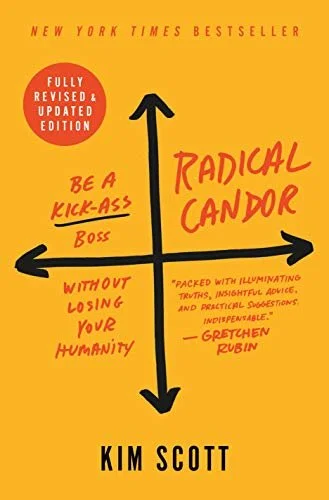
Radical Candor
Be a Kick-Ass Boss Without Losing Your Humanity
by Kim Scott
“Informational and clear, [Radical Candor] is necessary reading for anyone who’s having trouble coming to terms with an underperforming workforce.”
Stop Choosing Between Being Nice and Being Effective
Most of us have been conditioned to believe that if you don't have something nice to say, you shouldn't say anything at all. In the workplace, this childhood maxim transforms into a disastrous management philosophy. We worry that giving critical feedback will hurt feelings or damage morale, so we stay silent. Or, on the flip side, we assume that to get results, we have to be the hard-charging, desk-pounding boss who leaves a trail of tears in their wake.
We treat management as a binary choice: you can be a pushover, or you can be a jerk.
In Radical Candor: Be a Kick-Ass Boss Without Losing Your Humanity, Kim Scott argues that this is a false dichotomy. After leading teams at Google and Apple, she realized that the most successful managers—those who drove results and were beloved by their teams—did two things simultaneously: they cared personally and they challenged directly.
This summary explores how to break the "ruinous empathy" cycle and build a culture where honest feedback is the fuel for high performance.
What You'll Learn
The Feedback Matrix: Why "being nice" is often the most damaging thing you can do to an employee’s career.
The Sweet Spot: How to criticize without discouraging and praise without sounding patronizing.
Team Composition: The vital difference between "Rock Stars" and "Superstars" and why you need both.
The Origin Story: When "Nice" Isn't Helpful
To understand the core of Radical Candor, it helps to look at the moment Kim Scott learned it herself. She had just given a presentation to the executives at Google. It went well; revenue was up, and the data looked good. As she walked out, Sheryl Sandberg, her boss at the time, invited her for a walk.
Sandberg started with sincere praise, noting specific points Scott had handled well. But then she pivoted. She said, "You said 'um' a lot in there." Scott brushed it off, making a joke about it being a verbal tic. Sandberg stopped walking. She looked Scott in the eye and said, "When you say 'um' every third word, it makes you sound stupid."
It was a gut punch. It was harsh. But it was exactly what Scott needed to hear. If Sandberg had been "nice" or polite, Scott would have never fixed the issue. Because Sandberg had established a baseline of caring personally (by celebrating the win first and having a history of support), she had the relational capital to challenge directly. That specific interaction saved Scott’s career trajectory.
The Compass of Candor: Care vs. Challenge
Scott visualizes management style on a graph with two axes: Care Personally (vertical) and Challenge Directly (horizontal).
Most managers fail because they get stuck in the wrong quadrant. The most common trap—and the one you likely fall into—is Ruinous Empathy. This happens when you care personally but fail to challenge directly. You want to spare your employee’s feelings, so you don't tell them their presentation was confusing. You don't mention that they missed a deadline. You just say, "Good job!" and hope they improve by magic.
I once had a boss who was the definition of Ruinous Empathy. He was the kindest man I knew. He had an employee who was consistently underperforming—missing targets, alienating clients. Because the boss didn't want to have a "hard conversation," he said nothing. For a year. Eventually, the department’s numbers tanked, and upper management stepped in and fired the employee. By trying to be "nice," the boss denied that employee the chance to improve, eventually costing him his livelihood. That isn't kindness; it's negligence.
The opposite trap is Obnoxious Aggression. This is high challenge, low care. This is the boss who humiliates you in front of the team or gives feedback that feels like an attack. While these managers can sometimes get short-term results, they leave a wake of burnout and turnover.
The worst quadrant, however, is Manipulative Insincerity. This is low care and low challenge. It happens when you are too focused on being liked or too worried about office politics to be honest. It’s the backstabbing, passive-aggressive zone where toxic cultures breed.
Key Terms at a Glance
To navigate Scott’s framework, you need to recognize which quadrant your interactions fall into.
Radical Candor (Care + Challenge): The ideal state. You give feedback that is kind, clear, specific, and sincere. You praise in public and criticize in private. You don't sugarcoat, but you also don't attack character.
Ruinous Empathy (Care + No Challenge): "Nice" but damaging. You withhold critical feedback to avoid discomfort, preventing the employee from growing.
Obnoxious Aggression (No Care + Challenge): Brutal honesty without the humanity. It focuses on being "right" rather than helping the person improve.
Manipulative Insincerity (No Care + No Challenge): Political and selfish. You praise people to their face when you don't mean it and criticize them behind their back.
Building the Foundation: Growth Management
Once you understand how to talk to your team, you need to understand who is on your team. Scott introduces a critical distinction in talent management that challenges the relentless "up or out" mentality of Silicon Valley. She categorizes high performers into two groups: Rock Stars and Superstars.
Superstars are on a steep growth trajectory. They are ambitious, looking for the next promotion, and eager to take on new projects. They are your agents of change. You need to keep them challenged and provide a clear path for advancement, or they will leave.
Rock Stars, on the other hand, are on a gradual growth trajectory. They are the solid foundation of your team. They love their craft and are happy doing what they are doing. They don't necessarily want to manage people or take on a new role; they want to be excellent at their current role.
The mistake many managers make is trying to force Rock Stars into becoming Superstars. We assume that if someone is good at coding, they must want to become a Lead Developer. If we push a Rock Star into a role they don't want, we lose a great coder and gain a mediocre manager. Radical Candor means respecting the ambitions of the people on your team, even if those ambitions are simply to do a great job right where they are.
How to Give Feedback: The HIPS Framework
You can’t just walk into the office tomorrow and start blasting people with "truth." If you haven't built the trust (Care Personally), your feedback will just look like Obnoxious Aggression.
Scott suggests starting by asking for feedback. Show that you can take it before you dish it out. Ask your team, "What is one thing I could do or stop doing that would make it easier to work with me?" Then, shut up and listen. Reward the candor. If someone tells you that you interrupt too much, thank them publicly.
When it is your turn to give feedback, keep it HHIPP:
Humble: You might be wrong. Frame it as your perspective, not absolute truth.
Helpful: The goal is to help them win, not to prove you are smart.
Immediate: Don't save it for the annual review. Feedback has a short half-life.
In Person: Email is a terrible medium for criticism. It strips away tone and body language.
Private Criticism / Public Praise: Never undress someone in front of their peers.
Quick-Reference Checklist: Implementing Radical Candor
Audit Your Interactions: For the next week, categorize every piece of feedback you give. Was it Ruinous Empathy? Obnoxious Aggression? Be honest with yourself.
Start with Solicitation: Ask your direct reports for feedback first. "Is there anything I did in that meeting that shut down the conversation?"
The 2-Minute Impromptu: Stop relying on formal performance reviews. Try to give 2 minutes of impromptu feedback immediately after a meeting or event.
Clarify Ambition: Sit down with each team member and figure out if they are in a "Rock Star" phase (stability/depth) or a "Superstar" phase (growth/change). detailed career conversations are key.
Don't "Sandwich" It: Avoid the "Compliment-Criticism-Compliment" sandwich. It confuses people. They walk away remembering the compliments and ignoring the problem. Be clear.
Final Reflections
Radical Candor is not a license to be mean. In fact, Scott is careful to clarify that "brutal honesty" is not the goal; helpful honesty is. The framework forces us to confront the uncomfortable truth that protecting people from difficult news is actually a selfish act—we do it to protect our own feelings, not theirs.
By committing to the balance of caring personally and challenging directly, you build a team that is resilient, trusting, and high-performing. You move away from a culture of back-channel whispering and into a culture of open resolution. It requires courage to say the hard thing, but as Scott demonstrates, it is the kindest thing you can do.
Business Floss is reader-supported. When you use our links we may earn an affiliate commission that helps us keep the site running. Thank you for your support!


