
Flow
The Psychology of Optimal Experience
by Mihaly Csikszentmihalyi
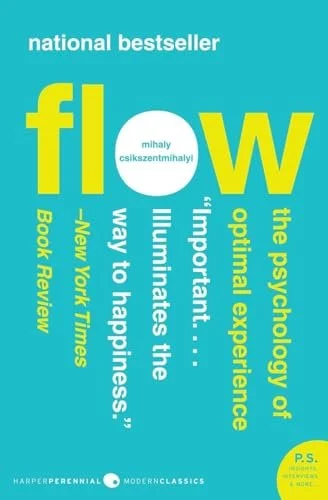
“Csikszentmihalyi arrives at an insight that many of us can intuitively grasp, despite our insistent (and culturally supported) denial of this truth. That is, it is not what happens to us that determines our happiness, but the manner in which we make sense of that reality. . . . The manner in which Csikszentmihalyi integrates research on consciousness, personal psychology and spirituality is illuminating.”
Unlock Peak Performance: The Science of Being "In The Zone"
Have you ever been so completely immersed in a task that the rest of the world seemed to disappear? The chatter of your colleagues faded away, your hunger pangs vanished, and five hours passed in what felt like five minutes. In sports, athletes call this being "in the zone." In creative fields, it’s often described as a "fugue state." But for the rest of us trying to navigate the demands of the modern workplace, it is simply the most productive and satisfying state of mind we can achieve.
We often assume that happiness is a passive state—something that happens to us when we are relaxing on a beach or winning the lottery. We chase external rewards, thinking they are the keys to contentment. However, psychology tells a different story. True satisfaction doesn't come from lounging; it comes from stretching our minds and bodies to their limits in a voluntary effort to accomplish something difficult and worthwhile.
What You'll Learn
The Sweet Spot: How to balance your skills against challenges to eliminate boredom and anxiety.
The Work Paradox: Why you are statistically more likely to be happy at work than during your free time.
The Autotelic Shift: How to transform mundane tasks into deeply rewarding experiences without changing your job description.
The Anatomy of Optimal Experience
In his groundbreaking book, Flow: The Psychology of Optimal Experience, psychologist Mihaly Csikszentmihalyi (pronounced "chick-sent-me-high") argues that the key to a fulfilling life is not the absence of challenges, but the mastery of them. After years of studying people who seemed to get the most out of life—from rock climbers and chess players to surgeons and assembly line workers—he identified a common state of consciousness he called "Flow."
Flow is a state of deep concentration where your thoughts, intentions, and feelings are all aligned. It is the opposite of "psychic entropy," which is that feeling of internal disorder, distraction, or listlessness that plagues us when we don’t know what to do next. When you are in flow, you aren't fighting yourself. Your energy is laser-focused on the task at hand.
Consider a surgeon performing a complex operation. The stakes are incredibly high, but the surgeon isn't panicking. She knows exactly what her hands need to do. Every cut gives her immediate visual feedback. There is no room in her mind for worrying about her mortgage or an argument with a friend. She is entirely integrated with the action. This isn't just "working hard"; it is a state of harmonious efficiency where the ego disappears.
The Challenge-Skill Balance
The central mechanic of flow is the relationship between challenge and skill.
If a task is too difficult for your current skill level, you feel anxious. Imagine being asked to give a keynote speech in a language you only started learning last week. Your brain overloads, and you freeze.
Conversely, if a task is too easy for your skill level, you feel bored. Think of a senior software engineer being asked to manually data-entry numbers into a spreadsheet for eight hours. Their mind wanders, and frustration sets in.
Flow lives in the narrow channel between these two extremes. It happens when high challenges are met with high skills. This dynamic is why flow is a moving target. As you master a task, your skills improve. The activity that used to produce flow now produces boredom. To re-enter flow, you must increase the challenge. This mechanism forces personal growth; to maintain enjoyment, you must keep getting better.
The Paradox of Work and Leisure
One of the most startling findings in Csikszentmihalyi’s research is the paradox of work. Most people claim they want to work less and have more leisure time. We dream of the weekend. Yet, the data shows that people actually experience flow more frequently at work than during their free time.
Why? Because work is structured. It has built-in goals, rules, and feedback loops—the very ingredients required for flow.
In contrast, free time is unstructured. When we finally get that Sunday afternoon with nothing to do, we often succumb to "Sunday Neurosis." Without a clear goal or challenge, our minds drift toward chaos and negative thoughts (psychic entropy). To cope, we turn to passive entertainment like mindless scrolling or watching TV, which Csikszentmihalyi notes provides a temporary distraction but rarely produces the high-quality experience of flow.
I once knew a graphic designer who complained endlessly about his agency job. He insisted he just wanted to quit and "relax." When he finally took a month-long sabbatical, he was miserable within a week. He felt aimless. He only regained his happiness when he started a difficult personal project—restoring a vintage motorcycle. He needed the problem-solving and the clear goals of the restoration to feel alive again. He didn't need rest; he needed a self-directed challenge.
Key Concepts Defined
To help you identify the components necessary for optimal experience, here are the non-negotiables of the flow state.
Clear Goals: You know exactly what you need to do next. There is no ambiguity about the objective.
Immediate Feedback: You know instantly how well you are doing. If you hit a wrong note on the piano, you hear it immediately.
Balance of Challenge and Skill: The task is hard enough to require your full attention but not so hard that it feels impossible.
Action and Awareness Merge: You stop feeling like an observer of your own actions; you become the action.
Distractions are Excluded: The intense concentration filters out irrelevant information, worries, and external noise.
No Fear of Failure: Because you feel in control and your skills match the challenge, the anxiety of failing recedes.
Loss of Self-Consciousness: The "ego" disappears. You aren't worrying about how you look or what others think.
Time Distortion: Clock time becomes irrelevant. Hours fly by, or in some split-second moments, time seems to slow down.
Autotelic Experience: The activity becomes an end in itself. You do it because the doing is rewarding, not just for the paycheck or the praise.
The Autotelic Personality: Creating Order from Chaos
We can't always choose our external circumstances. Sometimes the boss gives us a boring assignment; sometimes the subway breaks down. The difference between someone who is miserable and someone who thrives is often the possession of an autotelic personality (from the Greek auto meaning self, and telos meaning goal).
An autotelic person has the ability to self-generate flow. They don't wait for the environment to provide amusement or structure; they create it.
If an autotelic person is stuck in a waiting room, they might challenge themselves to memorize the pattern of the floor tiles or strike up a conversation to learn something new about a stranger. If they are doing a repetitive task at work, they turn it into a game: Can I do this batch 10% faster than the last one? Can I do it with fewer keystrokes?
By setting their own internal goals and monitoring their own feedback, they transform threats (boredom, waiting, difficult people) into enjoyable challenges. This is the ultimate freedom. If you can control your consciousness to find flow in the mundane, you are no longer dependent on external rewards for your happiness.
Mastering the Flow: A Quick Start Guide
Achieving flow isn't just about luck; it's about engineering your environment and your mindset. Whether you are managing a team or managing your own afternoon, use this checklist to trigger the state.
Define the Micro-Goal: Don't just say, "I need to work on this report." Break it down. "I need to write the introduction and format the first three data tables in the next 45 minutes." Specificity breeds focus.
Establish the Feedback Loop: How will you know if you are succeeding? If the task doesn't give you feedback (like tennis or coding does), create your own. Set a timer. Check off items on a list. Give yourself a metric to beat.
Adjust the Variables:
If you are bored: Increase the challenge. Do it faster. Do it with higher quality. impose a new constraint (e.g., "write this email without using the verb 'to be'").
If you are anxious: Lower the stakes or increase your skill. Break the daunting task into tiny, manageable steps. Ask for help to boost your capability.
Eliminate External Entropy: Flow requires initial energy to get the flywheel spinning. Protect your attention. Turn off notifications. Close the door. It takes about 15 minutes of focus to enter flow; one interruption resets the clock.
Reframe the Motivation: Stop asking, "Why do I have to do this?" and start asking, "What can I master while doing this?" This shifts you from a passive victim of work to an active architect of your experience.
Final Reflections
Flow fundamentally reframes how we view productivity and enjoyment. Csikszentmihalyi teaches us that the best moments in our lives are not the passive, relaxing, receptive times. The best moments occur when our body or mind is stretched to its limits in a voluntary effort to accomplish something difficult and worthwhile.
By understanding the mechanics of flow—specifically the balance between skill and challenge—we can stop waiting for happiness to happen to us and start engineering it into our daily lives. Whether you are coding a website, ironing a shirt, or negotiating a deal, the potential for optimal experience is always present. It requires only clear goals, focused attention, and the willingness to engage fully with the task at hand. Happiness, it turns out, is not a destination; it is a manner of traveling.
Business Floss is reader-supported. When you use our links we may earn an affiliate commission that helps us keep the site running. Thank you for your support!


