
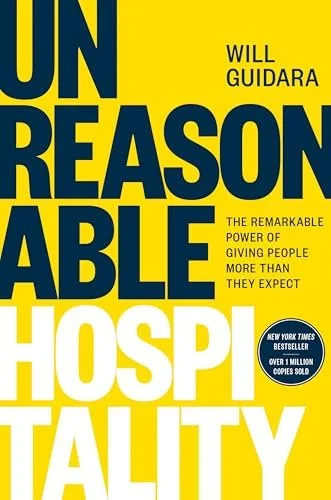
Unreasonable Hospitality
The Remarkable Power of Giving People More Than They Expect
by Will Guidara
“Will not only transformed a restaurant, but challenged our entire idea of service...any organization would benefit from his thinking.”
The Service Revolution: Winning Hearts in a Transactional World
In the modern business landscape, we are obsessed with efficiency. We automate emails, optimize supply chains, and use AI to predict customer behavior. We strive for a frictionless experience, believing that if we can just remove every bump in the road, we will win. But what if we are optimizing for the wrong thing? What if the "friction"—the messy, human, emotional connection—is actually where the value lies?
Will Guidara, the former co-owner of the legendary restaurant Eleven Madison Park (EMP), argues that we have forgotten the difference between service and hospitality. In Unreasonable Hospitality, he details how he took a middling brasserie and transformed it into the #1 restaurant in the world not by serving better food (though the food was excellent), but by loving his customers relentlessly.
Guidara’s thesis is simple but radical: In a world that is becoming increasingly commoditized, the last true competitive advantage is how you make people feel.
What You'll Learn
Service vs. Hospitality: Why "technical excellence" is merely the price of admission, while connection is the winning strategy.
The "Dirty Water Hot Dog" Moment: How a $2 gesture became the defining legend of a world-class brand.
The Rule of 95/5: How to budget for "magic" without bankrupting your business.
One Size Fits One: Moving away from standardized scripts to bespoke experiences.
Making It Cool to Care: How to build a culture where earnestness triumphs over cynicism.
Service is Black and White; Hospitality is Color
Guidara begins by drawing a sharp line between two concepts we often use interchangeably. Service is technical. It is getting the right plate to the right person at the right time. It is a monologue: "We do this to you." Service is competence.
Hospitality, on the other hand, is emotional. It is how the delivery of that plate makes the person feel. It is a dialogue: "We do this with you." Hospitality is connection.
You can have perfect service and still leave a client cold. Think of a robotic customer support agent who technically solves your issue but makes you feel like a ticket number. Conversely, you can have imperfect service—a spilled drink, a delayed shipment—but if handled with genuine warmth and hospitality, that error can actually deepen the customer's loyalty.
Guidara argues that most businesses stop at service. They focus on the "what." The companies that dominate—whether they are selling software, consulting, or sneakers—are the ones that obsess over the "how." They understand that people may forget what you said, and they may forget what you did, but they never forget how you made them feel.
The Legend of the Hot Dog
To understand what "Unreasonable Hospitality" looks like in practice, you have to know the story of the hot dog.
One afternoon, a table of four foodies arrived at Eleven Madison Park for lunch. They were on a culinary tour of New York and were leaving for the airport right after the meal. Guidara, clearing their appetizers, overheard them discussing their trip. They had been to all the top Michelin-starred spots—Per Se, Daniel, Momofuku. But one guest let out a sigh: "I can’t believe we didn't get a dirty water hot dog from a street cart."
Technically, Guidara’s job was to bring them their next course. That is service. But hospitality demanded he listen to the unstated desire.
Guidara ran out of the restaurant, found a hot dog cart, bought a $2 frankfurter, and sprinted back to the kitchen. He asked the chef to plate it. They cut it into four perfect pieces, added a swipe of mustard and some artisanal sauerkraut, and served it as a surprise mid-meal course. "To make sure you didn't leave New York with any culinary regrets," Guidara told them.
The guests didn't just smile; they wept. They said it was the best dish they had in New York. Not the foie gras, not the lobster—the $2 hot dog. Why? Because it proved they were being heard. It wasn't a transaction; it was a gift. That moment cost the restaurant two dollars and five minutes of effort, but it created a story that those customers told for the rest of their lives.
The Business Takeaway: What is the "hot dog" in your industry? It’s rarely the product you sell. It’s the moment you notice a client is stressed and you courier them dinner for their family. It’s the moment you notice a partner is confused and you offer a free training session, not because it’s in the contract, but because it helps.
The Rule of 95/5: Budgeting for Magic
A common criticism of this approach is, "That sounds nice, but we can't afford to buy hot dogs for everyone." Guidara is a businessman, not a charity worker. He explains that unreasonable hospitality is powered by a very reasonable financial discipline, which he calls the Rule of 95/5.
You manage 95% of your business down to the penny. You cut waste, you negotiate with vendors, you optimize labor, and you create rigorous systems for efficiency. You do this specifically so you can afford to spend the last 5% "foolishly."
That 5% is your "magic budget." It is the money set aside for the Dreamweavers (his term for the team members dedicated to creating special moments). If you try to be generous with 100% of your budget, you will go broke. But if you are ruthless with 95%, you earn the right to be extravagant with the 5% that impacts the customer the most.
In a corporate context, this might mean cutting travel costs or office supplies (the 95%) so you have the budget to send a high-value client a rare book they mentioned they wanted (the 5%). The ROI on that 5% is infinitely higher than the ROI on fancy office chairs.
Key Terms at a Glance
Unreasonable Hospitality: The practice of giving people more than they expect—going "over the top" in ways that build deep emotional bonds.
Service vs. Hospitality: Service is "black and white" (competence/technical delivery). Hospitality is "color" (emotion/how you make them feel).
The Rule of 95/5: Manage 95% of your budget with strict discipline so you can spend the remaining 5% on "foolish" gestures of generosity.
One Size Fits One: The rejection of standardized scripts. Tailoring the experience to the specific individual in front of you.
Dreamweavers: Employees or teams specifically tasked with listening for clues and creating bespoke experiences for customers.
Status Quo Bias: The enemy of hospitality. The tendency to defend "how we've always done it" rather than asking "how could we do this better for this person?"
Making It Cool to Care
Implementing this level of care requires a massive cultural shift. In many high-performance environments, there is a tendency toward cynicism. Being "cool" often means being detached, critical, or "above" the work.
Guidara realized that for unreasonable hospitality to work, he had to "make it cool to care." He had to create an environment where earnestness was celebrated, not mocked.
He achieved this through relentless reinforcement and language. When a busboy ran down the street to feed a parking meter for a guest, he was celebrated in the pre-shift meeting as a hero. When a sommelier spent 20 minutes helping a guest who wasn't buying expensive wine, they were praised for their hospitality, not reprimanded for their efficiency.
This also involved redefining communication and criticism. In many companies, feedback is weaponized. At EMP, Guidara instilled the belief that "feedback is a gift." If someone points out a flaw in your service, they aren't attacking you; they are helping you polish the diamond. But this only works if the feedback is delivered with the intent to help, not to assert dominance.
Slow Down to Speed Up
We live in the age of the script. Call centers have scripts; sales teams have playbooks. These exist for efficiency and consistency. But Guidara argues that scripts are the enemy of hospitality because they assume One Size Fits All.
True hospitality is One Size Fits One.
To achieve this, you have to slow down. You have to stop looking at the computer screen, the agenda, or the quota, and look at the human being. Guidara teaches his team to look for "clues."
Is the couple holding hands? (Maybe it's an anniversary).
Is the business executive checking their watch nervously? (They need speed, not a long spiel).
Is the guest reading a book on architecture? (Talk to them about the building's history).
When you slow down enough to spot these clues, you can tailor the experience. This seems inefficient in the moment, but it speeds up the relationship-building process. A client who feels seen trusts you faster, buys more, and forgives mistakes more easily.
Intentionality: The Secret Ingredient
None of this happens by accident. You don't stumble into being the #1 restaurant in the world. It requires extreme intentionality.
Guidara implemented systems to ensure magic wasn't left to chance. They had a "Dreamweaver" position—a person whose sole job during service was to execute the crazy ideas the staff came up with. If a waiter heard a table talking about how they had never seen snow, the Dreamweaver would run out, buy sleds, and arrange a ride to Central Park after dinner.
Your business might not need a full-time Dreamweaver, but it needs a system. Do you have a line item in your weekly meeting agenda for "Client Delight"? Do you have a Slack channel dedicated to sharing personal details you learned about customers? If you don't systemize it, it won't happen.
Quick Start Guide: bringing Hospitality to the Office
You don't need a kitchen to serve unreasonable hospitality. Here is how to apply Guidara’s principles to any business.
The "Listen" Audit:
In your next three meetings, stop thinking about what you will say next. Listen exclusively for personal details or unstated needs. Write them down.
Action: Act on one detail. If they mention they are exhausted from moving houses, send them a pizza voucher for dinner so they don't have to cook.
The 5% Experiment:
Look at your budget. Where are you bleeding money on things customers don't care about? (Expensive brochures? Generic holiday cards?).
Action: Reallocate that money into a "Magic Fund" for personalized gifts or gestures.
Ditch the Script:
Identify one area where your team relies on a rigid script (the intro email, the sales pitch, the support ticket response).
Action: Rewrite it to include a prompt for personalization. "Before we start, I noticed X about your company..."
Celebrate the "Busboy":
Find someone on your team who did something kind that wasn't in their job description.
Action: Publicly praise them for it. Send the signal that kindness is a KPI.
Create a "Dreamweaver" Moment:
Pick one loyal client. Brainstorm something "unreasonable" you could do for them. Not a discount—a gesture.
Action: Execute it.
Final Reflections
Unreasonable Hospitality is a compelling reminder that business is, at its core, a human pursuit. Will Guidara proves that you don't have to choose between being profitable and being kind; in fact, being relentlessly kind is the most profitable strategy of all. By mastering the distinction between service and hospitality, budgeting for magic, and treating every interaction as a chance to create a memory, you can turn customers into evangelists. In a world of automated transactions, the company that offers genuine human connection will always win.
Business Floss is reader-supported. When you use our links we may earn an affiliate commission that helps us keep the site running. Thank you for your support!


