
The Private Equity Playbook
Management’s Guide to Working with Private Equity
by Adam Coffey
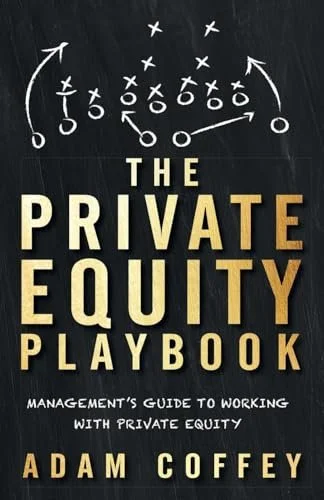
“CEO Adam Coffey has almost twenty years of experience building businesses for private equity companies. In this authoritative yet approachable handbook, he covers:
· The history and landscape of private equity
· Ground rules for finding the right firm to partner with
· Techniques for navigating the new governance
· Strategies for continued growth in the private equity space
· And more”
The Wealth Multiplier: How to Win the Private Equity Game
For decades, Private Equity (PE) has suffered from a PR problem. The popular narrative—fueled by movies like Wall Street and headlines about leveraged buyouts—paints PE firms as "barbarians at the gate." The stereotype suggests they are ruthless asset strippers who swoop in, fire half the staff, load the company with debt, and sell it for parts.
If you are a CEO or founder approached by a PE firm, your instinct might be to run. But Adam Coffey, a three-time CEO who has built and sold multiple companies for billions in exits, argues that this fear is costing you a fortune. In The Private Equity Playbook, Coffey flips the script. He reveals that for the savvy entrepreneur, Private Equity is not a predator to be avoided, but a powerful engine for wealth creation—if you know how to drive it.
The book is an insider’s manual to the opaque world of institutional capital. Coffey strips away the jargon to explain how PE funds actually work, what they look for, and most importantly, how a founder can structure a deal that pays them not just once, but two or three times. This is a guide for moving from being a business owner to being a partner in your own exponential growth.
What You'll Learn
The "Three Bites of the Apple": How to structure a deal so you get paid upon entry, during the hold period, and at the final exit, potentially tripling your total wealth.
The PE Lifecycle: Understanding how funds are raised and why the "clock" starts ticking the moment they buy you.
Adjusted EBITDA: The secret language of valuation and how to legitimize "add-backs" to increase your sale price.
The " Rollover" Math: Why keeping skin in the game (rolling equity) is usually the smartest investment you will ever make.
Life After the Deal: How the pace, reporting, and governance of your company will shift immediately after closing.
The Mechanics of the Money Machine
To win against Private Equity, you first have to understand the pressures they are under. Coffey explains that a PE firm is essentially a temporary holding tank for money. They raise capital from Limited Partners (LPs)—pension funds, endowments, wealthy families—with a promise to return it with interest in a specific timeframe, usually 10 years.
This creates a "use it or lose it" dynamic. PE firms are sitting on "dry powder" (unspent cash) that burns a hole in their pocket. If they don't deploy it, they can't make returns. This means they need to buy great companies just as much as you might want to sell one.
Understanding this timeframe is critical. When a PE firm buys your company, they aren't looking to hold it forever. They are looking to grow it aggressively and sell it within 3 to 5 years (the "hold period"). You aren't just selling a business; you are signing up for a sprint. If you aren't ready to run fast, don't take the check.
The "Second Bite": The Math That Changes Everything
The most compelling concept in the book is the "Three Bites of the Apple." Most entrepreneurs think of selling their business as a one-time event: You sell 100%, take the cash, and sail into the sunset. Coffey argues this is often a mistake.
Instead, the "Playbook" strategy involves selling a majority stake (say, 70%) while "rolling over" the remaining 30% into the new entity.
Bite #1: You get a massive cash payout up front (70% of your value), taking risk off the table and securing your family's future.
Bite #2: You stay on as CEO (or a board member) and partner with the PE firm to supercharge growth using their capital and expertise. Because PE firms aim for a "3x return" on their equity, your rolled 30% grows alongside theirs. When the PE firm sells the company 5 years later, your minority stake might be worth more than your original majority sale.
Bite #3: You roll a portion again into the next buyer's deal.
The Micro-Story: Consider "Jim," a founder of an HVAC company. He could sell 100% today for $10 million. He walks away rich. Or, he follows Coffey's playbook. He sells 70% for $7 million and rolls $3 million (30%) into the deal. The PE firm helps him acquire three smaller competitors. Five years later, the company sells for triple the value. Jim's $3 million stake is now worth $9 million. He has now made $16 million total ($7m + $9m), rather than the original $10 million. And he still has a job he loves. That is the power of the Second Bite.
Clean Your House: The Art of Adjusted EBITDA
Valuation in private equity is almost always a multiple of EBITDA (Earnings Before Interest, Taxes, Depreciation, and Amortization). But as Coffey points out, not all EBITDA is created equal.
The battleground of any deal is "Adjusted EBITDA." This is the process of adding back expenses that won't exist after the sale.
Are you running personal expenses through the business (country club dues, a company car for your spouse)?
is your salary above market rate?
Did you have a one-time legal settlement?
A "unsophisticated" seller shows their tax returns, which are designed to minimize profit to lower taxes. A "sophisticated" seller presents an Adjusted EBITDA schedule that proves the true earning power of the business. Every dollar you can legitimately "add back" to your bottom line gets multiplied by the valuation multiple. If your business sells for a 10x multiple, finding $100,000 in personal expenses to add back puts an extra $1 million in your pocket.
Key Terms at a Glance
Dry Powder: Cash reserves that a PE firm has raised from investors but has not yet deployed into an investment. They are under pressure to spend this.
Rollover Equity: The portion of the sale proceeds that the seller reinvests into the new company, aligning their interests with the PE firm.
The Multiple: The metric used to value a company, usually expressed as "X times EBITDA." (e.g., A company with $2M EBITDA sold at a 6x multiple is worth $12M).
Platform Company: A large, initial acquisition by a PE firm that serves as a foundation. They will then buy smaller "add-on" companies to merge into the platform.
LOI (Letter of Intent): The formal document outlining the terms of the deal. While the price is stated here, it is non-binding and subject to due diligence.
Carried Interest ("Carry"): The share of profits that the PE managers receive as compensation (usually 20% of gains), incentivizing them to maximize the exit value.
Dating the Money: Finding the Right Partner
Not all money is green. Coffey stresses that signing a deal with a PE firm is like a marriage—one that you cannot easily divorce. If you pick the wrong partner, your life will be miserable, regardless of the check size.
You need to diligence them just as hard as they diligence you.
Fund Lifecycle: Ask them where they are in their fund's life. If they are in Year 8 of a 10-year fund, they will force a sale in two years, regardless of whether it's good for the company. You want a fund that is fresh (Years 1-3) so you have time to execute your strategy.
The Operating Partner: Who will actually be sitting on your board? Is it the smooth-talking senior partner you met at dinner, or a 28-year-old MBA associate who has never run a business? You want operational empathy, not just spreadsheet wizardry.
Cultural Fit: Do they respect your legacy? If you care about your employees, avoid firms with a track record of slashing headcount to boost short-term margins.
Life in the Fast Lane
Once the wire transfer hits your account, the atmosphere changes. Coffey warns that the "mom and pop" days are over. You are now an institutional-grade company.
The Pace: Everything accelerates. Decisions that used to take months now happen in days.
Reporting: You can no longer run the business by "gut feel." You will need monthly board packages, clear KPIs, and rigorous financial reporting.
Governance: You still run the company, but you report to a Board of Directors. You have lost absolute autonomy, but you have gained a "brain trust."
Coffey advises viewing this not as a burden, but as professionalization. The rigorous discipline PE firms impose is exactly what allows the company to scale from $10 million to $100 million. They bring the systems, the recruiting power, and the M&A (Mergers and Acquisitions) expertise that you likely lack.
The Exit Strategy
The book concludes by reminding readers that every PE deal is built with the end in mind. From Day 1, the board is asking, "Who is the next buyer?"
You aren't building a legacy to hand down to your grandkids; you are building a transferable asset. This clarity of purpose can be liberating. It forces you to build a business that is independent of you. If the business relies on your personal relationships to survive, it isn't sellable. The ultimate goal of the "Playbook" is to professionalize the business so successfully that it outgrows you, allowing you to eventually exit with generational wealth.
Quick Start Guide: The Pre-Sale Checklist
If you are considering a PE deal in the next 12-24 months, start here.
Normalize Your Financials: Stop managing for tax minimization and start managing for profit maximization. Hire a CFO or a consultant to produce a "Quality of Earnings" report before the buyer asks for one.
Identify Your "Add-Backs": Create a detailed spreadsheet of every personal or one-time expense running through the business. Be aggressive but defensible.
Build Your "Data Room": Organize your contracts, employee agreements, IP filings, and leases. When a buyer asks for documents, having them ready in 24 hours signals competence and increases leverage.
Audit Your Team: Do you have the leadership team to double the company's size? If not, start upgrading talent now. PE firms buy management teams as much as they buy products.
Know Your Number: Determine your "walk-away" number (net of taxes and fees) and your "rollover" tolerance. Don't negotiate in a vacuum.
Final Reflections
The Private Equity Playbook is a demystifying force. Adam Coffey takes the terrifying specter of the "corporate raider" and replaces it with the image of a strategic partner. He teaches that in the high-stakes game of private equity, the house doesn't always have to win—or rather, that you can become part of the house. By understanding the motivations of the buyer, meticulously preparing your financials, and structuring a deal that allows for a "second bite of the apple," you can turn a life's work into a multi-generational fortune. The key is to stop thinking like an employee of your business and start thinking like an investor in it.
Business Floss is reader-supported. When you use our links we may earn an affiliate commission that helps us keep the site running. Thank you for your support!


