
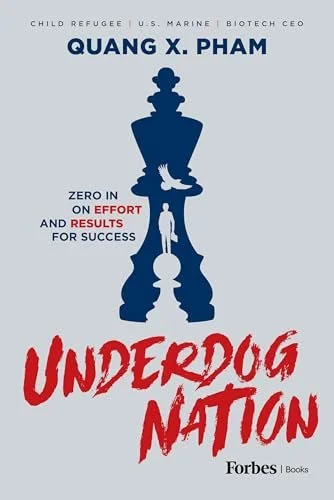
Underdog Nation
Zero In On Effort and Results For Success
by Quang X. Pham
“Quang X. Pham’s Underdog Nation is packed with wisdom, rare lessons on resilience and personal growth, and what it means to have and pursue a purpose... Delivered in gorgeous prose, this rollicking memoir is an exciting journey that will inspire readers...”
Lead From the Front: How Underdogs Win Wars and Markets
In the sanitized world of modern corporate strategy, leadership is often discussed in abstract, clean terms. We talk about "synergies," "30,000-foot views," and "stakeholder alignment" in air-conditioned boardrooms. But real leadership—the kind that rallies a team when a product launch fails or a competitor slashes prices—is rarely clean. It is gritty, immediate, and human.
Most business books are written by academics who study leaders, or by CEOs who have long since forgotten what the front lines feel like. Underdog Nation is different. Written by Quang X. Pham, a refugee who became a U.S. Marine combat pilot and then a successful tech entrepreneur, this book bridges the gap between the chaotic fog of war and the turbulence of the marketplace.
Pham challenges the pervasive notion that leadership is about privilege or hierarchy. Instead, he argues that in a world dominated by massive, slow-moving corporate giants, the "underdog" mentality is your greatest competitive weapon. But to wield it, you have to stop managing from the rear and start leading from the front.
What You'll Learn
The "30-Second Complain-and-Fix" Rule: A tactical method to instantly convert team negativity into proactive problem-solving.
The "Fire Team" Structure: How to dismantle bloated committees and replace them with agile, four-person units that actually ship products.
Officers Eat Last: The psychological power of shared hardship in building loyalty.
Calculated Courage: How to make high-stakes decisions with only 70% of the information (and why waiting for 100% is fatal).
The Underdog Advantage: Why lacking resources is often the very constraint that forces the innovation necessary to win.
The Underdog Advantage: Why Size Is a Liability
We often look at industry giants—the Googles, the Walmarts, the established competitors—with a sense of envy. They have the capital, the brand recognition, and the armies of staff. But Pham flips this perspective on its head. In both warfare and business, size creates sluggishness. Large organizations become risk-averse; they are obsessed with protecting what they have rather than conquering new ground.
This is where the "Underdog" identity shines. An underdog has nothing to lose and everything to prove. This creates a culture of urgency and resourcefulness that incumbents simply cannot replicate.
Consider the story of a small logistics startup competing against FedEx and UPS. While the giants had fleets of planes, they also had rigid protocols that made same-day changes nearly impossible. The startup, embracing its underdog status, allowed drivers to route their own deliveries based on real-time traffic apps on their personal phones. They didn't have the "system," but they had the speed. They won contracts not by being bigger, but by being an agile nuisance that the giants couldn't swat fast enough. Pham argues that you must protect this underdog spirit at all costs, even as you grow. The moment you start feeling "safe" is the moment you start losing.
The "Eat Last" Doctrine: Building Unshakeable Trust
The central metaphor of Pham’s philosophy is the distinction between "managing from the rear" and "leading from the front." In many corporate structures, the higher you climb, the further you get from the actual work. You get the corner office, the reserved parking spot, and the filtered reports.
In the Marine Corps, this is anathema. Officers eat last. If there is a shortage of food, the privates eat, and the colonel goes hungry. If the troops are sleeping in the mud, the commander isn't sleeping in a hotel; they are in the mud with them.
This isn't just a moral nicety; it is a tactical necessity. When a team sees their leader sharing their risks and hardships, it builds a reservoir of trust that can be drawn upon when things get tough.
A Tale of Two Managers I once worked with a creative director, "Sarah," during a grueling rebranding project. We were weeks behind schedule and working weekends. Sarah didn't just approve designs; she learned how to use the new software so she could help export files at 2:00 AM on a Sunday. She ordered the pizza, she brewed the coffee, and she stayed until the last person left.
Contrast that with a VP at a different firm who, during a similar crunch time, sent "motivational" emails from his vacation home in Aspen. When the project hit a snag, the team under Sarah rallied and fixed it for her. The team under the Aspen VP let the project burn, feeling no loyalty to a leader who wasn't in the trench with them. Leading from the front isn't about doing everyone's job for them; it's about showing that no job is beneath you.
Culture Hacking: The 30-Second Complain-and-Fix Rule
One of the most corrosive elements in any business is the culture of complaint. It starts small—gossip by the water cooler, eye-rolling in meetings—but it eventually calcifies into cynicism. However, enforced positivity is just as bad; it blinds leadership to real problems.
Pham offers a brilliant, battle-tested compromise: The 30-Second Complain-and-Fix Rule.
In his units, Marines were allowed to complain about anything—the food, the orders, the equipment—but only for 30 seconds. The moment the timer ran out, they were required to propose a solution.
This rule rewires the brain. It validates the emotion (frustration) but immediately channels that energy into cognitive processing (problem-solving).
Without the rule: "Marketing never gives us good leads. It’s impossible to hit quota." (End of discussion. Result: Resentment).
With the rule: "Marketing leads are weak (10 seconds)... My proposal is we have a weekly calibration meeting where sales reps grade the leads so marketing knows which ones to target." (Result: Action).
Implementing this rule transforms your team from a group of passive critics into a group of active owners.
Structure for Speed: The Fire Team Concept
How do you maintain the speed of a startup when you have 500 employees? You stop organizing by departments and start organizing by missions.
Pham advocates for the Fire Team model. In the Marines, a fire team is the smallest tactical unit—usually four people. They train together, eat together, and fight together. They are given a clear objective (e.g., "Secure that hill") and the autonomy to figure out how to do it.
In business, we tend to do the opposite. We form massive committees where accountability goes to die. A "Fire Team" in a corporate context might look like this: instead of passing a product launch from Product to Engineering to Marketing in a linear assembly line, you form a dedicated unit. You take one developer, one designer, one marketer, and one data analyst. You tell them, "Your mission is to launch Feature X by November. You have full autonomy."
Because the group is small, communication is instant. There are no "meetings to plan meetings." Peer accountability is high—there is nowhere to hide in a four-person team. This is how underdogs outmaneuver giants: they break the war down into small, winnable battles fought by small, empowered teams.
Core Concepts Defined
Leading From the Front: A leadership style where the leader is visible, accessible, and shares the physical and emotional burdens of the team. It is the opposite of "ivory tower" management.
The Fire Team: The smallest effective unit of operation (typically 3-4 people). It relies on decentralized command, meaning the team has the authority to make decisions without constantly checking with headquarters.
Calculated Courage: The ability to act decisively with incomplete intelligence. It distinguishes between "gambling" (acting without data) and "leading" (acting with the best available data to maintain momentum).
The "Eat Last" Principle: A servant-leadership habit where leaders prioritize the team's needs (resources, credit, rest) above their own to establish moral authority.
30-Second Rule: A communication protocol where complaints are permitted only if immediately followed by a proposed solution.
Calculated Courage: Deciding in the Fog of War
In combat, you never have 100% of the information. If you wait until you know exactly where every enemy combatant is, you will be dead. You have to learn to operate with 70% certainty.
Pham calls this Calculated Courage. In business, we often suffer from "analysis paralysis." We commission another study, we wait for Q4 data, we delay the launch. We tell ourselves we are being prudent, but often we are just being cowardly.
Calculated courage is about assessing the risk, mitigating the downside, and then moving. It is understanding that a good decision executed violently today is better than a perfect decision executed next week.
A CEO I know had to decide whether to pivot her software company to a new industry. The data was murky. Half the board was skeptical. But she knew that if they stayed in their current market, they would slowly bleed out. She didn't have proof, but she had conviction and enough data to see a trend. She made the call. It was terrifying, but it saved the company. As Pham notes, your team will forgive you for being wrong; they won't forgive you for being indecisive.
Quick Start Guide: The 30-Day Boot Camp
You don't need a uniform to apply these tactics. Here is how to operationalize Underdog Nation this month.
Week 1: The Audit (Get Out of the Office)
Cancel two internal status meetings.
Spend that time on the "front lines." If you are in software, answer customer support tickets. If you are in retail, work the register.
Goal: Identify one "pebble in the shoe" that frustrates your team daily that you didn't know about.
Week 2: The Protocol (30-Second Rule)
Introduce the 30-Second Complain-and-Fix rule at your all-hands meeting.
Action: The next time someone vents, gently interrupt: "I hear you, and that sounds frustrating. You have 15 seconds left—what is the fix?"
Week 3: The Deployment (Form a Fire Team)
Take one stalled project.
Strip the team down to 3 or 4 essential people.
Give them a hard deadline and removing one layer of approval they usually require.
Goal: Prove that speed comes from autonomy.
Week 4: The Sacrifice (Eat Last)
Identify a "win" the company achieved recently.
Write an email or give a speech praising the specific individuals who did the work. Do not mention your own contribution.
Action: If there is a late night or a crisis this week, be the last one to leave the building.
Final Reflections
Underdog Nation reminds us that the comfortable path is rarely the winning path. Quang X. Pham strips away the veneer of corporate politeness to reveal that business, like combat, is ultimately a contest of wills. It is won by those who are faster, more resilient, and more cohesive.
The book serves as a wake-up call for any leader who has become too comfortable. It demands that you leave the safety of the rear guard, walk to the front, and show your team that you are willing to fight for them. When you embrace the underdog spirit—that hunger, that agility, that refusal to accept the status quo—you don't just survive the battle; you change the map.
Business Floss is reader-supported. When you use our links we may earn an affiliate commission that helps us keep the site running. Thank you for your support!


