
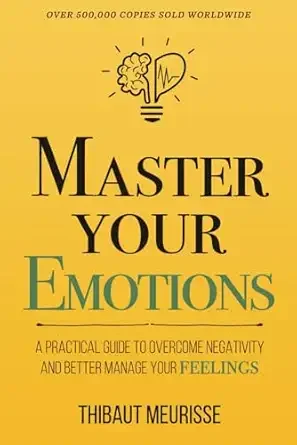
Master Your Emotions
A Practical Guide to Overcome Negativity and Better Manage Your Feelings
by Thibaut Meurisse
The 60-Second Take
In Master Your Emotions, personal development author Thibaut Meurisse provides a straightforward manual for untangling your identity from your feelings. He explains how our evolutionary survival mechanisms create a natural bias toward negativity, and how our ego traps us in destructive emotional loops. By learning to reframe your interpretations, manage your physical state, and view feelings as temporary data, you can build true emotional resilience.
You Are Not Your Feelings
We tend to treat our emotions like the weather. We wake up, look at the internal forecast, and resign ourselves to whatever storms happen to be passing through. If we feel anxious, we assume it is going to be an anxious day. If we feel irritable, we warn everyone around us to keep their distance. We view our feelings as uncontrollable forces of nature.
Thibaut Meurisse strongly disagrees with this passive approach. In Master Your Emotions, he argues that while you cannot stop feelings from arising, you absolutely have the power to dictate how long they stay and how much damage they do. The book strips away the mysticism surrounding mental health and treats emotional regulation as a highly mechanical, learnable skill. Meurisse breaks down exactly why our brains naturally default to negativity, how our egos manufacture unnecessary misery, and how we can use our physical bodies and our conscious thoughts to systematically change our emotional state.
What You'll Learn
Why your brain naturally defaults to expecting the worst
The difference between experiencing a feeling and absorbing it into your identity
How your ego manufactures unnecessary suffering by attaching to beliefs
The step-by-step cognitive formula of how emotions are actually formed
Tactical ways to alter your mental state through posture, sleep, and environment
How to decode the hidden messages behind envy, resentment, and fear
Your Brain Is Wired for Survival, Not Happiness
Meurisse asks a fundamental question: why is it so incredibly easy to feel miserable, and so difficult to stay consistently happy? The answer is not that you are broken. The answer is evolutionary biology. For hundreds of thousands of years, the human brain had one primary directive: keep you alive until you could reproduce. It did not care if you were joyful, peaceful, or fulfilled. It only cared if you noticed the predator hiding in the bushes.
Because of this ancient programming, we are hardwired with a negativity bias. Our brains act like Velcro for bad experiences and Teflon for good ones. If you receive ten glowing performance reviews at work and one slightly critical comment, your brain will completely ignore the praise and obsess over the criticism. The criticism represents a threat to your social standing, and to your ancient brain, social isolation meant death. Once you understand that your brain is actively searching for negativity as a survival mechanism, you can stop feeling guilty for having bad thoughts. You simply recognize the bias and intentionally override it.
Meet Your Ego: The Identity Trap
The deepest source of our emotional suffering is the ego. Meurisse does not use the word "ego" to mean arrogance or pride. He defines it as your identity—the story you tell yourself about who you are. Your ego desperately needs to exist, so it attaches itself to external things: your job, your political beliefs, your car, your relationships. When someone insults your favorite sports team, you get furiously angry because your ego has attached your personal identity to that team. An attack on the team feels like a literal attack on your existence.
Crucially, the ego also attaches itself to emotions. When we feel sadness, the ego grabs it and declares, "I am a sad person." We absorb the feeling into our identity. The critical step in emotional mastery is detachment. You have to realize that you are not your emotions. You are the consciousness observing the emotions. Anger, fear, and sadness are just clouds passing through the sky. You are the sky. When you separate your identity from the temporary feeling, the feeling instantly loses its overwhelming power.
The Formula: How Emotions Are Formed
We generally believe that external events cause our emotions. If someone cuts you off in traffic, they made you angry. Meurisse points out that this is entirely false. Between the event and the emotion lies a critical, invisible step: your interpretation.
The formula is straightforward: Event + Interpretation = Emotion.
The event itself is entirely neutral. A car swerved in front of you. That is a fact. But if your interpretation is, "This person is a reckless jerk who disrespected me," you will instantly feel rage. If your interpretation is, "That person must be having a terrible emergency and rushing to the hospital," you will feel mild annoyance or even empathy. The exact same event produces two completely different emotions based solely on how you frame it. You cannot always control the events in your life, but you have absolute control over your interpretation. By challenging the automatic stories you tell yourself, you short-circuit negative emotional loops before they even begin.
Hacking Your State: Physiology and Environment
Emotions do not exist purely in the mind; they are deeply physiological. You cannot think your way out of a negative emotion if your body is exhausted. Meurisse places heavy emphasis on the physical foundations of mood management.
If you are sleeping four hours a night, your emotional baseline is severely compromised. Lack of sleep mimics the symptoms of clinical depression and anxiety. Before you try to psychoanalyze your sadness, you need to ensure you are well-rested. Similarly, your physical posture dictates your feelings. If you slump your shoulders, look down, and breathe shallowly, your brain receives the chemical signals for depression. If you stand up straight, pull your shoulders back, and take deep, slow breaths, you force your nervous system to calm down.
Your environment also acts as an emotional incubator. The media you consume, the people you spend time with, and the words you use dictate your reality. If you constantly use catastrophic language—saying "This is a complete disaster" instead of "This is a minor setback"—you are actively conditioning your brain to panic. Limit your exposure to the daily news cycle, which is engineered to trigger your survival mechanism, and surround yourself with inputs that foster peace.
Using Negative Emotions as a Compass
We spend massive amounts of energy trying to avoid negative emotions. We numb them with scrolling, alcohol, or shopping. But negative emotions are not your enemy. They are a compass. They are simply internal signals telling you that something in your life requires your attention.
When you feel resentment, it is usually a signal that you have failed to set proper boundaries and are letting people take advantage of you. When you feel envy, it is not a sign that you are a bad person; it is a highly accurate indicator of what you truly desire but are too afraid to pursue. When you feel fear, it often points directly toward the exact challenge you need to face in order to grow. Instead of running from these feelings, Meurisse advises sitting with them, identifying the root cause, and asking what action they are prompting you to take. When you view emotions as data rather than as punishment, they become a tool for personal growth.
Master Your Emotions at a Glance
The Survival Mechanism. Your brain is hardwired to prioritize threats over rewards, creating a natural bias toward the negative.
The Ego. The fabricated identity that attaches itself to external objects and internal feelings, causing pain when threatened.
The Observer. The realization that you are not your emotions; you are the consciousness watching them pass by.
The Emotion Formula. A neutral event paired with your subjective interpretation creates your emotional response.
Physiological Baseline. Your physical posture, sleep habits, and breathing directly dictate your capacity for emotional resilience.
A Quick Start Guide to Emotional Control
Name the emotion without owning it. Instead of saying "I am angry," say "I am experiencing anger." This slight shift in language creates immediate detachment.
Challenge your interpretation. When you feel a sudden negative emotion, pause and ask yourself what story you just invented about the event.
Change your posture and breathing. If you feel anxious or depressed, physically force your shoulders back, look up, and take five slow, deep breaths.
Kill the negative loop with movement. You cannot always out-think a bad mood. Go for a brisk walk or do some pushups to change your physical chemistry.
Ask what the feeling is trying to tell you. Instead of running from envy or resentment, ask yourself what boundary you need to set or what goal you need to pursue.
Who Should Read Master Your Emotions (and Who Can Skip It)
Read it if you feel completely at the mercy of your moods and want a highly practical, step-by-step system for regaining control of your daily reactions.
Read it if you are a chronic overthinker who constantly assumes the worst-case scenario in professional or personal situations.
Read it if you liked the spiritual detachment concepts of Eckhart Tolle's The Power of Now but want them applied in a more tactical, everyday framework.
Skip it if you are looking for deeply clinical, academic neuroscience. This book relies heavily on broad psychological principles and self-help philosophy rather than dense medical data.
Skip it if you need treatment for clinical depression or severe trauma. This is a manual for daily mood management and mild negativity, not a substitute for professional therapy.
Final Reflections
Master Your Emotions succeeds entirely because of its simplicity. Thibaut Meurisse does not attempt to reinvent psychology; instead, he takes established concepts like cognitive reframing, evolutionary biology, and mindfulness, and strips them of all their academic jargon. The result is a highly readable, incredibly tactical manual. While the text can occasionally feel a bit repetitive, that repetition acts as necessary conditioning for the reader. The book's most profound contribution is shifting the reader's perspective from victimhood to ownership. It forces you to accept that while you cannot control the world around you, your internal weather is entirely yours to command.
The Bottom Line
You are the observer of your emotions, not the victim of them; by changing your physical state and challenging the stories you tell yourself, you can strip negativity of its power.
Frequently Asked Questions
What is the main premise of Master Your Emotions? The core idea is that emotions are temporary physical experiences driven by how we interpret the world, not permanent traits of our identity. Because our brains are wired to focus on negativity for survival, we must actively use our thoughts, physiology, and environment to condition ourselves for positive emotions.
How does the ego affect our emotions? The ego is our fabricated sense of identity. It constantly seeks validation and attaches itself to things, beliefs, and even feelings. When those things are threatened, the ego generates massive negative emotions to protect itself. Detaching from the ego is the key to emotional peace.
Can you actually control your emotions? You cannot always stop an initial emotion from flaring up, but you can absolutely control how long it lasts and how intensely you feel it. Meurisse argues that you do this by changing the interpretation of the event that caused it, or by changing your physical state through sleep, breathing, and movement.
Business Floss is reader-supported. When you use our links we may earn an affiliate commission that helps us keep the site running. Thank you for your support!


