
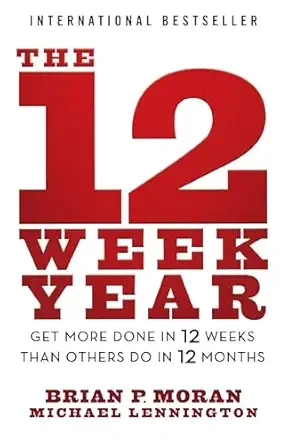
The 12 Week Year
Get More Done in 12 Weeks than Others Do in 12 Months
by Brian P. Moran and Michael Lennington
The 60-Second Take
In The 12 Week Year, Brian P. Moran and Michael Lennington expose the fatal flaw of annualized thinking. They argue that twelve-month goals breed complacency, causing us to delay the actual work until December. By redefining a year as just twelve weeks, the authors provide a rigorous execution system that manufactures constant urgency, replacing vague resolutions with ruthless weekly tracking, predictable routines, and measurable daily actions.
The Illusion of Plenty of Time
Every December, businesses experience a massive spike in productivity. Sales reps close deals they have been chasing for months, teams stay late to finish delayed projects, and executives aggressively push to hit their annual numbers. It is a frantic, exhausting sprint. Brian P. Moran and Michael Lennington watched this happen across countless organizations and asked a simple question: why does the sprint only happen in December?
The answer is annualized thinking. We are culturally conditioned to set goals on a twelve-month cycle. When your deadline is a full year away, your brain naturally assumes there is plenty of time to catch up later. A bad week in February feels harmless because you still have ten months to fix it. In The 12 Week Year, the authors argue that this mindset is the primary enemy of execution. To actually accomplish your goals, you have to kill the annual cycle and compress your timeline.
What You'll Learn
The hidden danger of annualized thinking and how it breeds complacency
Why consistent execution is more important than a flawless strategy
How to build a compelling vision that dictates your daily behavior
The mechanics of calculating a weekly execution score
How to use Strategic, Buffer, and Breakout blocks to control your calendar
Killing Annualized Thinking
The core premise of the book is a radical redefinition of the calendar. You must stop thinking in terms of 365 days. Instead, a year is exactly twelve weeks long. There are no seasons, and there is no "next quarter." When a year is only twelve weeks, every single week is the equivalent of a month. Every day is magnified.
This compression completely alters your relationship with time. If you have a bad week under an annualized system, it is a minor blip. If you have a bad week in a 12-week year, you have just blown an entire month of your timeline. You cannot afford to put off difficult tasks until tomorrow. This manufactured urgency forces you to abandon vague, theoretical planning and focus entirely on immediate execution. The authors argue that most people do not lack knowledge or strategy; they lack the discipline to execute the things they already know they should be doing.
Vision and the Weekly Plan
Execution without a target is just exhausting yourself for no reason. The 12-week system requires a highly specific, compelling vision. You must define exactly what you want your life and business to look like three years from now, and then distill that down into the specific outcomes you need to achieve in the next twelve weeks.
Once the 12-week goals are set, you do not look at them every day. Instead, you break them down into a weekly plan. A weekly plan is not a traditional to-do list, which is usually a dumping ground for every random thought and minor chore that crosses your mind. A weekly plan contains only the critical, strategic tactics required to hit your 12-week goals. If a task does not directly contribute to the 12-week target, it does not belong on the plan. This forces you to separate the truly important work from the merely urgent noise.
Keeping Score on Your Execution
We naturally want to measure our results: revenue earned, pounds lost, or books written. These are lagging indicators. By the time you measure them, the performance that created them is already in the past, and you cannot change it.
Moran and Lennington insist that you must shift your focus to leading indicators, which track your actual behavior. In the 12-week system, you do this by keeping a weekly execution score. At the end of the week, you look at your weekly plan and calculate the percentage of tactics you successfully completed. If you planned ten specific actions and completed eight, your execution score is 80 percent.
The authors found that if you successfully execute 85 percent of your weekly tactics, you will almost certainly achieve your 12-week goal. The execution score removes emotion and ego from the process. You are no longer guessing if you had a "good week." You have a cold, objective percentage staring back at you, forcing absolute accountability.
Taking Back Control of Your Time
You cannot execute a highly focused weekly plan if your calendar is dictated by the constant interruptions of other people. The authors introduce a time-blocking system to protect your attention, built around three specific types of blocks.
The first is the Strategic Block: three uninterrupted hours scheduled early in the week, entirely dedicated to your most important 12-week tasks. You accept no calls, check no emails, and allow no visitors. The second is the Buffer Block: thirty to sixty minutes scheduled once or twice a day to handle low-value, urgent tasks like responding to emails and returning calls. By grouping these together, you prevent them from bleeding into your strategic time. The third is the Breakout Block: three hours completely away from work to rest and recharge, ensuring you do not burn out during the 12-week sprint.
The 12 Week Year at a Glance
Annualized thinking. The flawed belief that twelve months provides plenty of time to achieve a goal, which inevitably leads to procrastination.
The 12-week cycle. Treating a 12-week period as a full year, where every week equals a month, creating a permanent sense of urgency.
The weekly plan. A rigid list containing only the strategic tactics required to hit your immediate 12-week goals, distinct from a general to-do list.
The execution score. A weekly, objective percentage measuring how many of your planned tactics you actually completed.
Lagging vs. leading indicators. Lagging indicators measure past results; leading indicators measure current behaviors you actually control.
Time blocking. Protecting your calendar using Strategic blocks (deep work), Buffer blocks (email and admin), and Breakout blocks (rest).
A Quick Start Guide to Compressing Your Goals
Draft a 12-week target. Pick one to three major goals you want to accomplish in the next twelve weeks. Ignore the rest of the calendar year.
Write the tactics. Break those goals down into the specific, measurable actions you must take every single week to hit the target.
Build the weekly plan. Every Friday afternoon, plan the tactics for the upcoming week. Do not wait until Monday morning to figure out what you are doing.
Track your execution score. At the end of the week, divide your completed tactics by your total planned tactics. Aim for an execution score of at least 85 percent.
Schedule a Strategic Block. Block off a continuous three-hour window on your calendar next week. Turn off all notifications and work exclusively on your most difficult weekly tactic.
Who Should Read The 12 Week Year (and Who Can Skip It)
Read it if you have a habit of setting ambitious New Year's resolutions in January and completely forgetting them by March.
Read it if you are a freelancer, entrepreneur, or salesperson whose income depends entirely on your ability to self-manage and execute consistently.
Read it if you feel incredibly busy all day but reach Friday realizing you accomplished nothing strategically important.
Skip it if you work in a highly reactive, heavily bureaucratic role where your daily schedule is entirely dictated by superiors and you have zero autonomy over your tasks.
Skip it if you are looking for abstract philosophical advice on finding your life's passion. This is a rigid, tactical manual for getting work done.
Final Reflections
The 12 Week Year is essentially a book about confronting your own excuses. Brian P. Moran and Michael Lennington strip away the comforting illusion that we have plenty of time. Their system is demanding, and the concept of scoring your own execution every single week requires a level of brutal honesty that many people will find uncomfortable. However, that discomfort is exactly why it works. It forces you to stop hiding behind long-term planning and face the reality of your daily behavior. While the text occasionally repeats its core premise, the methodology is sound, scalable, and impossible to argue with: if you control the days, the year takes care of itself.
The Bottom Line
Treating your goals as a twelve-month marathon breeds procrastination, but compressing your timeline into a twelve-week sprint manufactures the urgency required to actually execute your plans.
Frequently Asked Questions
What happens at the end of the twelve weeks? The system incorporates a "13th week." This is a planned week of rest, reflection, and celebration. You review your execution scores, assess what worked and what failed, take a breath, and then plan your goals for the next 12-week year.
Do I still need long-term goals? Yes. The authors emphasize that you must have a compelling three-year vision. The 12-week goals do not replace your long-term vision; they are simply the immediate, tactical steps required to reach it.
What if I only score 60 percent on my execution? A low score is not a reason to quit; it is data. It tells you that your plan was either unrealistic or you lacked the discipline to follow it. You adjust your tactics, clear your schedule of distractions, and aim to hit the 85 percent mark the following week.
Business Floss is reader-supported. When you use our links we may earn an affiliate commission that helps us keep the site running. Thank you for your support!


