
Creativity, Inc.
Good to Great
Building a Second Brand
The Lean Startup
Blue Ocean Strategy
Leaders Eat Last
The Innovator's Dilemma
Thinking, Fast and Slow
Lean In
The Power of Habit
Four Thousand Weeks
The 5AM Club
Crucial Conversations
The Infinite Game
Never Split the Difference
The First 90 Days
Creativity, Inc. Good to Great Building a Second Brand The Lean Startup Blue Ocean Strategy Leaders Eat Last The Innovator's Dilemma Thinking, Fast and Slow Lean In The Power of Habit Four Thousand Weeks The 5AM Club Crucial Conversations The Infinite Game Never Split the Difference The First 90 Days
Keep your mind fresh with summaries of the best business books

Atomic Habits
Atomic Habits is James Clear's implementation manual for behavior change. Its two central claims are that small improvements compound in ways people systematically underestimate, and that lasting change works through identity rather than outcomes. Around those sits the Four Laws of Behavior Change — make it obvious, attractive, easy, and satisfying — with each law mapped to a stage of the habit loop and each reversible for breaking bad habits. The book's strength is its density of specific, immediately usable tactics.

The 12 Week Year
In The 12 Week Year, Brian P. Moran and Michael Lennington expose the fatal flaw of annualized thinking. They argue that twelve-month goals breed complacency, causing us to delay the actual work until December. By redefining a year as just twelve weeks, the authors provide a rigorous execution system that manufactures constant urgency, replacing vague resolutions with ruthless weekly tracking, predictable routines, and measurable daily actions.

Discipline Is Destiny
In Discipline is Destiny, Ryan Holiday explores the ancient Stoic virtue of temperance. Drawing on historical figures like Queen Elizabeth II, Lou Gehrig, and Marcus Aurelius, Holiday argues that self-control is not a restriction, but the ultimate source of personal freedom. By mastering the physical body, regulating the mind, and elevating the soul, readers learn how to build the iron-clad habits required to achieve enduring greatness and avoid self-destruction.

Limitless
In Limitless, world-renowned brain coach Jim Kwik provides a practical manual for upgrading your cognitive performance. Having overcome a severe childhood brain injury, Kwik dispels the myth that intelligence is fixed. Instead, he introduces a three-part framework—Mindset, Motivation, and Methods—to help readers conquer digital distractions, accelerate learning, and unlock their brain's true potential. By mastering these pillars, anyone can train their memory, enhance their focus, and learn anything faster.
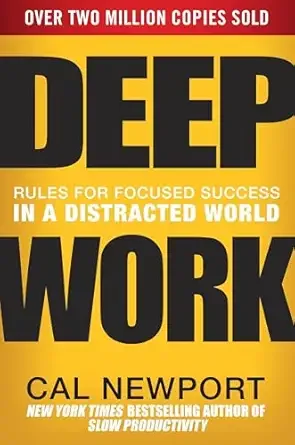
Deep Work
In Deep Work, computer science professor Cal Newport argues that the ability to focus without distraction is the defining skill of the modern economy. He divides professional activities into "deep" and "shallow" work, proving that constant connectivity actively destroys our cognitive capacity. Blending neuroscience with practical scheduling tactics, Newport provides a rigorous framework for eliminating digital noise, embracing boredom, and training your brain to produce massive value in less time.

StrengthsFinder 2.0
StrengthsFinder 2.0 by Tom Rath challenges the conventional wisdom of fixing weaknesses. Based on decades of Gallup research, it argues that the path to excellence is to identify your innate talents and invest in them to create powerful strengths. The book and its accompanying assessment reveal your top five of 34 "talent themes," providing a personalized guide to achieving higher engagement, performance, and fulfillment in your life and work.

Lean In
In her influential book Lean In, Sheryl Sandberg urges women to combat the internal barriers holding them back in the workplace. She argues that women should "sit at the table" by speaking up, owning their ambition, and fighting impostor syndrome. Sandberg provides a compelling framework for navigating career challenges, from avoiding the trap of "leaving before you leave" to the necessity of making your partner a true partner at home.
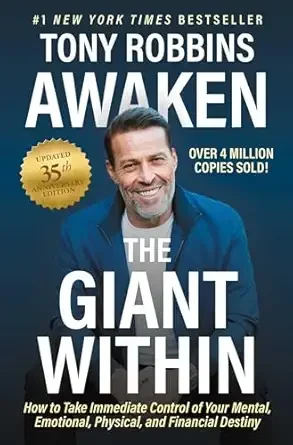
Awaken the Giant Within
In Awaken the Giant Within, Tony Robbins lays out a 544-page system for changing behavior on purpose: pain and pleasure as the engine, beliefs built on references, and the personal rules that quietly decide whether you ever feel satisfied. Overclaimed in places and unmistakably a seminar in book form, it still contains ideas that have outlasted most of the genre.

The Happiness Advantage
In The Happiness Advantage, Harvard researcher Shawn Achor argues the success formula most of us run is backwards. Happiness is not the prize waiting at the end of hard work; it is the fuel that makes the work go better. Across seven principles, from the Tetris Effect to the Zorro Circle to the 20-Second Rule, he shows how small mindset and habit shifts compound into real performance gains.

The 5AM Club
In The 5 AM Club, leadership expert Robin Sharma uses a narrative fable to present a comprehensive system for mastering your morning. He argues that waking up at 5:00 a.m. offers a distraction-free window to optimize your mind, body, and spirit. By applying structured routines like the 20/20/20 Formula and cultivating four interior empires, you can build lasting habits and dramatically increase your daily output.

Thinking, Fast and Slow
In Thinking, Fast and Slow, Nobel laureate Daniel Kahneman provides a masterclass in human irrationality. He reveals that our minds operate on two systems: one fast, intuitive, and prone to hidden biases, the other slow, logical, and incredibly lazy. By exposing the predictable mental shortcuts we take, Kahneman offers a profound framework for making better decisions in business and life while recognizing the limits of our own objectivity.