
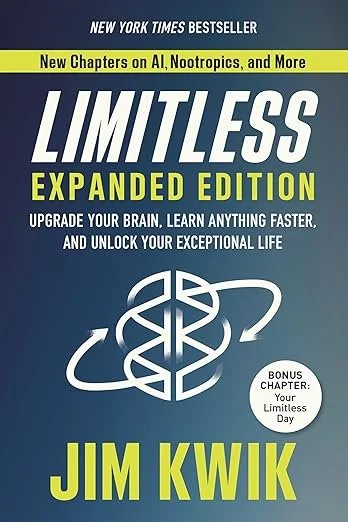
Limitless
Upgrade Your Brain, Learn Anything Faster, and Unlock Your Exceptional Life
by Jim Kwik
The 60-Second Take
In Limitless, world-renowned brain coach Jim Kwik provides a practical manual for upgrading your cognitive performance. Having overcome a severe childhood brain injury, Kwik dispels the myth that intelligence is fixed. Instead, he introduces a three-part framework—Mindset, Motivation, and Methods—to help readers conquer digital distractions, accelerate learning, and unlock their brain's true potential. By mastering these pillars, anyone can train their memory, enhance their focus, and learn anything faster.
Your Brain Is a Supercomputer, and You Are Outsourcing It
We live in an era of infinite information, yet our cognitive capacity seems to be shrinking. We constantly forget names, lose our train of thought, and find it nearly impossible to sit down and read a book without checking our phones every five minutes. We assume this is just the natural byproduct of aging or a busy life.
Jim Kwik strongly disagrees. When Kwik was in kindergarten, a severe fall resulted in a traumatic brain injury. For years, he struggled to learn, read, and focus, eventually internalizing the label a frustrated teacher gave him: "the boy with the broken brain." Because traditional education did not work for him, he had to manually teach himself how to learn.
Limitless is the culmination of the strategies he developed to fix his own broken brain, which he now teaches to CEOs, actors, and students worldwide. The book argues that your brain is not a static vessel; it is a highly adaptable muscle. When you stop outsourcing your thinking to technology and start applying the right mechanics, there is virtually no limit to what you can absorb, process, and remember.
What You'll Learn
The four "digital villains" quietly destroying your focus and memory
The Limitless Model: the intersection of Mindset, Motivation, and Methods
How to kill ANTs (Automatic Negative Thoughts) and optimize physical brain energy
The FASTER framework for absorbing new information rapidly
Why trying to learn something new while in a bored emotional state is a waste of time
The Four Digital Villains
Before you can upgrade your brain, you have to stop the daily damage being done to it. Kwik identifies four modern hazards that systematically erode our cognitive abilities.
The first is Digital Deluge. We are drowning in data, consuming more information in a day than our ancestors consumed in a lifetime, which leads to chronic overwhelm and fatigue. The second is Digital Distraction. Constant notifications and dopamine hits have fractured our attention spans, making deep, focused work incredibly difficult.
The third is Digital Dementia. We rely entirely on our phones to remember dates, math equations, and directions, causing our own memory muscles to atrophy from disuse. Finally, there is Digital Deduction. We are outsourcing our critical thinking. Instead of analyzing a complex problem ourselves, we quickly look up someone else's opinion online and adopt it as our own. To become limitless, you must consciously reclaim your attention and memory from these four villains.
The Limitless Model
The core of the book is Kwik’s Limitless Model, which he visualizes as three intersecting circles: Mindset, Motivation, and Methods. If you are failing to learn a new skill or reach a goal, you are almost certainly stuck in one of these three areas.
Mindset (The What): This is your belief system. It dictates what you believe is possible and what you believe you deserve. The biggest lie we are taught is that intelligence is fixed. If your mindset is tethered to the belief that you "just have a bad memory," no memory technique in the world will help you. Your brain will ensure your belief becomes reality.
Motivation (The Why): People mistakenly treat motivation as a character trait you either have or lack. Kwik defines motivation as Purpose multiplied by Energy. If you know exactly why you want to learn a language, but you are sleeping four hours a night and eating terrible food, your brain simply will not have the physical energy required to execute.
Methods (The How): Only after you have aligned your mindset and secured your motivation do you move to the methods. These are the specific, step-by-step techniques for speed reading, memory retention, and focus.
When all three circles overlap—when you believe you can do it, you have the energy and purpose to do it, and you know the exact steps to do it—you enter the limitless state.
Generating Energy and Killing ANTs
Because physical energy is the raw fuel for motivation, Kwik places a heavy emphasis on brain health. Your brain consumes roughly 20 percent of your body's energy. He provides a list of optimal brain foods—including avocados, blueberries, broccoli, dark chocolate, and walnuts—and stresses that sleep is not a luxury, but the time when your brain consolidates memory and flushes out toxins.
Equally important to physical diet is your mental diet. Kwik insists that readers learn to kill ANTs (Automatic Negative Thoughts). Your mind is always eavesdropping on your self-talk. If you walk into a room and tell yourself, "I am terrible at remembering names," your brain actively works to fulfill that command. You have to consciously catch those negative assumptions, interrogate them, and replace them with growth-oriented language.
The FASTER Method for Learning
When it is time to sit down and actually learn a new topic, Kwik offers a highly practical acronym to accelerate the process: FASTER.
Forget: Temporarily forget what you already know about the topic so you can approach it with a beginner's mind, and forget your situational distractions.
Act: Traditional education trains us to be passive consumers. Learning is an active sport. Take notes, ask questions, and engage physically.
State: All learning is state-dependent. Information combined with emotion becomes a long-term memory. If you are bored, you will forget it. Intentionally cultivate a state of curiosity and joy before you study.
Teach: Learn with the explicit intention of teaching the material to someone else. When you know you have to explain it, your brain naturally organizes the information more efficiently and pays sharper attention.
Enter: If it is not on your schedule, it is not real. Enter your learning blocks directly into your calendar.
Review: The brain forgets rapidly. Use spaced repetition—reviewing material periodically over days and weeks—to lock it into permanent memory.
Limitless at a Glance
Digital Dementia. We weaken our cognitive abilities by outsourcing our memory and critical thinking to smartphones and search engines.
The Limitless Model. True learning happens at the intersection of the right Mindset, sufficient Motivation, and proven Methods.
Neuroplasticity. Your brain is not a fixed asset; it physically rewires itself based on your daily actions, diet, and beliefs.
ANTs. Automatic Negative Thoughts act as self-fulfilling prophecies. You must identify and eliminate them to protect your focus.
The FASTER method. A six-step framework (Forget, Act, State, Teach, Enter, Review) designed to help you absorb and retain information quickly.
A Quick Start Guide to Upgrading Your Brain
Kill one ANT today. Catch yourself saying "I'm bad at X" and reframe it immediately to "I am currently learning how to improve at X."
Memorize a phone number. Fight digital dementia by intentionally memorizing the phone number of a close friend or family member instead of relying on your contacts app.
Schedule a digital detox. Carve out 30 minutes of "white space" today where your phone is completely in another room, allowing your brain to rest and wander.
Feed your brain. Swap out a processed snack for a high-quality brain food, like a handful of walnuts or blueberries.
Learn it to teach it. The next time you read a work report or a chapter of a book, pretend you have to give a five-minute presentation on it tomorrow. Watch how quickly your focus improves.
Who Should Read Limitless (and Who Can Skip It)
Read it if you constantly feel distracted, overwhelmed by information, or struggle with brain fog in your daily work.
Read it if you are a student, professional, or lifelong learner who wants tactical ways to read faster and remember more.
Read it if you liked the structure of Atomic Habits but want a framework applied specifically to cognitive performance and the brain.
Skip it if you are looking for deeply technical, academic neuroscience. Kwik keeps the science highly accessible and favors self-improvement frameworks over clinical data.
Skip it if you already possess a robust, disciplined system for speed-reading and memory retention; the tactical methods here are meant as foundational tools.
Final Reflections
Limitless is part memoir, part self-help, and part tactical manual. Jim Kwik's personal story of overcoming a traumatic brain injury makes his methods feel earned rather than theoretical. While some of the acronyms can feel a bit cheesy, they do exactly what they are designed to do: make the information sticky and memorable. The book’s greatest strength is its holistic approach. It proves that trying to learn a fancy speed-reading technique without first fixing your sleep, your diet, and your self-limiting beliefs is a complete waste of time.
The Bottom Line
Your brain is a muscle that atrophies when outsourced to technology, but by aligning your mindset, your physical energy, and proven learning mechanics, you can continually upgrade its capacity.
Frequently Asked Questions
What is the FASTER method?
It is Jim Kwik's framework for accelerated learning: Forget (distractions and assumptions), Act (engage actively), State (manage your emotional state), Teach (learn as if you have to teach it), Enter (schedule your learning time), and Review (use spaced repetition).
What are the 4 digital villains?
Kwik identifies four modern threats to our brain power: Digital Deluge (information overload), Digital Distraction (constant notifications), Digital Dementia (outsourcing memory to devices), and Digital Deduction (outsourcing critical thinking to algorithms).
Is Limitless just a book about speed reading?
No. While speed reading and memory techniques are covered in the "Methods" section, the first two-thirds of the book focus heavily on psychology, physical brain health, diet, and breaking limiting beliefs.
Business Floss is reader-supported. When you use our links we may earn an affiliate commission that helps us keep the site running. Thank you for your support!


