
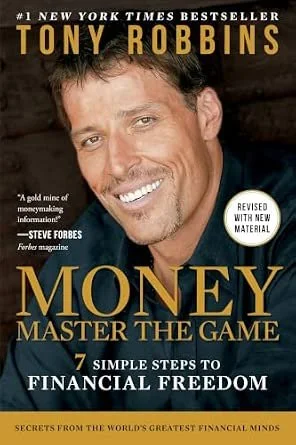
MONEY - Master the Game
7 Steps to Financial Freedom
by Tony Robbins
The 60-Second Take
MONEY Master the Game is Tony Robbins's attempt to distil interviews with roughly fifty of the world's most successful investors into a plan for ordinary people. Its seven steps run from automating savings through understanding fees and adviser incentives to asset allocation and generating retirement income. The strongest material is the unglamorous middle: the compounding cost of fees, the difference between a broker and a fiduciary, and the evidence on active management. The specific product recommendations warrant more skepticism, for reasons the book itself partly discloses.
Four Years, Fifty Investors, One Enormous Book
Tony Robbins spent four years and roughly fifty interviews on this project, reaching people who almost never sit for this kind of conversation: Ray Dalio, Warren Buffett, Jack Bogle, Paul Tudor Jones, Carl Icahn, David Swensen, and others.
MONEY Master the Game, published in 2014, is what came out of it — and it's enormous, running to several hundred thousand words in a register familiar to anyone who has read Robbins before. Underneath the length sits a structure of seven steps and a genuinely useful core.
One thing to establish before going further: this is a summary of a book, not financial advice, and nothing here is a recommendation. Some of what follows is well supported and some is contested, and the difference matters when real money is involved. Anyone acting on any of it should be talking to a qualified professional who knows their circumstances.
What You'll Learn
Why Robbins treats saving a fixed percentage automatically as the foundational decision
How fees compound against you, and why the effect is invisible
The difference between a broker and a fiduciary, and why it matters
The three-bucket approach to asset allocation and the All Seasons portfolio
Where the book's recommendations deserve scepticism
Step One: Become an Investor
The opening step is a decision rather than a technique: move from being a consumer to being an owner, by committing a fixed percentage of income to investment automatically, before it can be spent.
Robbins's emphasis on automation is well founded. Decisions made once and executed by default outperform decisions requiring monthly willpower, and the percentage matters more than the amount, since it scales as income grows.
He pairs this with compounding, illustrated with the familiar comparison of two savers who invest identical amounts and differ only in when they started — with the earlier starter finishing far ahead despite contributing less. It's a well-worn illustration and it earns its place, because the intuition it corrects is genuinely widespread.
Step Two: Know the Rules — Fees and Fiduciaries
The strongest section, and the reason to read the book at all.
Fees. Robbins's argument, drawn heavily from Jack Bogle, is that a seemingly modest annual fee compounds against you across an investing lifetime and can consume a substantial fraction of the wealth an untaxed, uncosted portfolio would have produced. The mechanism is that the fee is charged on the whole balance annually, including the money that would have compounded into future balances. Crucially, it never appears as a bill — it's deducted before you see the return.
He extends this to the layers of cost most investors never examine: expense ratios, trading costs from portfolio turnover, cash drag, sales loads, and the tax consequences of active trading in taxable accounts.
Active management. He presents the evidence that the large majority of professional fund managers fail to beat their benchmarks over long periods, and that identifying the exceptions in advance is not reliably possible. The conclusion, consistent with Bogle's and Buffett's, is that low-cost index funds are the sensible default for most people.
Fiduciaries. The distinction most readers won't have known. In the United States, some advisers operate under a fiduciary standard, legally required to act in the client's best interest. Others operate under a lower standard and may earn commissions on the products they recommend. Robbins's practical instruction — ask, in writing — costs nothing and is genuinely valuable.
Steps Three and Four: Your Number and Your Allocation
Make the game winnable. Robbins asks readers to calculate what they actually need, which he breaks into escalating tiers from basic security through independence to absolute freedom. His useful observation is that most people have never done the arithmetic and consequently pursue an undefined target, and that the number for genuine security is frequently lower than assumed.
Asset allocation. He treats this as the most important investment decision, and organizes it into three buckets. The Security Bucket holds what you cannot afford to lose. The Risk/Growth Bucket holds assets with higher expected returns and real downside. The Dream Bucket is funded from gains and spent on things that make the discipline worth sustaining.
This is where the book's best-known content appears: Ray Dalio's All Seasons allocation, an adaptation of the thinking behind his firm's all-weather approach, disclosed to a general audience for the first time here. Its logic is that asset prices are driven principally by growth and inflation, each of which can surprise upward or downward, producing four environments — and that holding assets that perform in each produces smoother returns than concentrating in equities.
The allocation Robbins publishes is heavily weighted toward long-duration government bonds, with smaller allocations to equities, gold, and commodities. The back-tested results in the book, covering roughly 1984 to 2013, show attractive returns with notably small drawdowns.
Two things to hold about that. Back-tests are not forecasts. And that particular period was one of steadily falling interest rates, which is the single best environment long-duration bonds can experience. In 2022, when rates rose sharply and stocks and bonds fell together, that allocation performed poorly. The underlying idea — diversifying across economic environments rather than just across equities — remains sound; the specific weights are a product of the era they were tested in.
Steps Five to Seven: Income, the Masters, and Doing It
Create a lifetime income plan. Robbins's framing that "income is the outcome" is a genuine corrective: a retirement portfolio's job is producing money to live on, not maximizing a headline number. His proposed instruments include annuities, and this is where the most caution is warranted. Annuities vary enormously in cost, structure, and quality; some are reasonable tools for guaranteed income and many carry high fees, surrender penalties, and complexity that makes them difficult to evaluate. Robbins's enthusiasm for specific types is contested among independent financial commentators, and this is a category where professional, unconflicted advice matters.
Invest like the wealthiest. The interview chapters, where each investor answers a standard set of questions. These are the most enjoyable part, though the honest reading is that their strategies are largely unavailable to ordinary investors — and the point of convergence, which Robbins highlights, is that nearly all of them prioritize not losing money over maximizing gains.
Do it, enjoy it, share it. The closing section on generosity and perspective, in Robbins's usual register.
MONEY Master the Game at a Glance
Automate the percentage. A fixed share of income invested before it can be spent, decided once.
Fee compounding. Annual fees charged on the full balance, invisible on statements, consuming a large share over decades.
Fiduciary standard. Advisers legally required to act in your interest, as distinct from those meeting a lower bar.
Three buckets. Security for what you can't lose, Risk/Growth for higher returns, Dream funded from gains.
All Seasons. Diversifying across economic environments rather than asset labels, published with specific weights.
Income is the outcome. Judging a retirement plan by the income it produces rather than its headline value.
A Quick Start Guide
Look up every fee you're paying. Find the expense ratio on each holding, and total what it costs annually.
Ask the fiduciary question in writing. Any adviser should answer clearly and quickly; hesitation is itself informative.
Automate a percentage today. Set the transfer before you decide what to invest in, since the habit matters more than the selection.
Calculate your actual number. Work out what genuine security costs per year, which is often lower than assumed.
Take specifics to a professional. Allocation, annuities, and tax treatment depend on your situation, and this book cannot know it.
Who Should Read MONEY Master the Game (and Who Can Skip It)
Read it if you've never engaged with personal finance and need motivation alongside information, which Robbins supplies better than almost anyone.
Read it if you don't know what you're paying in investment fees or whether your adviser is a fiduciary. Those two chapters justify the time.
Read it if you enjoy the interview material and want a wide range of professional investors answering the same questions in one place.
Skip it if you're already invested in low-cost index funds and understand fee drag. You know the core, and Bogle's own book covers it in a fraction of the length.
Skip it if length frustrates you. This is a very long book carrying maybe a hundred pages of essential content, with substantial repetition.
Skip it if you want unconflicted product guidance. The book discloses that Robbins had or was exploring commercial relationships in the sector, and the specific recommendations should be read with that in mind.
Final Reflections
The core of this book is genuinely valuable and largely borrowed. Fee awareness, the fiduciary question, the case for index funds, and the importance of allocation are all well established, and Robbins's contribution is reach — he has persuaded millions of people who would never open a book by Bogle to take those ideas seriously. That's worth something real.
Three cautions belong alongside it. The specific product and firm recommendations sit uneasily with the book's own disclosures about the author's commercial interests in the sector, and reviewers noted this at publication. The All Seasons weights were validated on a period uniquely favourable to long-duration bonds and behaved very differently when rates rose. And the annuity material describes a category where costs and terms vary enormously and where independent advice matters more than a book's enthusiasm.
None of that makes it a bad book. It makes it one to read for the principles rather than the products: find out what you're paying, understand who your adviser works for, automate your saving, and take the specifics to someone qualified who has no stake in what you choose.
The Bottom Line
The two questions worth taking from this are what you're paying in fees and whether your adviser is legally obliged to act in your interest. Both are quick to answer, most people never ask, and the answers matter more over decades than any allocation you'll choose.
Frequently Asked Questions
What is the All Seasons portfolio?
Ray Dalio's allocation, published in this book, designed to perform across four economic environments defined by rising or falling growth and inflation. It weights heavily toward long-duration government bonds alongside equities, gold, and commodities, and its published back-test covered a long period of falling interest rates.
What's the difference between a broker and a fiduciary?
A fiduciary is legally required to act in your best interest. Advisers operating under other standards may recommend products that are merely suitable while earning commission on them. Robbins recommends asking directly, in writing, which standard applies.
Should you follow the book's specific recommendations?
Treat them cautiously. The book itself discloses commercial relationships in the sector, the annuity material covers a category where costs vary enormously, and the published allocation was tested on an unusually favorable period. The general principles are sound; the specifics deserve independent advice.
Business Floss is reader-supported. When you use our links we may earn an affiliate commission that helps us keep the site running. Thank you for your support!


