
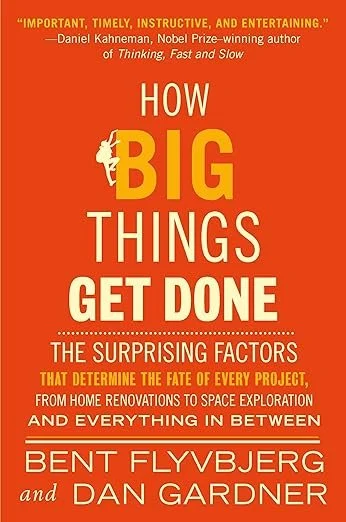
How Big Things Get Done
The Surprising Factors That Determine the Fate of Every Project, from Home Renovations to Space Exploration and Everything In Between
by Bent Flyvbjerg and Dan Gardner
The 60-Second Take
In How Big Things Get Done, megaproject expert Bent Flyvbjerg and journalist Dan Gardner reveal the hidden mechanics behind why projects fail. Drawing on a database of over 16,000 global endeavors, they show that successful projects share a counterintuitive approach: agonizingly slow planning followed by blistering execution. By mastering reference class forecasting and modularity, anyone can learn to beat the odds and deliver on time and on budget.
The Window of Doom and the Price of Rushing
Bent Flyvbjerg has spent his career studying fiascos. As an economic geographer at Oxford, he built the world's largest database of megaprojects—a massive ledger tracking the costs and timelines of over 16,000 bridges, tunnels, skyscrapers, IT systems, and the Olympics. The data reveals a terrifying truth. The vast majority of human endeavors, whether you are building a high-speed rail line or remodeling your kitchen, are wildly over budget, hopelessly behind schedule, and dramatically short on their promised benefits.
Co-authored with Dan Gardner, How Big Things Get Done is not just a catalogue of disasters. It is an autopsy of success. By isolating the rare projects that actually deliver exactly what they promised, the authors extracted a universal playbook for executing complex tasks. The rules they uncover apply just as powerfully to a software launch or a wedding as they do to a nuclear power plant, proving that the mechanics of getting things done scale up and down flawlessly.
What You'll Learn
The Iron Law of Megaprojects and why optimism guarantees failure
The concept of the "Window of Doom" during execution
How to use reference class forecasting to predict actual costs
Why treating your project as unique is a critical strategic error
The power of modularity and building with Lego
Why experience matters more than raw intelligence in project delivery
The Iron Law and the Fat Tail
The book starts with the sobering reality of the data. Flyvbjerg introduces the Iron Law of Megaprojects: only 8.5 percent of projects hit the mark on cost and time, and a dismal 0.5 percent hit the mark on cost, time, and benefits. We are fundamentally terrible at predicting the future, and we consistently lie to ourselves about how easily things will go.
The root of this failure is a mix of human psychology and political pressure. On a psychological level, we suffer from extreme optimism bias. We imagine the best-case scenario and build our budgets around it. On a political level, leaders engage in strategic misrepresentation—they intentionally underestimate the cost and exaggerate the benefits just to get the project approved and secure the funding.
The real danger, however, lies in probability. Most projects do not just fail a little bit; they fail spectacularly. They live in a statistical world of "fat tails," meaning that extreme, catastrophic outcomes are far more common than a normal bell curve would ever predict. A project is a highly fragile ecosystem. When something goes wrong—a labor strike, a supply chain collapse, a sudden global pandemic, or a change in government—the damage cascades. The longer a project drags on, the wider the target it presents to these black swan events.
Think Slow, Act Fast
To survive the fat tails, the authors introduce their central mantra: Think slow, act fast.
The biggest mistake amateurs, executives, and politicians make is rushing to execution. They want to see dirt moving and code shipping. Planning feels like stalling, so they start building while the blueprints are still half-finished. This was the exact mistake made during the construction of the Sydney Opera House. The government rushed to start digging before the impossibly complex roof engineering was even solved. As a result, they had to dynamite and rebuild the foundation, resulting in a decade of delays and a staggering 1,400 percent budget overrun.
Planning is cheap. Execution is incredibly expensive. Flyvbjerg argues that you should stay in the planning phase as long as humanly possible. You iterate, you simulate, you test, and you break things on paper or in computer models. Architect Frank Gehry used this exact approach for the Guggenheim Museum Bilbao. Because the titanium design was so radical, Gehry used advanced aerospace software to simulate every single piece of the building digitally before a single physical action was taken. When it was time to build, the plan was flawless, and the museum was delivered on time and on budget.
Once the plan is bulletproof, you transition to execution, and you must move with terrifying speed. Flyvbjerg calls the execution phase the "Window of Doom." Every single day that window is open, you are exposed to fat-tail risks. Your only goal during delivery is to slam that window shut as fast as possible.
Take the Outside View
When planning a budget or timeline, almost everyone takes the "inside view." We look closely at our specific project, add up the estimated costs of our materials and labor, assume everything will go reasonably well, and arrive at a final number. This method mathematically guarantees a budget overrun.
To get an accurate number, you must adopt the "outside view," leveraging a concept developed by Nobel laureate Daniel Kahneman called reference class forecasting.
You have to accept a humbling truth: your project is not unique. Someone, somewhere, has done this exact thing before. If you are renovating a kitchen, do not look at your spreadsheets. Go find fifty other people who recently renovated a similar kitchen in your city. Ask them what they originally budgeted and what they actually spent. The average of those fifty actual outcomes is your reference class, and it is a dramatically more accurate predictor of your final cost than your own optimistic math. By forcing yourself to take the outside view, you anchor your baseline to reality, not hope.
Build with Lego
Not all projects carry the same amount of risk. The data shows that nuclear power plants and the Olympics have incredibly fat tails; they routinely spiral out of control and bankrupt cities. Solar farms and wind power, on the other hand, almost always finish exactly on time and on budget.
The difference comes down to modularity. Wind farms are built with Lego.
A nuclear plant is a massive, bespoke, interconnected beast. Every part is custom, and if one system fails, the entire construction site halts. A wind farm is just the same standardized wind turbine repeated a hundred times. You build the first one, you learn how to do it slightly better, and by the time you are building the twentieth, you are an absolute expert moving at lightning speed.
Whenever possible, break a massive project down into small, repeatable, standardized units. Modularity allows you to scale up without scaling your risk. Software development moved to this model years ago with microservices, but the physical world is still lagging. If you can click your project together like Lego blocks rather than sculpting a singular bespoke monument, you can survive the Window of Doom.
Experience is the Master Builder
We have a cultural obsession with the brilliant novice. We love the idea of the fresh outsider who comes into an industry, disrupts all the established rules, and builds something extraordinary. The data shows that this narrative is poison for megaprojects.
When you are trying to deliver a complex project on time and on budget, experience is the only metric that actually moves the needle. Flyvbjerg is blunt: never hire someone who is doing this for the first time. You do not want a brilliant theorist; you want a master builder who has executed this exact type of project half a dozen times before.
Experience matters because it provides a visceral understanding of what can go wrong. A master builder does not need to guess at the fat-tail risks because they have lived through them. They have the tacit knowledge required to keep the momentum going when a supply chain inevitably breaks. If you want your project to succeed, swallow your pride, seek out the person with the most grey hair in that specific domain, and let them lead the execution.
Megaproject Survival at a Glance
The Iron Law. Projects almost invariably go over budget, over time, and deliver fewer benefits than promised.
Fat tails. Project risks are not normally distributed; extreme, catastrophic delays are highly probable.
Think slow, act fast. Iterate endlessly and safely in the planning phase; sprint violently in the execution phase.
The Window of Doom. The execution phase, during which your project is exposed to unforeseeable black swan events.
Reference class forecasting. The practice of basing your estimates on the actual outcomes of similar past projects rather than your own internal math.
Modularity. Designing projects as repeatable, standard blocks rather than bespoke, interconnected monuments.
A Quick Start Guide to De-Risking Your Next Project
Define the actual "Why." Figure out the core benefit you are trying to achieve before deciding on the physical solution.
Find your reference class. Locate at least twenty similar, completed projects and use their final, actual numbers as your baseline budget.
Iterate with cheap materials. Use sketches, 3D models, or storyboards to simulate and break the entire project before spending real money.
Hire a master builder. Do not rely on brilliant novices; deep domain experience is the strongest predictor of execution success.
Build in blocks. Break the execution phase into the smallest, most repeatable, modular steps possible to accelerate momentum.
Who Should Read How Big Things Get Done (and Who Can Skip It)
Read it if you manage large capital projects, software deployments, or heavy infrastructure initiatives.
Read it if you are planning a major life event like building a house or starting a massive renovation and want to protect your bank account.
Read it if you enjoyed the statistical rigor of Thinking, Fast and Slow and want to see those behavioral economics principles applied directly to management.
Skip it if you only want traditional, granular project management tools like Gantt charts and daily sprint mechanics. This is a book about high-level strategy, psychology, and risk architecture.
Skip it if your daily work consists entirely of short-term, low-stakes tasks where a delay has no financial or structural consequence.
Final Reflections
How Big Things Get Done is a rare business book that actually lives up to its ambitious title. By grounding its arguments in the largest dataset of its kind, it moves past theoretical advice and into empirical truth. Flyvbjerg and Gardner write with a sharp, engaging clarity, using compelling stories to prove that discipline does not kill creativity; it enables it. The lasting takeaway is a profound shift in how we view action. We are culturally conditioned to view planning as procrastination and digging as progress. This book proves that rushing to start is the actual failure of leadership, and that real speed is the reward for patience.
The Bottom Line
Most projects fail because we rush into execution to feel productive, leaving us exposed to catastrophic delays; the secret to survival is agonizingly slow, iterative planning followed by blistering, modular delivery.
Frequently Asked Questions
What is the Iron Law of Megaprojects? It is Bent Flyvbjerg’s statistical finding that the vast majority of projects fail to meet their goals. Specifically, 91.5 percent of projects go over budget, over time, or both, while only 0.5 percent hit their targets for cost, time, and benefits.
What does it mean to "Think slow, act fast"? It is the philosophy that planning should be a long, rigorous, highly iterative process where mistakes are cheap. Once planning is truly finished, the actual execution should be as fast as humanly possible to minimize exposure to unexpected risks.
What is reference class forecasting?
It is a method of predicting the cost and timeline of a project by taking the "outside view." Instead of calculating your own estimates from scratch, you look at the actual, historical outcomes of a large group of similar past projects and use their averages as your baseline.
Business Floss is reader-supported. When you use our links we may earn an affiliate commission that helps us keep the site running. Thank you for your support!


