
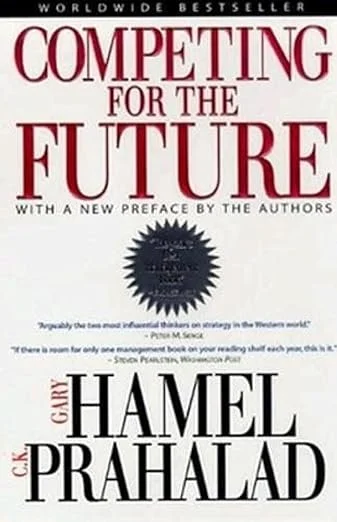
Competing For The Future
by Gary Hamel & C.K. Prahalad
The 60-Second Take
In Competing for the Future, strategy experts Gary Hamel and C.K. Prahalad dismantle the corporate obsession with downsizing and restructuring. They argue that cutting costs only makes an organization thinner, not healthier. To dominate tomorrow's markets, leaders must develop industry foresight, build a portfolio of core competencies, and pursue a massive strategic intent. It is a timeless blueprint for inventing new industries rather than playing endless catch-up in existing ones.
You Cannot Shrink Your Way to Market Dominance
If you walk into a typical executive board meeting and listen to the conversation, you will likely hear a lot of aggressive vocabulary about reengineering, restructuring, and downsizing. When faced with intense competition, the natural reflex of modern management is to cut costs.
Gary Hamel and C.K. Prahalad argue that this reflex is fundamentally flawed. In Competing for the Future, the authors point out that return on investment (ROI) is a fraction. You have a numerator (revenue) and a denominator (costs). You can improve your ROI by growing the numerator or by shrinking the denominator. Because cutting costs is mathematically easier and generates an immediate, predictable bump in the stock price, executives almost always choose the denominator.
The authors famously refer to this as "corporate anorexia." A starving company will certainly weigh less, but it lacks the muscle required to run a marathon. You cannot build a durable, market-dominating enterprise simply by firing people and squeezing efficiencies out of aging product lines. To survive, you have to get off the treadmill of cost-cutting. You have to lift your head, look ten years down the road, and deliberately architect a company capable of inventing an industry that does not even exist yet.
What You'll Learn
Why downsizing and reengineering are defensive tactics that destroy long-term growth
The exact definition of core competencies and how to identify them
How to use strategic intent to stretch an organization beyond its current resources
Why traditional market research fails when you are creating new industries
The mechanics of expeditionary marketing to test unproven ideas rapidly
Core Competencies
The most enduring concept introduced in Competing for the Future is the idea of core competencies. Most companies define themselves by the end products they sell. If you ask a television manufacturer what business they are in, they will say they make televisions. This is a fatal strategic error because end products eventually become obsolete.
Hamel and Prahalad use the metaphor of a tree. The leaves and flowers are the end products you sell to the consumer. The branches are your business units. The trunk is your core product. But the root system—the invisible engine that feeds everything else—is your core competence.
A core competence is a bundle of collective learning, specific skills, and integrated technologies that gives a company a unique advantage. Honda is the classic example. Honda does not view itself merely as a car company. Honda’s core competence is the design and manufacturing of incredibly efficient, reliable engines. Because they mastered that specific root competency, they can successfully produce cars, motorcycles, lawnmowers, and generators. If a market for a new engine-powered device suddenly emerges tomorrow, Honda can dominate it instantly.
Your goal is not to build a portfolio of products. Your goal is to build a portfolio of core competencies that can be rapidly assembled into whatever products the future demands.
Strategic Intent
You cannot build the future if your goals are strictly bound by the budget you have today. Most strategic planning is an exercise in resource allocation: the company looks at the money and talent it currently possesses, and plots a safe, incremental path forward.
Visionary companies ignore their current limitations. They operate on what the authors call strategic intent. This is a massive, ambitious, highly emotional goal that borders on the impossible. It creates a deliberate, agonizing gap between the company's ambition and its actual resources.
When President John F. Kennedy declared that the United States would put a man on the moon by the end of the 1960s, NASA did not have the technology, the materials, or the budget to do it. That was a strategic intent. When a relatively small Japanese company named Komatsu set out to "Encircle Caterpillar," they were taking aim at a global giant with vastly superior resources.
Because the strategic intent is so massive, traditional, incremental thinking fails. The organization is forced to innovate radically just to survive the pursuit. It rallies the entire workforce, giving them a unified, undeniable target that makes the daily friction of corporate life feel meaningful.
Industry Foresight
To pursue a massive goal, you need a hypothesis about where the world is actually going. You need industry foresight.
The authors warn that you will never gain industry foresight by asking your current customers what they want. Customers are notoriously terrible at predicting the future; they can only ask for a slightly cheaper, slightly faster version of what they already have. In the 1980s, you could not ask a consumer if they wanted a smartphone, because the concept was entirely outside their frame of reference.
Industry foresight requires looking past your existing customer base and studying the periphery. You look at shifting demographics, emerging lifestyle trends, and obscure technological advancements, and you ask how those forces will intersect in ten years. You are not trying to predict exactly what the product will look like; you are trying to understand the fundamental human problems that will need to be solved.
Expeditionary Marketing
When you are trying to invent a new industry, the risk of failure is astronomically high. If you spend five years and a billion dollars building the perfect product in secret, you might launch it and discover your industry foresight was entirely wrong.
To mitigate this risk, Hamel and Prahalad advocate for expeditionary marketing. You treat product development like a series of fast, cheap reconnaissance missions into enemy territory. You do not bet the entire company on one massive launch. Instead, you release a series of rapid, low-cost prototypes to see how the market reacts.
You launch a product, watch it fail, learn exactly why it failed, and immediately launch a slightly better version. The goal of expeditionary marketing is not immediate profitability. The goal is to maximize your rate of learning. By taking many small, calculated risks, you dramatically increase your chances of being in the exact right position when the new market finally explodes.
Competing for the Future at a Glance
Corporate anorexia. The dangerous practice of attempting to increase profitability solely by downsizing and cutting costs rather than generating new revenue.
Core competencies. The underlying, integrated skills and technologies that a company does better than anyone else, acting as the root system for all its products.
Strategic intent. A massive, unifying ambition that intentionally exceeds a company's current resources, forcing radical innovation.
Industry foresight. The ability to anticipate the future intersection of technology, demographics, and customer needs before the rest of the market sees it.
Expeditionary marketing. Launching fast, cheap, imperfect products into new markets purely to gather data and learn, rather than aiming for immediate perfection.
A Quick Start Guide to Building the Future
Stop obsessing over the denominator. Review your strategic initiatives for the quarter. If the vast majority are focused on cutting costs or improving efficiency, force the team to draft an equal number of revenue-generating ideas.
Identify your roots. Look past your specific products and write down the two or three underlying technical or operational skills your company possesses that are virtually impossible for a competitor to copy.
Draft a strategic intent. Create an aggressive, deeply uncomfortable goal for the next ten years. It must be a target that you currently have absolutely no idea how to achieve.
Ignore the focus groups. Stop asking your customers what they want you to build. Watch how they behave, identify the clumsy workarounds they use, and build something that eliminates the friction.
Launch an expedition. Take one unproven, futuristic idea and figure out how to build a cheap, functioning prototype in the next thirty days. Put it in front of users purely to see what breaks.
Who Should Read Competing for the Future (and Who Can Skip It)
Read it if you are an executive or strategist who feels trapped in a mature, stagnant industry and needs a framework for breaking out of the status quo.
Read it if you want to understand the origin of the term "core competency," which has become a foundational concept in every business school in the world.
Read it if your company relies entirely on acquiring other businesses for growth and has forgotten how to innovate internally.
Skip it if you are looking for highly modern, digital-first case studies. Published in 1994, the book’s examples (Kodak, early Motorola, traditional manufacturing) are entirely a product of the late twentieth century.
Skip it if you are a frontline manager looking for daily tactical advice on running a team. This is a high-level, macroeconomic strategy book designed for the C-suite.
Final Reflections
Competing for the Future is a fascinating artifact of business history. Because it was written in the mid-1990s, some of the companies Hamel and Prahalad praise as visionaries eventually stumbled, and some of the emerging technologies they hypothesized about are now ancient history. However, reading this book for the specific corporate examples misses the point. The underlying strategic architecture is completely bulletproof. The warning against "corporate anorexia" is arguably more relevant today in an era of private equity buyouts and mass layoffs than it was thirty years ago. The book serves as a permanent, rigorous reminder that true leadership requires the courage to focus on a future that has not happened yet.
The Bottom Line
A company’s future relies not on cutting costs to maximize today’s profits, but on building a portfolio of core competencies guided by a massive strategic intent to invent entirely new industries.
Frequently Asked Questions
What exactly is a core competency?
It is a specific combination of skills, knowledge, and technology that delivers disproportionate value to the customer and is incredibly difficult for competitors to copy. It is not a product. An engine is a core competency; a lawnmower is just the end product that utilizes it.
How does strategic intent differ from a mission statement?
A mission statement is usually a broad, passive description of what a company does (e.g., "to provide excellent customer service"). Strategic intent is an active, aggressive, seemingly impossible target that demands total organizational commitment and stretches the company far beyond its current capabilities (e.g., "to put a man on the moon").
Why do the authors criticize downsizing?
They do not argue that efficiency is bad. They argue that downsizing is an addiction. It creates the illusion of strong management because it quickly improves the balance sheet, but it starves the company of the resources, morale, and creative talent required to actually grow the business over the long term.
Business Floss is reader-supported. When you use our links we may earn an affiliate commission that helps us keep the site running. Thank you for your support!


