
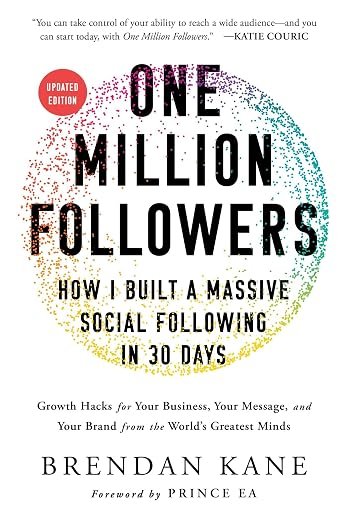
One Million Followers
How I Built a Massive Social Following in 30 Days
by Brendan Kane
The 60-Second Take
In One Million Followers, digital growth strategist Brendan Kane reveals the methodology he used to build a massive global audience in just thirty days. Drawing on his experience running campaigns for Fortune 500 brands and global celebrities, he outlines a systematic, data-driven approach to social media. By combining rapid testing, precise psychological targeting, and compelling hook points, Kane shows how to stop guessing and start engineering digital growth.
Social Media Virality Is a Science, Not a Lottery
For over eighteen years, Brendan Kane worked quietly behind the scenes as a digital strategist, building platforms for corporations like MTV, IKEA, and Vice, as well as celebrities like Taylor Swift and Rihanna. He knew his strategies worked for household names with massive budgets, but he wanted to prove they could work for an unknown individual starting from zero. In 2018, he turned his methods on himself with an audacious goal: generate one million followers in thirty days.
He accomplished his goal, and One Million Followers is the blueprint of exactly how he did it. The book dismantles the myth that online growth relies on luck, perfect timing, or mysterious algorithms. Instead, it presents audience building as a rigorous, systematic process. Kane argues that anyone can scale a significant digital presence if they are willing to abandon assumptions and let real-world data guide their content. This summary explores the specific frameworks, psychological models, and targeting strategies required to capture and hold attention at scale.
What You'll Learn
The Hypothesize, Test, Pivot framework for validating content ideas quickly
How to craft a Hook Point that captures attention in three seconds
Why the Process Communication Model is essential for writing compelling messages
How to use paid advertising to determine your Cost Per Acquisition
The strategic advantage of targeting emerging global markets for faster growth
The Hypothesize, Test, Pivot Methodology
Most people approach digital platforms with a fundamentally flawed mindset. They spend vast amounts of time producing a piece of content, release it to the public, and hope for the best. If it fails to gain traction, they assume they are simply not cut out for social media. Kane advocates a completely different approach based on relentless, analytical experimentation. He insists that early failures are not a reflection of your worth but rather necessary data points that tell you what your audience actually wants.
The core engine of this approach is a three-step cycle: Hypothesize, Test, and Pivot.
First, you form a hypothesis about a specific format, story, or theme that might engage your target audience. You might hypothesize that your audience prefers short instructional videos over inspirational quotes, or that they engage more with a humorous tone rather than a serious one.
Next, you test that hypothesis by producing a low-cost proof of concept. The goal is to spend as little money and time as possible to get a clear signal from the market. You validate the message by measuring real-world responses.
Finally, you evaluate the data. If the hypothesis is correct and the content resonates, you invest in it further and scale it up. If the data shows it is not working, you pivot immediately. You figure out why it failed, formulate a new hypothesis, and begin the cycle again. Kane emphasizes that this testing mindset requires you to be relentless; you must continue testing variables until you find the exact combination that works.
Finding Your Hook Point
Every day, more than sixty billion messages are sent across digital platforms. In a landscape this crowded, merely producing good content is not enough. You have to overcome the immense clutter and noise just to be noticed.
Kane introduces the concept of the "hook point" to solve this problem. A hook point is a unique, attention-grabbing element that immediately differentiates you in the marketplace. Kane compares the process of finding a hook point to walking past a kiosk of magazines in an airport. Your content must stand out instantly, signaling to the viewer that it holds something valuable enough to justify pausing their scroll.
A successful hook point works hand-in-hand with platform algorithms. Algorithms are not inherently malicious; they are designed for one specific purpose: to prioritize content a user is most likely to engage with based on their past behavior. If your hook point captures attention and initiates engagement, the algorithm will automatically push your content to a wider audience.
Once you have hooked the viewer, you must deliver genuine value. Kane recommends adhering to the 80/20 rule for content creation: provide pure value eighty percent of the time, and only ask for something (like a sale or a subscription) twenty percent of the time. By consistently prioritizing the audience's needs, you build the trust necessary for long-term growth.
The Process Communication Model: Speaking to Different Personalities
Creating content that resonates requires a deep understanding of human psychology. To target audiences effectively, Kane utilizes the Process Communication Model (PCM), a framework that categorizes how different people perceive the world and what type of "currency" motivates them.
Understanding these six distinct personality types allows you to tailor your messaging so it lands with maximum impact.
Thinkers and Persisters
Thinkers perceive the world primarily through logic and thought. For them, logic is currency. They respond best to data, structure, and clear rationale. Persisters, on the other hand, perceive the world through opinions, making values and beliefs their currency. They engage with content that aligns with their moral compass or takes a strong stance on an issue.
Harmonizers and Imaginers
Harmonizers process the world through emotions, and their driving currency is compassion. Kane notes that Harmonizers make up roughly thirty percent of the North American population, making emotional connection one of the most effective levers for mass reach in that region. Imaginers perceive the world through inactions, and imagination is their currency. They require space to reflect and often respond to highly creative or abstract concepts.
Rebels and Promoters
Rebels perceive the world through reactions, meaning humor is their primary currency. Content that breaks rules, uses sharp wit, or subverts expectations plays well with this group. Finally, Promoters perceive the world through actions, and charm is their currency. They are drawn to high energy, bold claims, and dynamic personalities. By explicitly deciding which personality type your content targets, you greatly increase its chances of sharing and engagement.
The Math of Attention: Advertising, Targeting, and Global Reach
While organic growth is possible, relying on it entirely is slow and unpredictable. Kane advocates using paid advertising to accelerate the testing phase and buy attention efficiently.
To do this successfully, you must understand your Cost Per Acquisition (CPA). Gaining a follower always carries a cost, whether you pay for it in hours of manual effort or in direct advertising dollars. By treating follower growth as a math equation, you can determine exactly how much you are willing to spend to acquire an engaged user and calculate your return on investment.
Kane outlines three specific strategies for growing a following on platforms like Facebook:
Organic Growth, which relies solely on the inherent shareability of your content.
Viral Content Advertising, where you put ad spend behind highly engaging posts designed strictly to generate mass awareness.
Page Likes Advertising, where you run tailored ads explicitly asking potential followers to follow your page.
Using these tools requires granular targeting. You must look beyond broad assumptions and use data to target specific demographics, interests, and locations. Kane recommends starting with a broad audience to gather initial insights, and then continuously refining your targeting using tools like look-alike audiences to expand your reach efficiently.
Finally, Kane stresses the massive opportunity found in global expansion. Many creators fight for highly competitive, expensive attention in North America while ignoring the rest of the world. By focusing on emerging markets and tailoring your content to align with regional cultural nuances, you can acquire engaged followers at a fraction of the cost, accelerating your path to a massive, diverse audience.
Social Media Strategy at a Glance
Hypothesize, Test, Pivot. Build low-cost content experiments to test ideas quickly, scaling what works and discarding what fails.
Hook points matter most. With sixty billion messages sent daily, you need a unique angle that captures attention instantly.
Understand the algorithm. Platforms only want to show users content they are highly likely to engage with based on past behavior.
Use the Process Communication Model. Tailor your message to different personality types, remembering that thirty percent of North Americans respond best to emotion.
Leverage global markets. Expanding your targeting to emerging global markets can dramatically lower your follower acquisition costs.
A Quick Start Guide to Rapid Audience Growth
Design a low-cost test. Do not spend weeks polishing a single video or post. Produce a quick proof of concept to see if the market actually cares about your idea.
Track your Cost Per Acquisition. Treat your social media like a business. Know exactly how much time or money it costs you to gain a new, engaged follower.
Follow the 80/20 rule. Give your audience pure value eighty percent of the time, and only ask them for a favor or sale twenty percent of the time.
Target specific personality types. Decide before you hit publish if your content is meant to appeal to a Thinker's logic, a Harmonizer's compassion, or a Rebel's humor.
Analyze the failures. When a post flops, do not ignore it. Dig into the metrics to understand why it failed so you can formulate a better hypothesis for your next test.
Who Should Read One Million Followers (and Who Can Skip It)
Read it if you are an entrepreneur or digital marketer struggling to get traction and want a systematic way to measure and improve your content.
Read it if you are tired of generic advice like "be authentic" and want concrete frameworks for running paid advertising and content tests.
Read it if you want to understand the psychology behind why people share content, specifically through models like PCM.
Skip it if you are solely interested in building deep, intimate relationships with a very small, niche community; this book is heavily focused on achieving massive scale and broad reach.
Skip it if you are looking for a manual on how to set up lighting, cameras, or editing software. The focus here is on strategy and data, not the technical aspects of media production.
Final Reflections
One Million Followers brings a much-needed dose of engineering discipline to an industry often dominated by guesswork and vanity metrics. Brendan Kane's primary contribution is shifting the creator's mindset away from a delicate artistic pursuit and toward rigorous, data-driven experimentation. By combining psychological frameworks like the Process Communication Model with hard advertising math, he provides a playbook that scales reliably.
The book is intensely focused on rapid growth, and readers should be aware that acquiring a million followers is only valuable if that audience actually serves your underlying business goals. Kane acknowledges this, warning that a massive audience is useless without meaningful engagement and a clear purpose. For anyone willing to put their ego aside and let data dictate their creative direction, this book offers one of the most pragmatic roadmaps available for digital expansion.
The Bottom Line
To build a massive audience, stop guessing what people want and start running cheap, rapid experiments to let the data prove exactly what holds their attention.
Frequently Asked Questions
What is the main idea of One Million Followers?
The core idea is that building a massive social media audience does not require luck or celebrity status. It requires a systematic approach of hypothesizing content ideas, testing them quickly and cheaply, and pivoting based on the data, while using strong hook points to stand out.
Is One Million Followers still relevant today?
Yes. While specific platform interfaces and short-term algorithm quirks change constantly, Kane's foundational principles—rapid testing, psychological targeting, and calculating cost per acquisition—remain highly effective across all current digital platforms.
Does the book only cover organic growth?
No. A significant portion of Kane's strategy involves using paid advertising to accelerate the testing process, gather data faster, and acquire followers efficiently by targeting specific demographics and emerging global markets.
Business Floss is reader-supported. When you use our links we may earn an affiliate commission that helps us keep the site running. Thank you for your support!


