
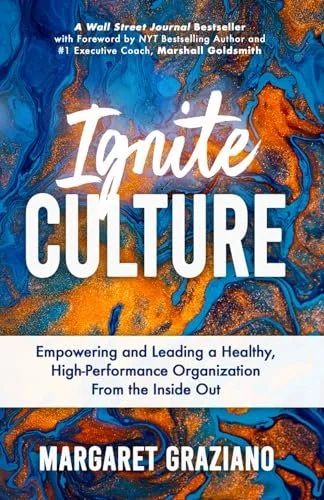
Ignite Culture
Empowering and Leading a Healthy, High-Performance Organization From the Inside Out
by Margaret Graziano
The 60-Second Take
In Ignite Culture, culture consultant Margaret Graziano argues that companies are human systems, and that most dysfunction traces to personal strengths running in overdrive. Structured around the leader, the leadership team, and the organization, the book makes the case that culture change starts with the CEO's self-awareness and takes years, not quarters. Practical in places, and openly an on-ramp to her consultancy.
Culture Doesn't Break Because People Are Bad at Their Jobs
Margaret "Magi" Graziano spent more than two decades in recruiting before founding KeenAlignment, a culture and organizational effectiveness consultancy. By her account her prior firm placed over ten thousand people across more than five hundred companies, which is an unusual vantage point: she watched, at scale, why people took jobs, why they stayed, and why they left.
Ignite Culture, published in 2022 with a foreword by executive coach Marshall Goldsmith, is the book that came out of that. Its premise is that companies are human systems rather than machines with people in them, and that revenue, innovation, and retention are downstream of how those humans actually behave toward one another day to day.
Where it diverges from most culture books is the diagnosis. Graziano's claim is not that organizations fail because people lack skills or care. It's that they fail because ordinary personality traits, under pressure, run past their useful range and turn into defensive behavior that everyone around them then adapts to. Culture, in this account, is the accumulated residue of that adaptation.
What You'll Learn
What it means to treat an organization as a human system rather than an org chart
How strengths in overdrive produce the two defensive patterns that damage most teams
Why the book insists culture change starts with the CEO and cannot be delegated to HR
The realistic timeline and critical mass required for a culture shift to hold
Where the book is useful and where it functions as marketing for the author's consultancy
Organizations Are Human Systems
The framing sounds soft and is not meant to be. Graziano's argument is that a company is an amalgamation of personalities, moods, behaviors, and interactions, and that this system produces the financial outcomes rather than merely accompanying them. Strategy documents, incentive plans, and org charts describe the intended system. The human system is what actually runs.
The practical consequence is a rejection of culture as an artifact. Values statements, perks, engagement surveys, and offsites are outputs of a culture at best and decoration at worst. What determines the culture is the pattern of interaction: what happens when someone brings bad news, who gets interrupted, whether a decision made in a meeting survives the hallway conversation afterward.
This is not an original observation, and Graziano is working in territory Edgar Schein mapped decades ago. What she adds is a diagnostic emphasis. If culture lives in interaction patterns, then culture work means changing specific behaviors in specific people, starting with the ones whose behavior everyone else calibrates against. Which is to say, the leadership.
Personality in Overdrive
This is the book's most distinctive contribution and the part most worth taking away.
Graziano's account is that relational friction usually originates in traits that are genuinely strengths, operating past the point of usefulness. Under stress, ambiguity, or threat, people don't become different people. They become more themselves, more insistently, and the trait that made them effective turns into the thing colleagues work around.
She sorts the resulting behavior into two polarities, using vocabulary that maps onto the Human Synergistics framework, whose research director endorsed the book. The aggressive-defensive pattern shows up as competitiveness, perfectionism, oppositional reflexes, and power-seeking: the leader who has to win the meeting, who cannot let a flawed draft go, who tests every proposal by attacking it. The passive-defensive pattern shows up as approval-seeking, conventionality, dependence, and avoidance: the manager who won't decide without cover, who defers to precedent, who lets a problem run rather than raise it.
Both are protective. Both are usually invisible to the person doing them, because from the inside it feels like maintaining standards or being a team player. And both are contagious downward, because subordinates adapt to whatever the person with power does.
The alternative Graziano points toward is the constructive range: achievement orientation, encouraging others, genuine affiliation, self-development. Her practical move is that these aren't new skills to install so much as what remains when the defensive overdrive is turned down. That reframing is useful. Most leadership development adds; this asks what to subtract.
Inside Out: The Leader, Then the Team, Then the Company
The book is organized in three sections, and the order is the argument. Part one addresses the leader, part two the leadership team, part three the organization.
Graziano's position is that this sequence cannot be reordered or compressed. A CEO who commissions a culture initiative while remaining unexamined is, in her framing, asking the organization to adopt behaviors that the most-watched person in the building is not modeling. The organization will read the actual behavior, not the initiative.
Each chapter closes with a consistent apparatus: a set of Key Takeaways, a "Brain Hack" exercise meant to convert the idea into practice, and a set of Powerful Questions intended for reflection or team discussion. It's a workbook structure, and the book is explicitly built to be reread and worked through over time rather than consumed once.
The honest assessment of this section is mixed. The insistence on leader-first sequencing is correct and underrated, and the self-examination material is the sturdiest part of the book. The exercises themselves are frequently generic, and Kirkus said as much, noting conclusions like "people are afraid of change" and "leaders should be intentional" that don't repay much attention.
The Timeline Nobody Wants to Hear
Two specifics in the book deserve more attention than they get.
The first is the timeline. Graziano puts genuine culture change at roughly 18 to 36 months, and she says it plainly rather than burying it. That's an unusual thing for a consultant to lead with, since it makes the sale harder in the room, and it's the correct number. It's also, worth noting, commercially convenient for a firm that sells multi-year engagements, so read it as both honest and self-serving at once.
The second is critical mass. She puts the threshold at roughly ten percent of the employee base operating as genuine change agents before a shift becomes self-sustaining. Whether that specific figure survives scrutiny is unclear, and I'd treat it as a working heuristic rather than a finding. But the underlying idea is sound and actionable: culture change is not achieved by announcement, and the operative question is not "have we communicated this" but "how many people are actually behaving differently, and are they enough."
Together these two claims do more real work than most of the exercises. They give a leader a way to tell whether an initiative is on track or theater.
Culture Concepts at a Glance
Human system. An organization understood as an interacting set of personalities and behaviors rather than a structure of roles and processes.
Personality in overdrive. A genuine strength operating past its useful range, typically under stress, where it starts producing friction instead of results.
Aggressive-defensive behavior. Protective patterns expressed outward: perfectionism, competitiveness, opposition, control.
Passive-defensive behavior. Protective patterns expressed inward: approval-seeking, deference to convention, dependence, avoidance.
Constructive styles. The behavioral range associated with healthy performance, including achievement orientation, encouragement of others, and self-development.
Critical mass. The share of an organization that must be actively behaving differently before a culture shift sustains itself.
A Quick Start Guide to Applying the Book
Name your own overdrive first. Identify the strength you rely on most and describe what it looks like when it runs too far. That description is what your team is already managing around.
Sort the friction. For a recurring conflict on your team, ask whether each party is running aggressive-defensive or passive-defensive. The two require opposite interventions.
Fix the sequence. Don't launch anything organization-wide until the leadership team's own behavior has changed observably. The gap between the two is the whole problem.
Set a two-year clock. Plan the initiative on an 18 to 36 month horizon and tell people that up front. A culture program scoped to a quarter will fail and teach everyone that culture work is theater.
Count behavior, not sentiment. Track how many people are visibly acting differently rather than how many rated the initiative favorably.
Who Should Read Ignite Culture (and Who Can Skip It)
Read it if you're a CEO or executive who suspects the problem is in the room with you and wants a structured way to look at your own contribution to it.
Read it if you've watched a culture initiative fail and want a credible explanation of why. The leader-first sequencing and the timeline argument are the useful diagnostics.
Read it if you want a workbook. The chapter-end exercises and questions are built for a leadership team to work through together over months.
Skip it if you want research. This is practitioner experience and case anecdote, not empirical work, and the evidence base is thinner than the marketing suggests. For the researched version of the same territory, Edgar Schein on organizational culture and Amy Edmondson on psychological safety are better starting points.
Skip it if consultant books irritate you. The specifics of implementation are frequently vague, and IndieReader's review made the point directly: much of the guidance is non-specific enough that acting on it substantially means hiring the author's firm.
Final Reflections
The core diagnostic idea is genuinely good. "Your strengths in overdrive are the problem" is a more useful lens than most of what gets written about culture, because it explains why competent, well-intentioned teams still generate friction, and because it points at something a person can actually change. Paired with the leader-first sequencing and the two-year timeline, that's three ideas worth the read.
The limitations are real and worth being direct about. The frameworks underneath the most distinctive material are licensed third-party instruments rather than Graziano's own research, which means the book is partly an introduction to tools you'd need to buy access to. The practical layer thins out precisely where implementation gets hard, and the later chapters assume a foundation the book itself doesn't fully build. The Wall Street Journal bestseller label attached to the title is a marketing credential common to this category of business book and is not a signal of independent reception. And Graziano's commercial interest in the argument is not hidden, which is to her credit, but it should shape how you weight the parts where the recommendation happens to be sustained expert involvement.
Read as a practitioner's structured perspective, it holds up. Read as an evidence-based system, it doesn't, and it doesn't really claim to.
The Bottom Line
The behavior costing your team the most is probably a strength you're proud of. Culture work that skips that fact, and starts anywhere other than the leadership's own conduct, is a communications campaign wearing a change program's clothes.
Frequently Asked Questions
What is the main idea of Ignite Culture?
That organizations are human systems, and that most cultural dysfunction comes from personal strengths running in overdrive, producing aggressive-defensive or passive-defensive behavior that everyone else adapts around. Graziano argues change has to begin with the leader's own self-awareness, then the leadership team, then the wider organization, in that order.
How long does culture change take, according to the book?
Graziano puts it at roughly 18 to 36 months, and she argues that quick-fix culture programs fail because they treat as a project something that is really a sustained change in behavior. She also suggests roughly ten percent of employees need to be genuinely acting as change agents before a shift becomes self-sustaining.
Is Ignite Culture worth reading?
It's worth it if you're an executive looking for a structured, honest lens on your own contribution to your company's culture, and it works well as a team workbook. It's less worth it if you want research-backed frameworks or specific implementation detail, since the practical guidance stays general and the book functions in part as an introduction to the author's consulting practice.
Business Floss is reader-supported. When you use our links we may earn an affiliate commission that helps us keep the site running. Thank you for your support!


