
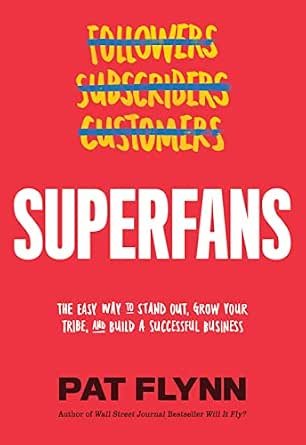
Superfans
The Easy Way to Stand Out, Grow Your Tribe, And Build a Successful Business
by Pat Flynn
The 60-Second Take
In Superfans, entrepreneur and podcaster Pat Flynn reveals how to build a devoted community around your brand, proving that you do not need millions of passive followers to build a highly profitable business. By intentionally guiding people through the Pyramid of Fandom—from casual audience members to active participants to a connected community and true superfans—Flynn provides a tactical blueprint for cultivating loyalty that outlasts any algorithm change.
You Do Not Need to Go Viral to Build a Business
Every day, entrepreneurs and creators log into their dashboards and stare at the numbers. They track pageviews, email subscribers, and social media likes. When the numbers go up, they feel successful. When an algorithm update pushes the numbers down, panic sets in. We have been conditioned to believe that the only way to build a meaningful digital business is to achieve massive scale and reach everyone.
Pat Flynn wrote Superfans to tear down that assumption. Over his career building the Smart Passive Income brand and numerous other online businesses, Flynn realized that audience size is a vanity metric. A massive list of casual followers will not buy your products, defend your brand, or sustain you during an economic downturn. What actually sustains a business is a small, fiercely loyal group of people who are emotionally invested in what you do.
Drawing heavily on Kevin Kelly's famous concept of "1,000 True Fans," Flynn argues that the strongest brands—from solo podcasters to giants like LEGO and Apple—thrive because they focus on cultivating deep loyalty rather than shallow reach. The book provides a practical, step-by-step roadmap for moving people from casual passersby to lifelong advocates.
What You'll Learn
The four distinct stages of the Pyramid of Fandom
Why understanding your audience's exact vocabulary is critical for trust
How to deliver a "quick win" that immediately activates a new follower
The importance of shifting the spotlight onto your community members
Why doing unscalable, highly personal things is the only way to create a true superfan
The Pyramid of Fandom
Flynn organizes the journey of an audience member into a framework called the Pyramid of Fandom. The pyramid represents the fact that not everyone who interacts with your brand will become a superfan, and that is perfectly fine. The goal is to build a systematic path so that those who want to go deeper have a clear way to do so.
The bottom and largest tier is the casual audience. These are people who discover you through a Google search, a forwarded email, or a link on another website. They might read a single article or listen to ten minutes of a podcast, but they do not really know who you are yet. They are passing through.
The next level up is the active audience. These people have taken a concrete step to hear from you again. They have subscribed to your newsletter or followed you on a social platform. They know what you offer, and when you release something new, they pause to decide whether they want to invest their time or money in it.
Above them is the connected community. This is where the dynamics of your business begin to change dramatically. In the connected community, people are not just talking to you; they are talking to each other. They identify as part of a group, they answer questions for newcomers, and they provide the raw feedback you need to build better products.
At the very top sits the smallest but most powerful group: the superfans. A superfan will buy your next product before you have even finished pitching it. They will travel across the country to attend your live event. They will fiercely defend your reputation in online forums. You only need a fraction of your audience to reach this peak to ensure the financial security of your business.
Earning the Active Audience
The transition from a casual observer to an active subscriber does not happen by accident. You have to earn it by proving that you actually understand the person's specific problems.
Most brands fail here because they talk about themselves. Flynn insists that you must talk about the customer, and you must do so using their exact language. If you describe a problem using industry jargon, the casual visitor will assume you are out of touch. If you describe their problem exactly the way they describe it to their friends, they will instantly assume you have the solution. You find this language by seeking out the forums, comment sections, and platforms where your audience already complains about their challenges.
Once you have their attention, you have to deliver a quick win. A quick win is a small, highly actionable piece of advice that a person can implement in five to ten minutes and see an immediate result. When you solve a tiny problem for someone right away, you build a massive amount of trust. They realize that if your free, five-minute advice works, your paid products must be incredible. That realization is the trigger that moves them from casual to active.
Building a Connected Community
Once you have an active audience paying attention to your content, your next job is to foster a connected community. You must shift from a broadcast model, where you speak and everyone listens, to a facilitation model, where you create the space for people to interact.
One of the most effective ways to do this is to open the curtain and show your audience the messy, behind-the-scenes reality of your business. People connect with humans, not flawless corporate facades. Share your struggles, talk about the project that failed, and ask for their opinions on a product you are currently building. When you involve them in the creation process, they feel a sense of ownership over the final result.
You also have to shine the spotlight back on the audience. Instead of always interviewing industry experts or highlighting your own successes, highlight a member of your community. When you feature an ordinary person who used your methods to achieve a result, two powerful things happen. First, the person you highlighted becomes an instant, lifelong advocate for your brand. Second, the rest of your audience sees someone exactly like them succeeding, which makes your brand feel significantly more accessible and real.
Doing the Unscalable for Superfans
The final leap, from a connected community member to a superfan, cannot be automated. You cannot write a piece of code, design a sophisticated sales funnel, or run a targeted ad campaign that generates a superfan. True fandom requires genuine, unscalable human connection.
Flynn emphasizes that you have to do things that take time and cannot be easily replicated. This might mean sending a personalized, ten-second video message to a new customer on Instagram just to say thank you. It might mean paying attention to the people who naturally step up to moderate your community forums and reaching out to acknowledge them.
When you do something completely unexpected and highly personal, you break the standard transactional relationship of the internet. You show that you view them as a human being, not just a row in a spreadsheet. That moment of recognition is what secures a superfan. While you cannot do this for every single person who buys from you, doing it for just a handful of people every week steadily builds an army of advocates who will sustain your business for decades.
The Dynamics of Fandom at a Glance
The casual audience. They found you by accident and do not know your brand yet. You have to capture their attention fast.
The active audience. They have subscribed to your content. They need a quick win to prove you can deliver real value.
The connected community. They are talking to each other, not just to you. They need a safe space to interact and be recognized.
The superfans. They buy everything you make and promote you fiercely. They require unscalable, personal connection to thrive.
The 1,000 True Fans math. You do not need millions of followers to succeed. A small, highly dedicated base provides sustainable, predictable revenue.
A Quick Start Guide to Cultivating Fandom
Find their exact words. Spend time in the forums and comment sections where your ideal audience hangs out. Write down the specific phrases they use to describe their problems.
Design a quick win. Create a single piece of free content that helps a casual visitor solve a small problem in under ten minutes.
Open the curtain. Show your audience a behind-the-scenes look at how you operate. Ask for their feedback on an unfinished project.
Highlight a community member. Stop talking about your own wins. Feature a customer or subscriber who achieved something great, making them the hero of the story.
Do one unscalable thing a week. Pick a handful of people who frequently comment on your posts and send them a direct, personalized video thanking them for their time.
Who Should Read Superfans (and Who Can Skip It)
Read it if you are a podcaster, creator, or entrepreneur who is tired of constantly chasing algorithmic growth and wants a more sustainable business model.
Read it if you have a decent-sized email list or follower count, but you struggle to get people to actually buy your products or engage with your content.
Read it if you want highly practical, low-cost tactics for improving customer retention and building community infrastructure.
Skip it if your business relies entirely on anonymous, one-off transactional sales where brand loyalty plays zero role in your revenue model.
Skip it if you are looking for advanced technical tutorials on how to set up community software or configure complex email marketing funnels. This is a strategy book focused on human connection, not a technical manual.
Final Reflections
Superfans is a refreshing antidote to the constant pressure of digital marketing. While the industry pushes business owners to obsess over volume, Pat Flynn makes a compelling, highly practical argument for depth. The framework is straightforward, but it requires a fundamental shift in how you view your audience. You have to stop seeing them as leads to be converted and start seeing them as people to be served.
The greatest strength of the book is its accessibility. Flynn’s advice does not require a massive advertising budget or a dedicated public relations team. Anyone with a smartphone and a willingness to care can start executing these strategies immediately. The only real caveat is that building true fans is a slow, methodical process. If you are desperate for a massive spike in revenue by next Tuesday, these tactics will not help you. But if you are trying to build a resilient, future-proof brand that will survive the next major shift in technology, Superfans is an excellent blueprint.
The Bottom Line
Stop treating your audience like numbers in a funnel, and start treating them like people by creating quick wins, fostering real conversations, and doing unscalable things to earn their permanent loyalty.
Frequently Asked Questions
What is the main idea of Superfans?
The core idea is that building a future-proof business does not require millions of followers. It requires cultivating a small, highly dedicated group of superfans by intentionally moving people through a journey from casual observers to active, connected community members.
What is the Pyramid of Fandom?
It is a four-stage framework Pat Flynn uses to categorize an audience. It starts at the bottom with the Casual Audience, moves up to the Active Audience, then the Connected Community, and finally peaks with the Superfans at the top.
Do you have to be a celebrity to have superfans?
No. Flynn explicitly argues that any type of business, from a solo consultant to a large corporation like Apple or LEGO, can cultivate superfans by prioritizing human connection, community recognition, and outstanding customer experiences over simple transactions.
Business Floss is reader-supported. When you use our links we may earn an affiliate commission that helps us keep the site running. Thank you for your support!


