
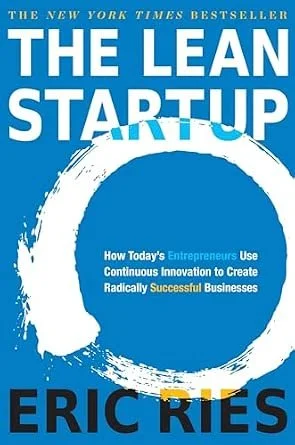
The Lean Startup
How Today’s Entrepreneurs Use Constant Innovation to Create Radically Successful Businesses
by Eric Ries
The 60-Second Take
In The Lean Startup, entrepreneur Eric Ries applies the principles of lean manufacturing to early-stage business creation. He argues that startups must abandon complex, long-term business plans in favor of rapid, scientifically tested experimentation. By embracing the Build-Measure-Learn feedback loop, deploying Minimum Viable Products, and replacing vanity metrics with rigorous data, founders can systematically reduce uncertainty and build products that real customers actually want to buy.
Stop Executing a Plan and Start Testing a Hypothesis
We have a deeply romanticized view of how great companies are born. The cultural myth tells us that a brilliant founder sits in a garage, formulates a flawless master plan, executes it with relentless determination, and eventually launches a finished product to massive acclaim.
Eric Ries lived that exact myth, and it led to spectacular failure. Early in his career, he spent months working with a highly talented engineering team to build a sophisticated software platform in total secrecy. When they finally launched, no one cared. They had successfully executed a brilliant plan to build a product that the market completely rejected.
That failure led Ries to a profound realization: startups are not simply smaller versions of large corporations. A large, established corporation executes a known business model. A startup, by definition, is a human institution designed to create a new product or service under conditions of extreme uncertainty. Because the conditions are uncertain, traditional management tools like five-year financial forecasts, milestone planning, and rigid organizational charts are worse than useless—they are dangerous. In The Lean Startup, Ries outlines a completely different management methodology. He replaces the chaos of early-stage ventures with a rigorous, scientific approach designed to systematically eliminate uncertainty.
What You'll Learn
Why "validated learning" is the only metric that matters in the early days
How to use the Build-Measure-Learn feedback loop to test your core assumptions
What a Minimum Viable Product (MVP) actually is, and how to launch one safely
How to implement Innovation Accounting to track real progress instead of vanity metrics
The mechanics of a pivot and why it is essential for long-term survival
Validated Learning in Extreme Uncertainty
The primary goal of a traditional business is to produce a return on investment. The primary goal of a startup is entirely different: it is to figure out the right thing to build.
Ries introduces the concept of "validated learning" as the core unit of progress for any new venture. When you are operating in extreme uncertainty, you cannot measure progress by how many hours you worked, how many lines of code you wrote, or how beautiful your branding looks. You can only measure progress by how much verifiable truth you have learned about your customers.
Every new business is built on a set of unproven assumptions, which Ries calls "leap-of-faith assumptions." The two most critical are the value hypothesis (does this product actually deliver value to the customer?) and the growth hypothesis (how will new customers discover this product?).
Imagine you are transitioning from corporate finance to launch a fractional CFO consulting practice. Your instinct might be to spend three months designing a pristine Squarespace website, writing dense thought-leadership articles, and building an automated intake form for three different service tiers. But doing that relies on an untested value hypothesis: that target clients actually want those specific packages. Instead of building the infrastructure first, you should seek validated learning. Can you get one local business owner to hand you a check for a single hour of advisory work? If they will not pay for one hour of your time, a polished website will not save you. Validated learning proves your assumptions with real-world behavior, not hypothetical projections.
The Build-Measure-Learn Feedback Loop
To achieve validated learning quickly, Ries developed the core operational framework of the lean methodology: the Build-Measure-Learn feedback loop.
The cycle seems straightforward. You start with an idea, you build a product, you measure how customers interact with it to gather data, and you learn from that data to refine your next idea. However, Ries insists that the most effective way to use this framework is to plan it in reverse.
You do not start by deciding what to build. You start by identifying exactly what you need to learn about your business model. Once you know what you need to learn, you figure out what specific data you need to measure to prove or disprove that hypothesis. Only then do you design the simplest possible experiment—the "build" phase—to acquire that measurement.
The total speed at which you can move a hypothesis through the Build-Measure-Learn loop is the defining metric of a startup's success. Your runway is not defined by how much cash you have in the bank. Your runway is defined by how many times you can complete the feedback loop before that cash runs out. If you can shorten the loop, you give yourself more chances to find a sustainable business model.
The Minimum Viable Product (MVP)
The mechanism you use to run your first trip through the feedback loop is the Minimum Viable Product, or MVP. This is perhaps the most famous, and most misunderstood, concept in the book.
An MVP is not a buggy, half-finished version of your final vision. It is simply the version of a new product that allows a team to collect the maximum amount of validated learning with the least amount of effort. It is an experiment designed to test fundamental business hypotheses.
Ries highlights several famous examples of brilliant MVPs. When the founders of Zappos wanted to test if people would buy shoes online, they did not build a massive inventory warehouse or a complex logistics network. They simply went to local shoe stores, took photographs of the inventory, and posted them online. When a customer bought a pair, they bought them from the local store at retail price and shipped them via the post office. It was a highly inefficient system, but it was the perfect MVP. It proved the value hypothesis—that people were willing to buy shoes on the internet—with almost zero capital risk.
You can apply this to physical products as well. If you are starting an e-commerce reselling business, say a brand called Golfing Buddies that focuses on tournament-branded golf apparel, you do not need to buy thousands of dollars of wholesale inventory upfront. You can build a simple, single-page website offering a limited-edition item and measure how many people attempt to click the "Buy" button or join a waitlist. If the conversion rate is zero, you have saved yourself a massive financial loss. The MVP prevents you from scaling an illusion.
Innovation Accounting
Once you launch your MVP, you need a way to measure whether you are actually making progress. Traditional accounting metrics like profitability, market share, and ROI are useless in the early days of a startup because they are usually hovering around zero.
To replace them, founders often fall into the trap of using "vanity metrics." Vanity metrics are numbers that always go up and make you feel good, but offer no actionable guidance. Total registered users, gross page views, or total social media followers are vanity metrics. They might look impressive on a chart, but they do not tell you if your business is actually sustainable. If your website gets ten thousand hits because of a single viral post, but no one ever returns, you have not built a business.
Ries insists on replacing vanity metrics with "actionable metrics" through a system called Innovation Accounting. Actionable metrics are usually measured through cohort analysis and split testing. Instead of looking at total revenue, you look at the behavior of specific cohorts of users over time. Of the one hundred people who signed up in March, how many were still active in May? If you change the color of the checkout button in June, does the June cohort purchase at a higher rate than the May cohort?
Innovation Accounting requires discipline. You establish the baseline of your current business, you attempt to tune the engine to improve those metrics, and then you face the hardest decision in entrepreneurship: you look at the objective data and decide whether to pivot or persevere.
The Pivot or Persevere Decision
When a startup runs an experiment and the actionable metrics show that they are not making adequate progress, they reach a crossroads. The founders must decide whether to persevere with the current strategy, or make a pivot.
A pivot is a structured course correction designed to test a new fundamental hypothesis about the product, strategy, or engine of growth. Ries is careful to note that a pivot is not a failure, nor is it throwing everything away and starting from scratch. It is a strategic shift that keeps one foot rooted in what you have already learned while moving the other foot in a new direction.
There are many different types of pivots. In a zoom-in pivot, what previously was considered a single feature of a product becomes the entire product. In a customer segment pivot, you realize the product solves a real problem, but for a completely different group of people than you originally anticipated. In a channel pivot, you change how the product is delivered to the market, perhaps moving from direct enterprise sales to an online self-serve model.
The tragedy of most startups is not that they run out of money quickly. The tragedy is that they drown slowly in a sea of mediocrity. They achieve just enough success to keep going, but not enough to scale, and the founders stubbornly refuse to pivot because they are overly attached to their original vision. The lean methodology is ultimately designed to force founders to face the objective truth faster, allowing them to pivot before their resources are depleted.
The Lean Startup at a Glance
Validated learning. Progress in a startup is measured by testing hypotheses with real customers, not by writing code or finishing business plans.
Build-Measure-Learn. The core operational loop of a startup. You minimize the total time it takes to turn an idea into a product, measure its impact, and learn whether to pivot or persevere.
Minimum Viable Product (MVP). The fastest, lowest-effort way to get through the Build-Measure-Learn loop and test a fundamental assumption.
Innovation Accounting. Tracking progress using actionable cohort data rather than feel-good vanity metrics like total registered users.
Pivot. A structured course correction designed to test a new hypothesis about the product or strategy when the current path proves unviable.
A Quick Start Guide to Testing Your Next Business Idea
Identify your leap-of-faith assumptions. Before you build anything, write down the specific, unproven assumptions your business model relies on to succeed.
Work backward through the loop. Decide what you need to learn about those assumptions, then define the exact metric that will prove or disprove them.
Build an MVP. Construct the simplest, cheapest possible experiment to gather that metric. Do not over-engineer it.
Ignore vanity metrics. Stop looking at total page views or gross follower counts. Track the specific conversion rates and engagement levels of user cohorts.
Hold regular pivot meetings. Schedule time specifically dedicated to looking at the data and asking the brutal question: are we making enough progress to persevere, or is it time to pivot?
Who Should Read The Lean Startup (and Who Can Skip It)
Read it if you are an entrepreneur, founder, or product manager trying to bring a new idea to market without burning through your entire savings or funding round.
Read it if you work inside a large corporation tasked with "intrapreneurship" or launching new, highly uncertain divisions.
Read it if you have a habit of over-planning, over-polishing, and delaying your product launches out of fear of market rejection.
Skip it if you are purchasing a stable, established franchise or operating a business in a highly predictable market where the operating model is already a known commodity.
Skip it if you are looking for specific advice on how to incorporate a business, raise venture capital, or manage daily corporate accounting. This is a framework for product development and learning, not a legal or financial manual.
Final Reflections
The Lean Startup is arguably one of the most influential business books of the twenty-first century, and for good reason. It fundamentally changed how entrepreneurs approach building companies by injecting scientific discipline into an inherently chaotic process. Ries brilliantly dismantles the myth of the visionary founder who knows exactly what the market wants, replacing it with the reality of the humble founder who lets the market dictate the product. The framework is highly pragmatic, fiercely objective, and deeply practical. The only real caveat is that the methodology requires ironclad discipline to execute properly. It is emotionally painful to launch an imperfect MVP, and it is difficult to ignore vanity metrics when they look impressive to outsiders. But for those willing to endure the discomfort of being wrong in the short term, this book offers the safest, most reliable path to being right in the long term.
The Bottom Line
Your startup's true runway is not how much cash you have in the bank, but how many Build-Measure-Learn cycles you can complete before that cash runs out.
Frequently Asked Questions
What is the main idea of The Lean Startup?
The core idea is that startups operate under extreme uncertainty, so traditional business planning fails. Instead, founders should treat their business ideas as scientific hypotheses and test them rapidly through a Build-Measure-Learn feedback loop, allowing them to figure out what customers actually want without wasting time and money.
What exactly is a Minimum Viable Product (MVP)?
An MVP is the simplest version of a new product that allows a team to collect the maximum amount of validated learning about customers with the least amount of effort. It is not necessarily a smaller or buggier version of the final product; it is an experiment designed to test a specific assumption.
Is The Lean Startup only for software and tech companies?
No. While Eric Ries's background is in software, and many of the examples are tech-focused, the core methodology—identifying assumptions, running cheap experiments, and tracking actionable metrics—applies to physical products, service businesses, and internal corporate innovations.
Business Floss is reader-supported. When you use our links we may earn an affiliate commission that helps us keep the site running. Thank you for your support!


