
The Man Who Solved the Market
How Jim Simons Launched the Quant Revolution
by Gregory Zuckerman
The 60-Second Take
In The Man Who Solved the Market, Wall Street Journal reporter Gregory Zuckerman tells the story of Jim Simons and Renaissance Technologies, the hedge fund whose Medallion Fund produced what may be the greatest investment record in history. The book details how a team of mathematicians and physicists built a quantitative system that beat the market for three decades. Eye-opening reading for anyone curious about how systematic investing actually works.
The Man Who Solved the Market: How Jim Simons Built the Greatest Trading Record
Most investment legends produce annual returns in the low double digits over their best decades. Warren Buffett's long-term record is around 20 percent annualized, an achievement that has made him one of the wealthiest people in history. Jim Simons, the founder of Renaissance Technologies, ran a fund called Medallion that produced gross returns averaging 66 percent annually over 30 years, with net returns to investors averaging 39 percent.
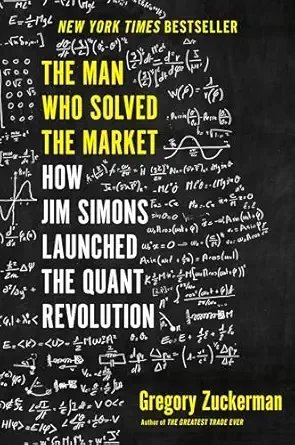
Those numbers are so far beyond the rest of the industry that they require explanation. Gregory Zuckerman, a senior reporter at the Wall Street Journal, spent years interviewing former Renaissance employees and reconstructing the firm's history. The Man Who Solved the Market: How Jim Simons Launched the Quant Revolution is the result. The book is the most detailed public account of how the firm actually works and what it tells us about the markets.
What You'll Learn
The personal background that made Simons different from other Wall Street figures
How Renaissance built its data and modeling infrastructure
The role of mathematicians, physicists, and code rather than economists
Why the strategy works on Medallion's scale but does not scale to large public funds
Practical lessons about systematic versus discretionary decision making
The Improbable Founder
Simons was not raised on Wall Street. He was a mathematician of the first rank, awarded the Oswald Veblen Prize in Geometry for work on differential geometry that has applications in physics. He chaired the math department at Stony Brook University, codebroke for the NSA, and only entered finance in his late thirties.
This background shaped what Renaissance became. Most hedge funds are built around investors who have spent decades learning the patterns of markets through experience and judgment. Simons built a fund around the assumption that markets are a complex data problem that yields to the same tools that yield to other complex data problems: extensive data collection, statistical modeling, and computational power.
For Simons, the question was never "what does this trade mean fundamentally?" It was "what does the data say happens next?" The orientation made Renaissance look more like a research lab than a trading desk.
The Data Edge
Renaissance built its early advantage on data infrastructure that the rest of the industry took years to match. The firm collected, cleaned, and stored vast amounts of historical market data at a time when this was an expensive and unusual practice. The cleaning mattered. Most raw market data is full of errors, gaps, and biases that ruin statistical analysis. Renaissance invested in the unglamorous work of producing reliable historical inputs.
Once the data was reliable, the firm ran extensive statistical analysis to find patterns. The patterns it identified were not "stocks tend to go up after good earnings." They were far subtler and often non-intuitive. Many patterns lasted only briefly before being arbitraged away by Renaissance's own trading.
The lesson is that the data infrastructure is the moat. Once your data is meaningfully better than the next firm's, you can extract signals they cannot see.
The Team
Renaissance famously refuses to hire people from Wall Street. The firm hires mathematicians, physicists, computer scientists, and occasionally astronomers. The hiring filter prioritizes raw scientific talent and the willingness to subordinate ego to the data.
The culture inside the firm is unusual. Renaissance employees share their models with each other openly. The firm operates as a single research collective, with all models contributing to a single Medallion portfolio. There is no individual P&L for traders. There are no portfolio managers in the conventional sense.
This structural choice matters. It removes the political and competitive incentives that fragment most asset managers. Information flows freely because there is no career advantage in hoarding it.
The Capacity Problem
The reason Medallion has produced such extraordinary returns is also the reason the strategy does not scale. The patterns Renaissance trades on are typically short-lived and limited in capacity. A signal that produces 10 cents of profit per share on 10,000 shares does not work on 10 million shares. The market moves before the trade completes.
Medallion is capped at roughly $10 billion in assets, distributed only to firm employees. Outside investors have been excluded for over twenty years. The firm's other funds, available to outside investors, produce respectable but not extraordinary returns because they operate at scale where the Medallion-style strategies do not work.
The structural lesson is that some kinds of alpha are inherently small. The hunt for capacity is itself a constraint that shapes most of the asset management industry.
What Quant Investing Does Not Mean
Zuckerman is helpful in clarifying what Renaissance does and does not do.
It is not "AI" in the popular sense. The models are statistical pattern detection, not deep learning analysis of company fundamentals.
It is not high-frequency trading in the millisecond sense. Many trades hold positions for hours, days, or weeks.
It does not predict the long-term direction of stocks or markets. It predicts short-term price movements based on patterns in historical data.
It does not work without constant retraining. Patterns decay. The firm runs a continuous research operation to find new signals as old ones fade.
The picture that emerges is of a research operation that is methodical, expensive, and dependent on continuous improvement rather than a one-time breakthrough.
Implications for Discretionary Investors
The Renaissance story does not invalidate fundamental, discretionary investing. The two approaches operate in different parts of the market on different time horizons. Buffett and Simons are not competing with each other.
But the story does suggest some humility for discretionary investors. The patterns most retail investors think they see in markets are typically already arbitraged by systematic players or were never real to begin with. The advantage of discretionary investing, for those who can deliver it, is in patient understanding of businesses over long horizons rather than in clever short-term pattern recognition.
For finance professionals working in fundamental analysis, the message is to stay in the lane where your tools work. Long-term business analysis is one lane. Short-term price prediction is another, dominated by very different players.
A Quick Start Guide
Pull these lessons into your own thinking.
Respect data quality. In any analysis, the cleanliness of the inputs determines the reliability of the outputs.
Identify the time horizon where you have an edge. Build your work around that horizon and refuse to play in others.
Build culture for information sharing. Hoarding insights inside a team destroys the value of the insights.
Plan for signal decay. Whatever advantage you have today will be competed away. Build the next one before you need it.
Be honest about scale. Some advantages disappear as the operation grows. Plan for the right size.
Final Reflections
The Man Who Solved the Market is the best public account of one of the most successful financial firms in history. Zuckerman's reporting fills in the picture as much as Renaissance's secrecy allows. The book is most useful as a counterweight to two extreme views. The first view is that markets are perfectly efficient and no one can systematically beat them. The Medallion record refutes that. The second view is that any sufficiently smart person can beat the market with the right approach. The book makes clear that what Renaissance does requires a level of data, talent, and capital that is unavailable to nearly everyone. For finance professionals, the takeaway is to read both lessons carefully.
Business Floss is reader-supported. When you use our links we may earn an affiliate commission that helps us keep the site running. Thank you for your support!


