
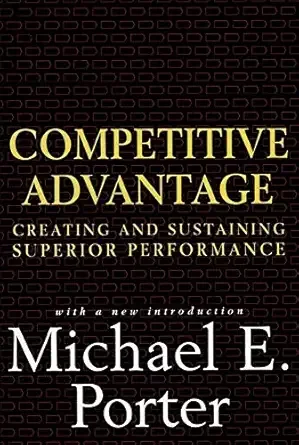
Competitive Advantage
Creating and Sustaining Superior Performance
by Michael E. Porter
The 60-Second Take
In Competitive Advantage, Michael Porter argues that lasting profitability comes from one of three deliberate strategies, cost leadership, differentiation, or focus, and almost never from a blend of all three. Using the value chain to dissect a business into discrete activities, he shows where real advantage is built and why most companies leak margin without realizing it. The strategist's bible for a reason.
When "Just Be Better" Stops Being a Strategy
Every business eventually hits the same uncomfortable question. We have a decent product, a decent team, decent margins. Why aren't we winning? Most companies try to answer it by working harder, cutting a little here, adding a feature there. A few decades' worth of academic research suggests that almost none of those moves actually create lasting advantage. They just make everyone slightly tired.
Michael Porter's Competitive Advantage, published in 1985 by the Harvard Business School professor who had already redrawn corporate strategy with Competitive Strategy five years earlier, set out to answer the question with precision. Porter's argument is direct. Profitable companies don't outperform because they "execute better" in some vague sense. They outperform because they have made deliberate choices that produce either lower costs than their rivals or a product so distinctive that customers will pay more for it. Anything in between, what Porter famously called "stuck in the middle," tends to lose to both ends.
This summary distills the framework that has been taught in every MBA program for forty years and explains how to use it on a Tuesday morning at your own company.
What You'll Learn
Porter's three generic strategies and why most companies pick none of them clearly
How the value chain breaks a business into the parts where advantage is actually built
The ten cost drivers that explain why some companies make money and others don't
The difference between real differentiation and the kind customers won't pay for
How to apply the framework to a single product line this quarter
Three Roads, Pick One
Porter argues that there are only three generic ways to outperform an industry over the long term.
Cost Leadership. Be the lowest-cost producer in your market. Walmart in retail, Southwest in airlines, Geico in insurance. Lower cost lets you either undercut on price or earn fatter margins at parity.
Differentiation. Offer something the market perceives as unique enough to pay extra for. Think Apple in consumer electronics, BMW in cars, or a private bank that knows every client's grandchildren by name.
Focus. Pick a narrow segment and serve it better than anyone else, either through cost focus or differentiation focus. Ferrari doesn't try to beat Toyota at volume. It beats Toyota at one specific customer.
The trap most companies fall into is trying to do all three at once. They want premium positioning, but they also want scale discounts, but they also have a niche luxury line. Porter's verdict on the stuck-in-the-middle company is blunt. Margins erode, customers get confused, and a clearer competitor on either end eats your lunch.
The Value Chain: Where Advantage Actually Lives
The book's most enduring tool is the value chain. Porter's insight is that competitive advantage cannot be understood by looking at a company as a whole. It has to be broken into the discrete activities the company performs to design, produce, market, deliver, and support its product. Each of those activities either adds cost or creates value, and advantage is built one activity at a time.
The chain has two layers.
Primary activities are the ones that physically create and sell the product.
Inbound logistics (receiving and storing materials)
Operations (turning inputs into the finished good)
Outbound logistics (warehousing and shipping)
Marketing and sales (getting buyers to pay for it)
Service (everything after the sale)
Support activities prop those up.
Firm infrastructure (general management, finance, legal, planning)
Human resource management
Technology development
Procurement
The point of mapping a value chain isn't to be exhaustive. It's to spot the two or three activities where your company either has a real edge or quietly bleeds money. IKEA's competitive advantage isn't in any one place. It's in how flat-pack design, in-store warehouses, customer self-assembly, and global sourcing reinforce each other. Pull any one piece out and the system breaks.
The Ten Cost Drivers
If you're chasing cost leadership, Porter says you need to understand why your costs are what they are. He identifies ten structural drivers:
Economies of scale
Learning and experience curve effects
Capacity utilization
Linkages between activities (a faster shipping process can lower inventory costs upstream)
Interrelationships between business units
Vertical integration choices
Timing (first-mover or late-mover advantages)
Discretionary policies (your choices about features, quality, and service levels)
Location
Institutional factors like regulation and unionization
The takeaway is that cost leadership is rarely the result of one heroic cost-cutting drive. It's the cumulative result of getting these drivers right across many activities. Most companies that benchmark themselves only against scale or labor cost miss eight of the ten reasons their competitor is winning.
Differentiation That Customers Will Actually Pay For
Porter is careful about differentiation. Being different isn't enough. The differentiation has to be valuable to the buyer, perceived by the buyer, and difficult for rivals to copy. He locates the sources of differentiation in the same value chain. A company can differentiate through product features, but also through faster delivery, better service, more knowledgeable salespeople, more attractive packaging, or even how easy the company is to do business with.
The mistake here is differentiating in ways customers don't actually value. A B2B software company that spends years perfecting a feature its buyers don't use, or a hotel chain that invests in lobby art when guests only care about reliable Wi-Fi, has differentiated itself out of profit. Porter's test is simple. Can you charge a price premium for it? If not, it isn't differentiation. It's just expense.
Sustainability and Why Most Advantages Decay
The final third of the book deals with how to keep an advantage once you have it. Porter is sober here. Most advantages decay because competitors imitate, technology shifts, or buyers change what they want. Sustainable advantages tend to come from sources that are hard to copy, like proprietary technology, brand reputation built over decades, complex internal linkages, or scale that requires committed investment. The companies that compound returns over time aren't the ones with the best idea this year. They're the ones whose advantages have multiple reinforcing roots.
Quick Start Guide: Run the Porter Diagnostic on Your Business
Pick one product line or business unit. Don't try to do the whole company at once.
Decide which generic strategy you are actually pursuing. Not what you wish, what your prices, costs, and customers say you are.
Map the value chain. List your primary and support activities and mark the three to five where you create the most value or carry the most cost.
Run the cost drivers. For each high-cost activity, ask which of the ten drivers explain the cost and which are within your control.
Test your differentiation. Identify what you do differently. Then ask whether customers know, care, and pay extra for it.
Check for stuck-in-the-middle. If your strategy reads like a list of buzzwords (premium, scalable, agile, low-cost), you're probably blurred. Recommit to one road.
Stress-test sustainability. For each advantage, ask how a well-funded competitor would copy it in two years. The ones that survive that test are the ones worth investing in.
Final Reflections
Competitive Advantage is dense, sometimes academic, and demands more patience than most modern business books. It's also one of the few that has aged almost untouched. The reason it sits on every strategy syllabus is that Porter gave managers something most strategy talk lacks, which is a structured way to ask why your company makes money and whether it will keep making money. Read it slowly. Apply it to one piece of your business at a time. The clarity it forces is the kind that quietly separates the companies that compound from the ones that just survive.
Business Floss is reader-supported. When you use our links we may earn an affiliate commission that helps us keep the site running. Thank you for your support!


