
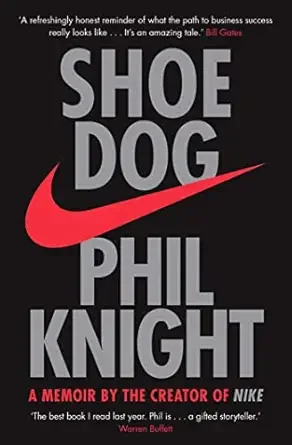
Shoe Dog
A Memoir by the Creator of Nike
by Phil Knight
The 60-Second Take
In Shoe Dog, Nike founder Phil Knight tells the raw, honest story of building the company from a car-trunk sneaker operation into a global brand. It is less a how-to than a memoir of doubt, debt, and stubborn persistence. Knight shows that entrepreneurship is messy, lonely, and rarely tidy, and that surviving long enough to win often comes down to a simple refusal to quit.
Shoe Dog: The Unfiltered Story Behind Building Nike
Most founder memoirs are written to make the author look like a visionary who saw the future clearly and marched toward it. Phil Knight's Shoe Dog does the opposite. It is the rare business memoir that admits how broke, anxious, and unsure of himself the founder was for most of the climb. The result is the most honest startup story many readers will ever encounter, and it is far more useful than the polished legend Nike became.
Knight starts in 1962 with what he calls his Crazy Idea: importing high-quality, low-cost running shoes from Japan to sell in the United States. He had run track at Oregon, earned an MBA at Stanford, and could not shake the feeling that he wanted his life to mean something. This summary traces how that idea became Nike, and pulls out the lessons that any builder, operator, or finance professional can carry into their own work.
What You'll Learn
Why cash flow, not profit, is the thing that actually kills growing companies
How a tiny importer survived years on the edge of bankruptcy
The messy reality of hiring, partnerships, and betrayal in a young business
Why persistence and belief matter more than a flawless plan
How Nike was built by a band of misfits rather than polished executives
The Crazy Idea and the Leap
Knight's first move was pure hustle. He flew to Japan, talked his way into a meeting with the Onitsuka shoe company, and when asked the name of his firm, he invented one on the spot: Blue Ribbon Sports. He had no company, no money, and no inventory. He simply could not bear the thought of a conventional life selling encyclopedias or working as an accountant forever.
His first partner was Bill Bowerman, his legendary Oregon track coach, who put in 500 dollars to match Knight's own and became a relentless tinkerer with shoe design. Bowerman famously poured rubber into his wife's waffle iron to prototype a new sole, an experiment that eventually became the waffle trainer. The lesson is that big companies often begin with unglamorous obsession rather than grand strategy.
Cash Is Oxygen: Growth Without Money in the Bank
The most valuable thread in Shoe Dog for any finance-minded reader is the constant, grinding cash crunch. Blue Ribbon grew sales every single year, sometimes doubling them, and was perpetually one bad week from collapse. Knight plowed every dollar back into more inventory, which meant the faster he grew, the more cash he needed and the less he had.
His bankers hated this. They wanted to see reserves and slow, steady expansion. Knight wanted to grow as fast as humanly possible. That tension eventually got Blue Ribbon dropped by its bank and investigated when the company leaned hard on its Japanese trading partner, Nissho Iwai, for financing. The takeaway is durable and worth tattooing on a spreadsheet: profit on paper means nothing if you run out of cash. Growth consumes money, and managing that gap is the real job.
Key Lessons at a Glance
Cash flow beats profit. A growing company can be profitable and still die for lack of cash. Knight lived this every quarter.
Partnerships are fragile. The Onitsuka relationship that launched Blue Ribbon ended in lawsuits when the supplier tried to cut Knight out. Never depend entirely on a partner who can replace you.
Hire for grit, not polish. Knight's early team was a collection of oddballs, including a paralyzed former runner and an overweight accountant, who outworked far slicker competitors.
Brand is built, then named. The name Nike came from an employee's dream of the Greek goddess of victory. The swoosh cost 35 dollars from a design student. Iconic outcomes can have humble origins.
Survival is the strategy. Most of Knight's wins came simply from staying in business long enough for the next opportunity to appear.
Building a Team of Misfits
Nike was not built by a roomful of MBAs. Knight surrounded himself with people he called his Buttfaces, the loyal early employees who met for raucous strategy retreats. There was Jeff Johnson, the first full-time employee, who obsessed over customers and coined the Nike name. There was Bob Woodell, paralyzed in an accident, who ran operations with extraordinary discipline. There was Del Hayes, the accountant who left a stable career to help wrangle the chaos.
Knight's gift was loyalty and trust. He gave these people enormous responsibility and rarely looked over their shoulders. The lesson for leaders is that talent often hides in unconventional packages, and that a culture of trust can unlock more than a culture of control.
The Onitsuka Break and the Birth of Nike
For years Blue Ribbon was simply a distributor for Onitsuka. When the Japanese supplier began shopping for other American distributors and tried to buy out Knight's business, he was forced to build his own brand or die. That existential threat is what created Nike in 1971. The company that betrayed him handed him the push he needed.
This is the quiet pattern of the whole book. Almost every disaster, the dropped bank, the customs fight with a 25 million dollar demand, the supplier betrayal, became the setup for the next stage of growth. Knight does not pretend he planned it that way. He simply refused to stop.
A Quick Start Guide for Founders and Operators
Watch cash, not just the income statement. Model your cash runway every month and treat it as your true scoreboard.
Reduce single points of failure. If one supplier, customer, or lender can end you, start building a backup now.
Hire people who care more than they polish. Grit and loyalty outlast resumes.
Reinvest, but know your limit. Aggressive reinvestment fuels growth, but only if you survive the squeeze it creates.
Expect the plan to break. Treat each setback as raw material for the next move rather than proof you should stop.
Final Reflections
Shoe Dog endures because it refuses to sanitize the founder's journey. Knight admits to fear, doubt, family strain, and a near-constant sense that the whole thing might collapse. His central message is that building something meaningful is messy, financially terrifying, and rarely linear, and that the people who win are usually the ones who simply outlast the chaos. For anyone who manages money, builds a company, or dreams of doing their own Crazy Idea, it is both a cautionary tale and a quiet permission slip. Keep going.
In a Nutshell
In Shoe Dog, Nike founder Phil Knight tells the raw, honest story of building the company from a car-trunk sneaker operation into a global brand. It is less a how-to than a memoir of doubt, debt, and stubborn persistence. Knight shows that entrepreneurship is messy, lonely, and rarely tidy, and that surviving long enough to win often comes down to a simple refusal to quit.
Business Floss is reader-supported. When you use our links we may earn an affiliate commission that helps us keep the site running. Thank you for your support!


