
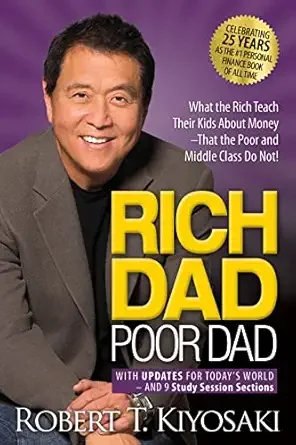
Rich Dad Poor Dad
What the Rich Teach Their Kids About Money That the Poor and Middle Class Do Not
by Robert Kiyosaki
The 60-Second Take
In Rich Dad, Poor Dad, Robert Kiyosaki contrasts the financial mindsets of two father figures to show why a paycheck rarely builds wealth. Through plainspoken stories and a blunt asset-versus-liability framework, he argues that financial literacy, owning income-producing assets, and learning to make money work for you matter more than any salary. A classic starter book for anyone ready to step off the earning treadmill.
Why Your Paycheck Will Never Make You Wealthy
Most of us grew up with a tidy formula. Study hard, land a steady job, save what you can, and one day you'll be financially secure. It's the script almost every parent passes down, and it sounds responsible. The trouble is, by the time most people realize the script doesn't actually build wealth, they've spent thirty years following it.
Robert Kiyosaki's Rich Dad, Poor Dad, first published in 1997 and still one of the best-selling personal finance books ever written, tears that script up on page one. Kiyosaki tells the story of growing up in Hawaii with two father figures, his biological dad (the "poor dad"), a highly educated PhD who chased promotions and pensions, and the father of his childhood best friend (the "rich dad"), an eighth-grade dropout who became one of the wealthiest men in the state. Both men worked hard. Both were intelligent. Only one died wealthy. The difference, Kiyosaki argues, came down to a handful of mindset shifts that schools never teach.
What You'll Learn
Why the traditional "go to school, get a job" path quietly traps middle-class earners
How Kiyosaki defines assets and liabilities (and why your home might not be what you think it is)
The mindset gap between people who work for money and people who make money work for them
Why financial literacy beats raw income for long-term wealth
A practical starter list for shifting from earning to investing
Two Dads, Two Different Operating Systems
The book's central device is the contrast between the two dads' beliefs. Poor dad said, "I can't afford it." Rich dad said, "How can I afford it?" Poor dad treated his house as his largest investment. Rich dad treated his house as a liability and put his money into income-producing real estate and businesses instead. Poor dad believed his paycheck made him secure. Rich dad believed his paycheck was the leash that kept him running on a wheel.
Neither man was a caricature. Poor dad earned a respectable salary, owned a home, and was widely admired in his community. But Kiyosaki watched him struggle financially his whole life and leave bills behind when he died. Rich dad, meanwhile, built an empire of small businesses, rental properties, and stocks. The lesson the author drew is uncomfortable. Working harder inside a broken financial framework just makes you tired, not wealthy.
Rule One: Know What an Asset Actually Is
If there is one idea that anchors the whole book, it is Kiyosaki's deliberately blunt definition of assets and liabilities.
An asset puts money in your pocket. Rental property that cash-flows, dividend-paying stocks, a business that runs without you, intellectual property like books or royalties.
A liability takes money out of your pocket. A car payment, a credit card balance, and yes, in most cases, your primary residence with its mortgage, taxes, insurance, and upkeep.
This last one is where readers tend to argue with Kiyosaki, and accountants will rightly point out that his definitions don't match GAAP. But the point isn't bookkeeping precision. It's behavioral. The middle class, he argues, spends its career buying liabilities it believes are assets, like a bigger house, a nicer car, a boat, and then wonders why the raises never feel like progress. The rich buy assets first and use the cash flow from those assets to pay for the toys later.
Rule Two: Mind Your Own Business
Kiyosaki draws a careful line between your profession and your business. Your profession is what pays your bills today. Your business is the column of assets you are quietly building on the side. He uses Ray Kroc, the man who scaled McDonald's, as the example. Kroc once told a class of MBA students that he wasn't in the hamburger business. He was in the real estate business. Hamburgers paid the rent. The land underneath every franchise built the fortune.
The practical takeaway is that you don't have to quit your job to get wealthy. You have to start treating your job as the funding source for an asset column that compounds whether you show up to work or not.
Rule Three: The Rich Don't Work for Money
This is the chapter that gives most readers their first real jolt. Working for a paycheck, Kiyosaki argues, keeps you in a loop of fear and desire. You fear not having money, so you take a job. You earn money, so your desires expand. Bills follow, and the fear returns. Raises don't break the cycle. They usually enlarge it.
The wealthy break the loop by learning to make money work for them. That requires what Kiyosaki calls financial intelligence, which he breaks into four parts:
Accounting. The ability to read financial statements and understand where money is actually going.
Investing. The science of money making money.
Understanding markets. Supply, demand, and timing.
The law. Tax advantages and asset protection available through corporations and entities, which W-2 employees rarely get to use.
Most schools teach none of this. Kiyosaki's argument is that picking up even basic fluency in these four areas matters more than any single salary bump.
The Five Obstacles That Stall Almost Everyone
Even readers who understand the concepts often fail to act. Kiyosaki points to five recurring obstacles.
Fear of losing money keeps people in cash or out of the market entirely.
Cynicism, that constant "sky is falling" thinking, talks them out of every opportunity.
Laziness dressed up as "I'm too busy" prevents the work of learning.
Bad habits, especially paying everyone else before paying yourself, quietly drain the asset column.
Arrogance about what you already know blocks you from learning what you don't.
He's not gentle about these. The book reads at times like a coach who has run out of patience with excuses, which is part of why it has aged so well with a certain reader and so poorly with others.
Work to Learn, Not to Earn
Kiyosaki's career advice cuts against conventional wisdom too. He encourages young professionals to chase skills over salaries early on. Take the sales job even if you're an engineer. Learn how systems are built even if your title is marketing. The goal isn't the next promotion. The goal is to accumulate the cross-functional toolkit that lets you eventually build your own business or evaluate other people's businesses as investments.
Quick Start Guide: Putting Rich Dad to Work This Month
Write down your real asset column. Not your net worth statement from the bank. List only the things that produce income whether you show up or not.
Audit one liability disguised as an asset. The car, the second home, the timeshare. Decide whether it earns its keep.
Pay yourself first. Move a fixed percentage of every paycheck into an investment account before any bill is paid.
Pick one financial intelligence area to improve this quarter. Accounting, investing, markets, or law. One book, one course, one conversation with a professional.
Find a mentor who already owns what you want. Kiyosaki's rich dad was unpaid and unofficial. Yours can be too.
Buy one income-producing asset in the next ninety days. It can be small. A dividend ETF position counts. The habit matters more than the size.
Final Reflections
Rich Dad, Poor Dad is not a technical manual, and it isn't trying to be. Critics have rightly pointed out that some of Kiyosaki's stories are sparse on detail and some of his definitions bend traditional accounting. But the book has endured for nearly three decades because its core lesson is true. Financial outcomes are shaped less by income and more by literacy, mindset, and the willingness to own the asset side of your balance sheet. Read it for the framework, not the prescriptions. Then go build the column your school never told you to build.
Business Floss is reader-supported. When you use our links we may earn an affiliate commission that helps us keep the site running. Thank you for your support!


