The Factory Novel That Changed How Managers Think
Alex Rogo's week starts badly and gets worse. A division vice president shows up unannounced at his manufacturing plant demanding that an overdue order ship immediately, and soon delivers worse news: the plant is losing money, and unless Alex can turn it around in three months, it will be shut down. At home, his marriage is under strain from the long hours. Alex is working harder than ever, his machines are busy, and the plant still cannot get products out the door on time.
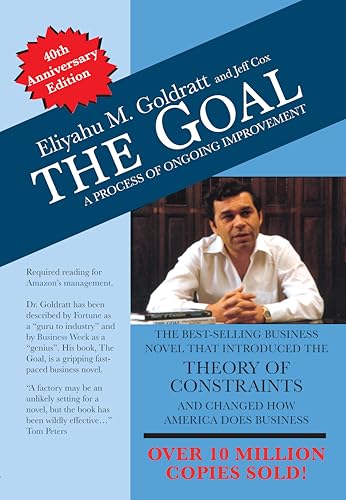
That is the setup of The Goal: A Process of Ongoing Improvement, first published in 1984 by physicist and management thinker Eliyahu M. Goldratt and writer Jeff Cox. Instead of a textbook, Goldratt chose to teach his ideas through a novel. The approach worked. The book has been revised several times, including a 30th-anniversary edition in 2014, and Time included it on its list of the most influential business management books. This summary covers the story's key lessons, the Theory of Constraints, the measures Goldratt uses to judge performance, and the limits of his approach.
What You'll Learn
- Why the goal of a business is to make money, and how that changes what "productive" means
- How throughput, inventory, and operating expense replace traditional efficiency measures
- What dependent events and statistical fluctuations do to a production line
- How to identify and manage bottlenecks using the five focusing steps
- Why Goldratt's ideas apply well beyond manufacturing
What Is the Goal?
Alex's turning point begins when he runs into Jonah, a physicist Alex knew from his student days who now thinks deeply about how organizations work. Jonah asks Alex a deceptively simple question: what is the goal of his company? After much reflection, Alex arrives at the answer: to make money, now and in the future.
That realization reframes everything. Alex's plant has been chasing local measures of efficiency, such as keeping every machine and worker busy. It has even installed expensive robots that appear to improve productivity. Jonah challenges Alex to ask whether these improvements actually help the plant make more money. If they do not increase sales or reduce inventory and costs, they are not truly productive.
Jonah gives Alex three measures that connect daily operations to the goal:
- Throughput is the rate at which the system generates money through sales, not just production.
- Inventory is all the money the system has invested in things it intends to sell.
- Operating expense is the money the system spends turning inventory into throughput. The aim is to increase throughput while reducing inventory and operating expense. Measured this way, a machine running at full capacity to produce parts no one is waiting for is not helping. It is adding inventory and cost.
Dependent Events and Statistical Fluctuations
Jonah rarely gives Alex direct answers. Instead, he asks questions and sends Alex off to figure things out with his team. One of the most important lessons comes from two ideas Jonah introduces: dependent events and statistical fluctuations.
In a plant, most steps depend on earlier steps. Each step's output also varies from day to day. Traditional planning assumes these variations average out. Goldratt shows why they do not. When steps depend on each other, delays accumulate down the line, while gains upstream are limited by slower steps downstream. In the book, Alex illustrates this with a simple game using dice and matchsticks, showing that even when every step has the same average capacity, the system as a whole underperforms and inventory piles up.
The lesson becomes vivid on a weekend hike with his son's Boy Scout troop. The line of boys keeps spreading out, and Alex realizes the group can only move as fast as its slowest hiker, a boy named Herbie. Pushing the faster kids to move quicker only widens the gaps. The solution is to put Herbie at the front so the group stays together, lighten his load by distributing the contents of his heavy backpack, and keep everyone moving at a pace he can maintain. Herbie becomes the book's enduring symbol of a bottleneck.
Finding and Managing Bottlenecks
Back at the plant, Alex and his team search for their own Herbies. They identify two bottlenecks: a sophisticated machine called the NCX-10 and the heat-treat operation. Every other resource in the plant has more capacity than these two, which means the bottlenecks determine the output of the entire plant.
That insight leads to a cascade of changes:
- Protect bottleneck time. Since the bottlenecks determine overall output, any time they sit idle is lost for the whole plant. The team stops letting them sit unused during breaks and shift changes.
- Do not waste bottleneck capacity. They move quality checks ahead of the bottlenecks so the constrained machines do not spend time processing parts that will later be scrapped.
- Prioritize the right work. Bottlenecks should work on orders that customers are waiting for, not on parts that will sit in a warehouse.
- Add capacity where it matters. The team brings an older machine back into service to help the NCX-10 and finds ways to relieve heat treat.
- Pace the rest of the plant. Non-bottleneck resources should release work at the pace the bottleneck can handle, even if that means they are sometimes idle. Alex also learns to reduce batch sizes, which shortens lead times and reduces inventory, even though it looks less "efficient" by traditional measures. As these changes take hold, the plant begins shipping orders on time and its financial results improve.
The Five Focusing Steps
As the story progresses, Alex and his team distill what they have learned into a repeatable process, now known as the five focusing steps of the Theory of Constraints:
- Identify the system's constraint.
- Exploit the constraint by getting the most out of it with existing resources.
- Subordinate everything else to the constraint, aligning the rest of the system to support it.
- Elevate the constraint by adding capacity if needed.
- Repeat the process, because once a constraint is broken, a new one will emerge. Do not let inertia become the new constraint. By the end of the book, Alex realizes that the same logic applies beyond the factory floor. A constraint can be a market, a policy, or a way of thinking. Goldratt's broader message is that every organization has a few constraints that determine its performance, and focusing improvement efforts on them produces outsized results. The same principles later inspired The Phoenix Project, which applies them to IT and software delivery.
Theory of Constraints at a Glance
- Local efficiency can hurt the system. Keeping every resource busy often increases inventory without increasing sales.
- The constraint sets the pace. Improvements anywhere else have little effect on overall output.
- Measure money, not motion. Throughput, inventory, and operating expense reveal whether activity actually helps the business.
- Improvement never ends. Fixing one constraint reveals the next.
A Quick Start Guide to Finding Your Constraint
- Define the goal. Decide what your team or business is ultimately trying to achieve, in measurable terms.
- Map the flow of work. Trace how work moves through your team or process from start to finish, and look for where it piles up.
- Protect the constraint. Make sure the bottleneck resource is never idle waiting for inputs, approvals, or rework.
- Stop overproducing upstream. Release work into the system only as fast as the constraint can handle it.
- Re-evaluate regularly. After relieving one bottleneck, look for the next one rather than assuming the job is done.
Who Should Read The Goal (and Who Can Skip It)
- Read it if you manage operations, supply chains, manufacturing, or any process where work flows through multiple steps.
- Read it if you want an engaging introduction to systems thinking that sticks better than a textbook.
- Read it if you work in project management, software, or services and want to understand where the Theory of Constraints came from.
- Skip it if you dislike business fables. The dialogue and subplot can feel stilted, and the core ideas could fit in a much shorter book.
- Skip it if you need a rigorous implementation manual. The book introduces concepts but leaves many practical details for later works.
Final Reflections
The Goal has endured for decades because it makes systems thinking intuitive. Herbie and the dice game are memorable teaching tools, and the book's central insight, that improving non-constraints is often wasted effort, challenges assumptions many managers still hold. Its critique of traditional cost accounting and local efficiency metrics remains relevant in organizations that reward busyness over results.
The book also has limitations. As a novel, it simplifies the messiness of real organizations: Alex's breakthroughs arrive neatly, and the plant's turnaround happens faster than it likely would in practice. The romance and family subplot can feel dated and distracting to some readers. The Theory of Constraints works best in environments with clear, relatively stable bottlenecks; in systems where constraints shift constantly, or where many variables interact, identifying a single constraint can be harder than the story suggests. Goldratt also founded a consulting and education organization around these ideas, and some critics argue the approach was oversold as a universal solution. Read it as an introduction to a powerful way of thinking, then test it carefully against your own operations.
The Bottom Line
Every system is limited by a small number of constraints, so the fastest way to improve results is to find the bottleneck, protect it, and align everything else around it.
Frequently Asked Questions
What is the Theory of Constraints?
The Theory of Constraints holds that every system's performance is limited by a few constraints, or bottlenecks. Improving overall results requires identifying those constraints, getting the most out of them, aligning the rest of the system to support them, and adding capacity where needed.
Why does Goldratt criticize efficiency metrics?
Traditional efficiency metrics reward keeping every machine and worker busy. In a system with bottlenecks, this produces excess inventory and cost without increasing sales. Goldratt argues that throughput, inventory, and operating expense better reflect whether activity helps a business make money.
Does The Goal apply outside manufacturing?
Yes. The same principles apply to any process where work moves through multiple steps, including software development, healthcare, project management, and services. The key is to identify where work piles up and focus improvement efforts there.