
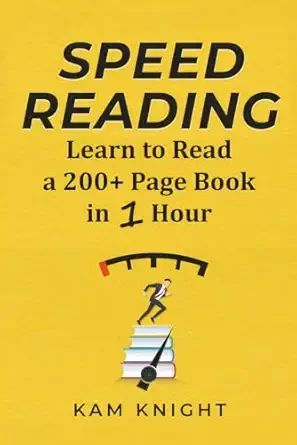
Learn to Read a 200+ Page Book in 1 Hour
by Kam Knight
The 60-Second Take
In Speed Reading, Kam Knight lays out a practical system for dramatically increasing your reading speed without sacrificing comprehension. He targets the habits that slow most readers down, like silently sounding out words and rereading, and replaces them with techniques such as using a pacer, widening your vision span, and sharpening focus. It is a hands-on guide to reading more in far less time.
How to Read Far Faster Without Losing Comprehension
Most of us read at roughly the same pace we did as children, sounding out each word in our heads one at a time. Given how much of modern professional life involves reading, reports, emails, articles, books, that habit quietly costs us enormous amounts of time. Kam Knight argues that reading speed is not a fixed trait but a skill, and that with the right techniques almost anyone can read substantially faster while understanding just as much. In Speed Reading, he offers a straightforward system for doing exactly that.
Knight's approach is practical rather than theoretical. He focuses on identifying the specific habits that slow readers down and replacing them with better ones through deliberate practice. This summary lays out the main culprits behind slow reading and the core techniques he recommends for overcoming them, along with the mindset needed to make the gains stick.
What You'll Learn
Why most people read far slower than they could
The habits that quietly cap your reading speed
How to use a pacer to guide your eyes
Why widening your vision span lets you read in chunks
How focus and practice cement faster reading
The Habits That Slow You Down
Knight begins by diagnosing why most people read slowly, and the causes are largely habits rather than limits of intelligence. The first is subvocalization, the inner voice that pronounces each word as you read. Because it ties your reading speed to your speaking speed, it acts as a ceiling, and learning to reduce it is one of the biggest levers for going faster. We learned to read by sounding words out, and most of us never unlearned it.
A second major culprit is regression, the habit of unconsciously rereading words and sentences you have already covered. These backward jumps feel like they aid comprehension but usually just waste time and break your flow. A third is reading word by word, fixating on each individual word rather than taking in groups of words at a glance. Together these habits keep most readers crawling along well below their potential, and naming them is the first step to fixing them.
The Core Techniques
The book's central practical tools follow directly from those problems. To combat reading word by word, Knight teaches readers to widen their vision span so they take in several words, or whole phrases, in a single fixation. The eyes naturally see more than one word at a time, and with practice you can train yourself to read in meaningful chunks rather than tiny individual steps, covering far more ground per glance.
To address pacing and regression, he recommends using a pacer, such as a finger, pen, or cursor, to guide your eyes smoothly across and down the page. A pacer sets a steady rhythm, discourages the backward jumps of regression, and keeps your attention moving forward. Combined with conscious effort to quiet subvocalization, these techniques attack the three main bottlenecks at once. None of them is complicated, but each requires deliberate practice to become natural.
The Speed Reading Toolkit at a Glance
Reduce subvocalization. Quiet the inner voice that ties reading speed to talking speed.
Eliminate regression. Stop the unconscious rereading that wastes time and breaks flow.
Widen your span. Take in groups of words per glance instead of one word at a time.
Use a pacer. Guide your eyes with a finger or pen to keep a steady forward rhythm.
Practice deliberately. Treat speed reading as a skill built through consistent drills.
Focus, Comprehension, and Practice
A concern many people have is that reading faster must mean understanding less. Knight argues the opposite can be true. Slow, word-by-word reading actually invites the mind to wander, because it under-uses your mental capacity, whereas reading at a brisker pace can demand more active engagement and improve focus. The goal is not reckless skimming but a faster, more attentive form of reading that keeps your mind fully occupied with the material.
Knight also stresses that concentration is central to reading well at any speed, and he offers guidance on minimizing distractions and staying mentally present. Above all, he treats speed reading as a trainable skill that responds to deliberate practice. The techniques feel awkward at first and may even slow you down briefly as you break old habits, but with consistent drills they become automatic, and your everyday reading speed rises. Like any skill, the gains come from reps, not from reading about the method once.
A Quick Start Guide to Reading Faster
Notice your inner voice. Become aware of subvocalization and practice quieting it on easy material.
Stop rereading. Resist the urge to jump back, trusting that your first pass caught the meaning.
Use a pacer. Run a finger or pen under the lines to set a smooth, steady pace.
Read in chunks. Practice taking in groups of words per glance rather than one word at a time.
Drill consistently. Treat it as skill-building, accepting early awkwardness on the way to lasting speed.
Final Reflections
Speed Reading is a focused, no-frills guide that delivers on a genuinely useful promise: for readers willing to practice, it can meaningfully increase how much they get through without sacrificing understanding. Its value lies in clearly naming the habits that hold most people back and offering simple, repeatable techniques to replace them. The catch, as Knight is honest about, is that results require practice rather than a one-time read. For busy professionals, students, or anyone who faces more reading than time allows, the book offers a practical path to reclaiming hours by turning reading into a skill you actively develop.
The Bottom Line
You read slowly mostly because of fixable habits like silently sounding out words and rereading, so break those, guide your eyes with a pacer, and your speed climbs without costing comprehension.
Business Floss is reader-supported. When you use our links we may earn an affiliate commission that helps us keep the site running. Thank you for your support!