
Do Hard Things
Why We Get Resilience Wrong and the Surprising Science of Real Toughness
by Steve Magness
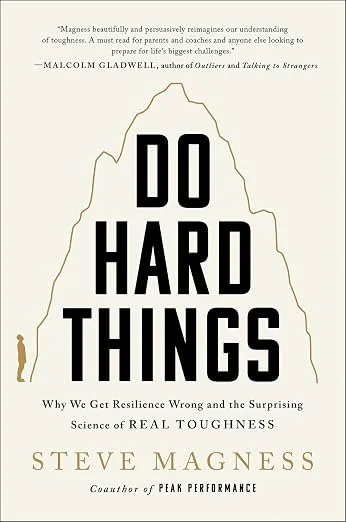
“In Do Hard Things, Steve Magness beautifully and persuasively reimagines our understanding of toughness. This is a must-read for parents and coaches and anyone else looking to prepare for life’s biggest challenges.”
Do Hard Things: Redefining Toughness for the Modern Professional
We have a massive cultural misunderstanding about what it means to be "tough."
Picture the classic image of resilience. You probably imagine a stoic leader—maybe a football coach or a CEO during a crisis—who shows zero emotion. They grit their teeth, suppress their fear, and barrel through obstacles with sheer willpower. We are taught that to be tough is to ignore pain, to silence our internal doubts, and to act with unwavering confidence even when we are terrified.
But what if this "fake it 'til you make it" approach is actually making us weaker?
In Do Hard Things, performance coach and science writer Steve Magness dismantles the traditional, machismo-fueled definition of resilience. He argues that the old model—based on fear, hiding weakness, and suppressing emotion—is brittle. It works right up until the moment it snaps. Real toughness isn't about ignoring how you feel; it's about acknowledging the difficulty, sitting with the discomfort, and making a calculated choice anyway.
What You'll Learn
The Myth of the Poker Face: Why hiding your stress actually increases the biological load on your body and mind.
Interoception: How to read your body’s signals accurately so you don't panic unnecessarily.
The Gap: How to create a split-second of space between a stimulus (stress) and your response (action).
True Control: Why trying to control the uncontrollable is a recipe for anxiety, and what to focus on instead.
The Façade of Toughness: Why "Gritting Your Teeth" Fails
For decades, the business and sports worlds have subscribed to the "drill sergeant" model of toughness. This model tells us that emotions are weaknesses to be stamped out. If you are nervous before a big pitch, you are told to suppress it. If you are burned out, you are told to grind harder.
Magness points to research showing that this method is scientifically flawed. When we suppress our emotions—known as "expressive suppression"—our internal stress response actually skyrockets.
Imagine you are in a high-stakes negotiation. Your heart starts racing. The old model says, "Ignore it. Don't let them see you sweat." You put on a mask of calm. But physiologically, your body enters a state of dissonance. The effort required to hold up that mask consumes the cognitive energy you need to negotiate effectively. You become less adaptable, more rigid, and more likely to make a bad decision.
The "Glass Jaw" of the Stoic Magness shares a compelling insight: people who rely on external displays of toughness often have the most fragile internal states. They are terrified that if they let the mask slip, they will be exposed as frauds. Real resilience is having the security to say, "This is really hard, I am feeling anxious, and I am going to proceed."
Real-World Example: Consider a project manager whose deadline is suddenly cut in half. The "old toughness" approach is to bark orders, claim "we've got this," and drive the team into the ground while privately panic-spiraling. The "new toughness" approach is to gather the team, admit the situation is dire ("This is a brutal timeline"), and then pivot to problem-solving ("Let's cut these three non-essential features so we can survive"). The former creates a brittle team; the latter builds a resilient one.
Listen to Your Body: The Science of Interoception
One of the most practical concepts Magness introduces is interoception. This is your brain's ability to sense what is happening inside your body—your heartbeat, your breath, your gut feelings.
Many of us are terrible at this. We feel a sensation—say, a tightening chest—and our brain immediately interprets it as "Fear! Danger! Panic!" We catastrophize. We assume that because we feel shaky, we are failing.
True toughness involves decoupling the sensation from the story. A truly tough individual feels the racing heart and thinks, "My body is mobilizing energy for a challenge. This is arousal, not just fear." By accurately interpreting the signal, you strip it of its power to paralyze you.
The Panic Spiral Think of it like a car dashboard. If a light flashes, you can either tape over it (suppression/old toughness) or you can check the engine (real toughness). If you tape over it, you might drive for another 100 miles, but eventually, the engine will blow. If you check it, you might realize it’s just a sensor error, or a minor issue you can manage.
Respond, Don't React: Creating "The Gap"
The core skill of real toughness is creating space. In psychology, this is often linked to the work of Viktor Frankl, who famously said that between stimulus and response, there is a space, and in that space lies our freedom.
When we are under pressure, the amygdala (the brain's threat detection center) wants to hijack the system. It wants an immediate reaction: yell, run, freeze, or give up. This is the "react" mode.
Resilience is the ability to widen the gap between the urge and the action. It is the discipline to feel the urge to scream at a frustrating client, notice that urge, sit with it for three seconds, and then choose a calm, professional reply.
Magness suggests that we often confuse "reactive discipline" with toughness. We think the person who immediately jumps into action is the leader. But often, the person who pauses, assesses, and then acts is the one who survives the storm.
Key Terms at a Glance
The Resilience Toolkit
Expressive Suppression The act of masking inner emotions to appear calm. Research shows this increases blood pressure and cognitive load, making you less effective at solving problems.
Interoception The sense of the internal state of the body. High interoception allows you to distinguish between "I am tired" and "I am injured," or "I am excited" and "I am terrified."
Cognitive Reappraisal The ability to change the emotional trajectory of a situation by reinterpreting it. Instead of viewing a difficult meeting as a "threat," you view it as a "challenge."
Approach Motivation vs. Avoidance Motivation Avoidance is driven by fear (trying not to lose). Approach is driven by reward (trying to win). Toughness is shifting your mindset from "Don't mess this up" to "Let's see what I can do."
Urge Surfing A mindfulness technique where you notice an impulse (to quit, to yell, to check your phone) and "ride the wave" of the urge until it subsides, rather than giving in to it immediately.
Parenting and Leadership: Stop Removing Obstacles
Magness applies these principles beyond the individual, touching on how we lead teams and raise children. In an effort to be helpful, many modern leaders and parents try to "snowplow" the path—removing all obstacles so their team or child never experiences failure.
This destroys resilience. If you never let your junior employees struggle with a difficult client, they never develop the "psychological immune system" necessary to handle stress. They become dependent on you to fix everything.
The "Wise" Leader The goal is not to be a tyrant who creates artificial hardship, nor a helicopter boss who prevents all hardship. The goal is to be a "responsive" leader. You provide support and resources, but you allow the struggle to happen. You validate their feelings ("I know this client is frustrating") without solving the problem for them ("How do you think we should handle it?").
Transcend Discomfort: Finding the "Why"
Finally, Magness argues that toughness is easier when it is in service of something bigger than your ego. If you are enduring a difficult quarter just to get a bonus (extrinsic motivation), your resilience will be shallow. When the pain of the work outweighs the pleasure of the potential money, you will quit.
But if you are enduring the difficulty because you care deeply about your team or the mission of the company (intrinsic motivation), you can withstand significantly more pain. This is "transcendent" toughness. It shifts the focus from "poor me, this is hard" to "this is necessary for what I want to achieve."
Quick Start Guide: The 4-Step Resilience Reset
The next time you feel overwhelmed, threatened, or on the verge of "losing it" at work, use this process to move from reactive to responsive.
Drop the Mask Stop trying to look cool. Admit to yourself (and perhaps a trusted peer) that the situation is difficult. Saying "I am feeling anxious right now" actually reduces amygdala activation.
Audit Your Body (Interoception) Scan your physical state. Are your hands shaking? Is your jaw clenched? Label these sensations objectively. "My heart is beating fast." Do not attach a judgment to it. It’s just data.
Zoom Out Shift your perspective. Ask yourself: "Is this a tiger attacking me, or just an awkward email?" Most business threats are social, not physical. Remind your brain that you are safe.
Choose the "Hard" Right Once you have created that space, identify the action that aligns with your values, not your fears. The "easy" thing might be to stay silent; the "hard" thing might be to speak up. Do the hard thing.
Final Reflections
Do Hard Things fundamentally rewrites the script on what it means to be strong. Steve Magness moves us away from the outdated, Hollywood version of the unshakeable hero and toward a more human, scientifically accurate version of resilience. Real toughness is not the absence of fear; it is the ability to navigate through it. It is about honesty, self-awareness, and the deliberate choice to face reality rather than hide from it. Whether you are leading a company through a downturn or just trying to get through a stressful Tuesday, the path to resilience isn't found in suppressing your humanity—it's found in embracing it.
Business Floss is reader-supported. When you use our links we may earn an affiliate commission that helps us keep the site running. Thank you for your support!