
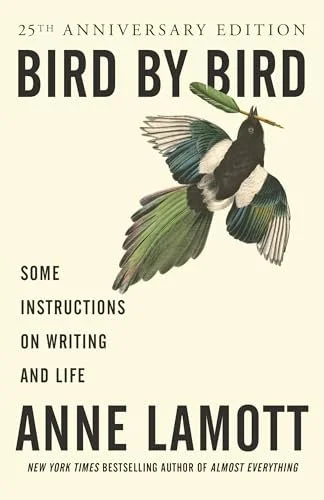
Bird by Bird
Some Instructions on Writing and Life
by Anne Lamott
“[Lamott] uses her writing exercises or lessons as a way to help us more deeply understand ourselves and the human condition in all its messiness. If you’re looking for sense-making and meaning during this deeply destabilizing time, this book is timeless.”
Don’t Scale the Glacier: Master Your Craft Bird by Bird
Imagine you are staring at a blank slide deck for a board meeting that determines your department's budget for the next three years. Or maybe you are sitting in front of a draft for a brand-new product launch that feels so monumental it has essentially paralyzed your ability to type a single sentence. You know where you need to go, but the sheer distance between "here" and "finished" feels like trying to scale a glacier in dress shoes. Most professionals respond to this pressure by cleaning their desks, checking emails for the tenth time, or descending into a spiral of self-doubt.
In her classic summary of the creative life, Bird by Bird, Anne Lamott offers a deceptively simple solution to this paralysis. The title comes from a story about her ten-year-old brother, who was sitting at the kitchen table surrounded by unopened books on birds, close to tears because a massive report due the next day felt impossible to finish. Their father sat down, put an arm around him, and said, "Bird by bird, buddy. Just take it bird by bird."
This is more than just writing advice; it is a fundamental strategy for managing the overwhelming complexity of professional life. Lamott argues that the secret to high-level output isn't a rare spark of genius, but a disciplined commitment to showing up, being messy, and focusing on the tiny "one-inch picture frame" directly in front of you.
What You'll Learn
The Permission to Fail: Why "shitty first drafts" are the only path to a brilliant final product.
The One-Inch Frame: How to stop "scaling the glacier" and start focusing on the next manageable task.
Silencing the Inner Critic: Tactics for turning down the volume on "Radio Station KFKD"—the internal broadcast of self-loathing.
The Polaroid Strategy: Why you should let your projects develop slowly rather than forcing immediate clarity.
Truth Over Polish: How being authentic in your professional communications builds more trust than a perfectly curated facade.
The Liberating Power of the Shitty First Draft
One of the greatest myths in the business world is the idea of the "effortless expert." We see a polished keynote speech or a flawless quarterly report and assume the creator sat down and channeled perfection directly onto the page. Lamott shatters this illusion with her concept of "shitty first drafts" (SFDs).
She confesses that almost every successful writer she knows—including herself—starts with a draft that is disorganized, overlong, and downright embarrassing. The purpose of this first attempt isn't to be good; it’s to exist. In a corporate environment where we are often terrified of looking incompetent, we tend to edit our thoughts before they even leave our brains. This internal censorship kills innovation.
Think of a young marketing executive tasked with writing a high-stakes campaign pitch. If she tries to write the "perfect" version on the first try, she will likely spend four hours staring at a blinking cursor. If she gives herself permission to write a "shitty" version, she might finish in forty-five minutes. Only then does she have the raw material she needs to begin the actual work of editing and refining.
Core Concepts Defined
Shitty First Drafts (SFDs): The essential, unpolished first attempt at any project where the goal is quantity and "getting it down" rather than quality.
The One-Inch Picture Frame: A mental tool to limit your focus. If you can’t write the whole report, just write the paragraph describing one specific data point.
Radio Station KFKD: Lamott’s metaphor for the obsessive internal monologue that alternates between "you are a genius" and "you are a total fraud."
Polaroid Analogy: The idea that a story or project develops like an old-school photo; it starts blurry and vague, and you must wait for the details to sharpen over time.
Shrink Your Horizon: The One-Inch Picture Frame
When a project feels too big, our brains tend to "zoom out" to the entire mountain range, which triggers a fight-or-flight response. To counter this, Lamott keeps a small, one-inch picture frame on her desk. It serves as a physical reminder that she doesn't need to see the whole landscape. She only needs to see what fits inside that one-inch square.
In a business context, this is the ultimate antidote to "analysis paralysis." If you are overwhelmed by a massive restructuring plan, don't think about the restructuring. Think about the one-inch frame: the email you need to send to a single stakeholder to schedule a discovery call. Once that is in the frame, do it. Then, move the frame to the next inch.
By intentionally narrowing your focus, you bypass the amygdala's fear response. You stop worrying about the "publication" (the final board approval) and start focusing on the "writing" (the work itself). This shift from outcome-oriented thinking to process-oriented thinking is what allows for sustained, high-quality output over a long career.
Key Terms at a Glance
Short Assignments: Breaking a massive goal into tiny, specific tasks that can be completed in a single sitting.
"The Down Draft": Another name for the first draft—you just get everything "down."
"The Up Draft": The second draft, where you "fix it up" and find the structure.
"The Dental Draft": The final polish where you check every "tooth" to ensure it’s healthy and aligned.
Managing the Chaos of the Inner Critic
Even with a one-inch frame and permission to be "shitty," your brain will still try to sabotage you. Lamott identifies this as "Radio Station KFKD." On one side of the dial, you hear the "K-Fucked" broadcast: a stream of insults telling you that your ideas are derivative, your peers are smarter, and you will eventually be found out. On the other side is the ego-driven broadcast: the fantasy of standing ovations and universal acclaim.
Both stations are dangerous because they pull you away from the work. Lamott’s advice isn't to fight these voices—that just gives them more energy. Instead, she suggests a visualization technique. Imagine the voices as small mice. Pick them up one by one, drop them into a jar, and put the lid on. You can still hear them thumping around, but you don't have to listen to the lyrics of their song.
A senior partner at a law firm once shared a similar tactic. Before every major trial, he would write down his three biggest fears on a post-it note—"I'll forget the evidence," "The judge will dislike me," "The client will fire me"—and then literally lock that note in his desk drawer. By "housing" the anxiety elsewhere, he freed up his mental RAM to focus on the actual case.
Watching the Polaroid Develop
We often demand clarity too early in the process. We want the "Executive Summary" to be clear before we’ve even finished the research. Lamott compares the creative process to a Polaroid photo. When the film first pops out of the camera, it’s a yellowy-gray mess. If you get frustrated and throw it away because you can't see the image yet, you’ve failed. You have to wait. You have to trust that the chemicals are working.
In project management, this means allowing for a "discovery phase" where the goal is actually to be confused. If you already know exactly how the project will end, you aren't innovating; you're just executing a pre-existing plan. True breakthroughs happen when you allow the details to sharpen on their own time.
If you are developing a new brand identity, the first three weeks might feel like a hazy blur of disconnected ideas. Don't panic. Keep looking at the "photo." Eventually, a certain color, a specific word, or a unique customer insight will start to darken and take shape. That is your lead. Follow it.
The Reward is the Process, Not the Publication
Lamott spends a significant portion of the summary discussing the "publication" trap. Many people believe that once they get published—or in a business sense, once they get the promotion, the big exit, or the public recognition—all their problems will vanish. They think they will finally feel "enough."
The reality is far grimmer. Success often brings a new set of anxieties: the pressure to repeat the performance, the jealousy of peers, and the realization that the "high" of a win lasts about forty-eight hours. If you are only doing the work for the "payoff," you will eventually burn out.
The "genius" of the Bird by Bird philosophy is that it reframes the work itself as the reward. The act of paying close attention to your world, of trying to tell the truth in your communications, and of solving difficult problems "inch by inch" is what provides lasting satisfaction. When you focus on the craft, the results tend to take care of themselves.
Quick-Reference Checklist: Your "Bird by Bird" Action Plan
Is your current project paralyzed? Shrink your focus until it fits inside a one-inch picture frame. What is the one thing you can do right now?
Are you editing while you draft? Stop. Commit to a "shitty first draft." Set a timer for 30 minutes and write without hitting the backspace key.
Is the internal critic too loud? Acknowledge the "KFKD" broadcast, put the "mice" in the jar, and return to the work.
Are you forcing clarity? Remember the Polaroid. If the project is still blurry, your only job is to stay in the room and keep watching.
Is the goal purely the "win"? Find one thing about the process of this task that is inherently interesting or satisfying, regardless of the outcome.
Are you being too polished? Try "telling the truth" in your next update. Use simple, human language instead of corporate jargon.
Final Reflections
Bird by Bird is an essential guide for any professional who has ever felt the weight of high expectations. Anne Lamott reminds us that perfectionism is not a virtue; it is a "voice of the oppressor" that prevents us from ever getting started. By embracing the "shitty first draft" and the "one-inch frame," we can break down even the most daunting glaciers into manageable steps. The key takeaway is that excellence is a byproduct of persistence and honesty, not a prerequisite for beginning. Take your career, your projects, and your life one bird at a time, and you’ll be amazed at how far you can go.
Business Floss is reader-supported. When you use our links we may earn an affiliate commission that helps us keep the site running. Thank you for your support!


