
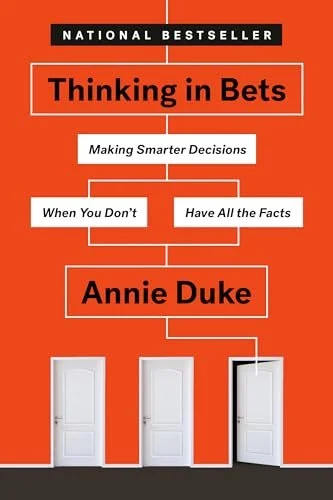
Thinking in Bets
Making Smarter Decisions When You Don’t Have All The Facts
by Annie Duke
“Through wonderful storytelling and sly wit, Annie Duke has crafted the ultimate guide to thinking about risk. We can all learn how to make better decisions by learning from someone who made choices for a living, with millions on the line.”
Betting on Success: How the World’s Best Leaders Master Uncertainty
Have you ever made a decision that felt absolutely right at the time, only to have it blow up in your face? Maybe you hired a candidate with a stellar resume who ended up being a toxic cultural fit, or you launched a marketing campaign that fell flat despite perfect data. In the aftermath, it’s tempting to point at the failure and say, "I made a huge mistake." But was the decision actually bad, or were you just the victim of a bad break?
In her book Thinking in Bets, Annie Duke—a former professional poker player turned cognitive psychology expert—argues that our lives are not games of chess where every move has a clear, logical outcome. Instead, life is like poker. It’s a game of imperfect information, hidden variables, and a massive amount of luck. Most of us are "resulting," a term Duke uses to describe the habit of judging the quality of a decision based solely on its outcome.
If you win a hand of poker while playing foolishly, you weren't "right"; you were lucky. If you make a calculated, high-probability business move and it fails, you weren't "wrong"; you just encountered the wrong side of the probability curve. By shifting your mindset to view every choice as a bet on a specific version of the future, you can strip away the ego, embrace uncertainty, and start making decisions that lead to long-term success.
What You'll Learn
The "Resulting" Trap: Why judging decisions by their outcomes is the fastest way to stall your professional growth.
Probabilistic Thinking: How to replace "I’m 100% sure" with "I’m 60% confident" to make smarter, more flexible choices.
The Power of "I Don't Know": Why admitting uncertainty is actually a competitive advantage in the boardroom.
Decision Pods: How to use social groups to fact-check your biases and prevent "echo chamber" errors.
Backcasting and Premortems: Strategic tools to visualize failure before it happens so you can plot a safer course.
The Danger of "Resulting" and the Illusion of Control
Imagine a CEO who decides to pivot the company’s entire product line based on a "gut feeling." The pivot works, and the stock price triples. The business world hails them as a visionary. Now, imagine the same CEO makes the same choice, but a global supply chain crisis hits two months later, bankrupting the company. Now, they are labeled "reckless."
In both scenarios, the quality of the decision-making process was identical. The only difference was luck. Duke points out that when we "result," we fail to learn the right lessons. A salary-negotiation win might have been the result of your brilliant persuasion, or it might have just been that the manager was desperate to fill the role that morning. If you don't distinguish between your skill and the luck of the draw, you’ll repeat the same mistakes when the luck runs out.
To think in bets is to realize that there are very few "sure things." When you frame a decision as a bet, you are forced to acknowledge that there is a range of possible outcomes. You begin to ask, "How much am I willing to wager on this belief?" This naturally leads to a more rigorous evaluation of the facts.
Core Concepts Defined
Resulting: The tendency to equate the quality of a decision with the quality of its outcome.
Hindsight Bias: The inclination, after an event has occurred, to see the event as having been predictable, even if there was no objective basis for predicting it.
The "Wanna Bet?" Probe: A mental (or literal) challenge that forces you to examine how much you actually trust your own information.
Information Asymmetry: The reality that you never have all the facts; the "other side" always knows something you don't, and the "world" has hidden variables.
Embracing Uncertainty: The "I’m Not Sure" Advantage
In many corporate cultures, saying "I don't know" is seen as a sign of weakness. We are rewarded for being "bold" and "certain." However, Duke argues that the most successful people are those who can quantify their uncertainty.
Instead of saying, "Our new software will be a hit," a "betting" leader says, "I am 70% confident this software will meet our Q4 targets." That remaining 30% is crucial. It’s not a lack of confidence; it’s an admission of reality. This 30% allows you to:
Stay Open to New Information: If you are "100% sure," you’ll ignore red flags. If you are "70% sure," you’ll actively look for the missing 30% of data.
Mitigate Risk: By acknowledging the chance of failure, you can build contingencies.
Lower the Temperature: It’s much easier to change your mind when you weren't "certain" to begin with.
Consider a small marketing firm that landed a huge client. Instead of popping champagne and assuming they are "the best," the team did a "luck audit." They realized they won partly because the client’s cousin worked at their firm. By acknowledging this bit of luck, they didn't get overconfident; they worked twice as hard to prove their actual skill once the contract started.
Building a Truth-Seeking Culture
We are all prone to "motivated reasoning"—the habit of only seeing the information that confirms what we already believe. To fight this, Duke suggests forming a "decision pod." This is a group of people committed to accuracy over ego.
A true decision pod follows three rules:
A Focus on Accuracy: The goal isn't to be "nice" or "supportive"; it’s to find the truth.
Accountability: Members are held responsible for the logic of their choices, regardless of how they turned out.
Openness to Diversity: You need people who think differently than you do to spot the blind spots you can't see.
When a manager at a high-growth tech startup started a "Bad Decision Log," the culture shifted. Instead of hiding mistakes, team members competed to show how they had identified a flaw in their own thinking. By rewarding the process of finding errors, the company actually made fewer of them.
Tactics for Better Betting
The Premortem: Before starting a project, imagine it has failed spectacularly. Now, look backward and ask, "What happened?" This uncovers risks that optimism usually hides.
Backcasting: Imagine a successful outcome and map out the specific steps required to get there. It’s the positive version of a premortem.
10-10-10 Rule: Ask yourself: How will I feel about this decision in 10 minutes? 10 months? 10 years? This helps detach from the emotional "sting" of a temporary setback.
Tilt Control: In poker, "tilt" is when emotions take over. In business, recognize when you are too angry, tired, or frustrated to make a rational bet. Walk away from the keyboard or the meeting until you’re "level."
Navigating the Future with a Betting Mindset
The world is chaotic, and your "bets" won't always pay off. However, the secret to a successful career isn't avoiding bad outcomes; it’s about making the best possible bets with the information you have. If you play the percentages correctly over a long enough timeline, the "luck" tends to even out, and your superior decision-making process will carry you to the top.
When you stop trying to be "right" and start trying to be "accurate," you transform the way you lead. You become more resilient to failure and more humble in success. You stop being a victim of the "resulting" trap and start being a master of the game.
Quick Start Guide: Your First 30 Days
Day 1-7: Conduct a Decision Audit. Look at your three biggest wins and three biggest losses from the last year. Be honest: How much of each was skill, and how much was luck?
Day 8-14: Implement "Percent Thinking." For the next week, don't allow yourself to say you are "sure" about anything. Assign a percentage of confidence to every prediction you make in meetings.
Day 15-21: Run a Premortem. Take your most important current project. Gather your team and spend an hour explaining why it failed a year from now. Document the "causes" and adjust your plan today.
Day 22-30: Find Your Truth-Seekers. Identify two colleagues who aren't afraid to tell you you're wrong. Ask them to be your "decision pod" for one specific upcoming choice.
Final Reflections
Thinking in Bets is a masterclass in intellectual humility and strategic discipline. Annie Duke successfully bridges the gap between the high-stakes world of professional poker and the high-pressure environment of corporate leadership. The core takeaway is simple but profound: outcomes are not the same as decision quality. By detaching our egos from the results and focusing instead on a rigorous, probabilistic process, we can navigate uncertainty with confidence. Master the art of the "bet," and you’ll find that while you can't control the cards you're dealt, you can certainly control how you play the hand.
Business Floss is reader-supported. When you use our links we may earn an affiliate commission that helps us keep the site running. Thank you for your support!


