
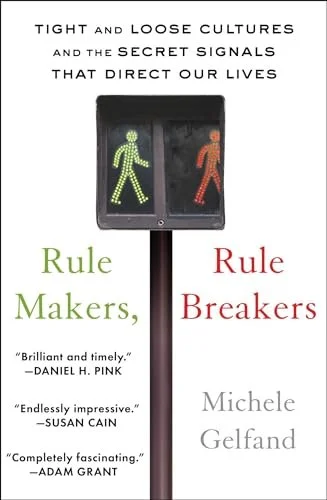
Rule Makers, Rule Breakers
Tight and Loose Cultures and the Secret Signals That Direct Our Lives
by Michele Gelfand
“Remarkable. Not just an enlightening book but a game-changing one. By uncovering the inner workings of tight and loose cultures, Rule Makers, Rule Breakers suddenly makes sense of the puzzling behavior we see all around us—in colleagues, family, and even ourselves.”
The Invisible Blueprint: Why Some Teams Thrive on Order and Others on Chaos
It is 11:00 PM in Berlin. The streets are deserted, and not a single car is in sight. Yet, a solitary pedestrian stands patiently at the crosswalk, waiting for the red light to turn green. Four thousand miles away in Boston, at the height of rush hour, a group of commuters barely glances at the "Don't Walk" sign before darting through a gap in traffic, forcing a cab driver to slam on his brakes.
Why do these two groups—both intelligent, modern professionals—behave so differently? In her groundbreaking work Rule Makers, Rule Breakers, cultural psychologist Michele Gelfand reveals that this isn't just about personal discipline or local habits. It’s about a hidden code that governs every nation, state, and boardroom on earth: the "Tight-Loose" continuum. By understanding whether your organization is "tight" (heavy on rules and social norms) or "loose" (permissive and open to deviation), you can finally make sense of why certain mergers fail, why some employees feel like they’re "walking on eggshells," and how to lead a team through a crisis.
What You'll Learn
The Tight-Loose Spectrum: Identify where your company, your country, and your family sit on the scale of social norms.
The Threat Factor: Why war, natural disasters, and even population density force cultures to "tighten up" for survival.
The Merger Minefield: How a mismatch between tight and loose cultures doomed the $36 billion Daimler-Chrysler merger.
Tight-Loose Ambidexterity: How to apply the "Goldilocks Principle" to ensure your team isn't too rigid to innovate or too loose to execute.
Leadership Nudges: Specific models (SECURE and EASE) to calibrate your management style based on your team's current DNA.
The Secret Code of Social Norms: Tight vs. Loose
Every professional environment has unwritten rules. In some offices, showing up five minutes late to a meeting is a fireable offense; in others, the meeting doesn't actually start until the coffee is brewed and everyone has caught up on their weekend. Gelfand defines these differences through the strength of social norms.
Tight cultures have many strong rules and a low tolerance for deviance. They value order, coordination, and precision. Think of the Swiss banking sector or the U.S. Navy. In these environments, you know exactly what is expected of you, and the social "punishment" for breaking a rule is swift and clear.
Loose cultures, by contrast, have weak social norms and a high tolerance for rule-breaking. They revel in ambiguity, risk-taking, and individual expression. Think of a Silicon Valley startup or a design agency in Amsterdam. Here, "moving fast and breaking things" isn't just a slogan; it’s the default setting.
Neither is inherently better. Tight cultures are masters of execution and safety, while loose cultures are the engines of creativity and tolerance. The danger arises when we don't realize which one we are working in.
Core Concepts Defined
Tightness: A culture characterized by strong social norms and low tolerance for deviation. Success is measured by coordination and self-control.
Looseness: A culture with weak social norms and high permissiveness. Success is measured by innovation and openness to new ideas.
The Fractal Pattern: The idea that tight-loose dynamics repeat at every level—from nations (Singapore vs. Brazil) to organizations (The FBI vs. Google) to individuals.
Normative Radar: Our innate ability (which varies by person) to detect and adjust to the social rules of the room.
Why Rules Evolve: The Evolutionary Logic of Threat
Gelfand's research shows that cultural tightness isn't a random accident; it is an evolutionary response to threat. When a group faces chronic danger—whether from natural disasters, famine, infectious diseases, or hostile neighbors—they must coordinate perfectly to survive. Rules become the "social glue" that prevents chaos.
Consider the contrast between Germany and Brazil. Germany, located in the heart of Europe, has faced centuries of territorial conflict and high population density. To survive, it developed a "tight" culture where clocks are accurate and laws are followed. Brazil, with its vast resources and historically fewer external threats, evolved a "loose" culture that prioritizes flexibility and social warmth over punctuality.
In business, we see this during a crisis. When a company is facing a hostile takeover or a massive product recall, it naturally "tightens" its culture. Decision-making becomes centralized, and rules become non-negotiable. However, if a company stays in "threat mode" for too long after the danger has passed, it risks becoming an oppressive environment that crushes the very innovation it needs to grow.
Utility Box: The Trade-Off Table
Tight Cultures (The Rule Makers)
Pros: Low crime, high synchronization, efficient execution, greater self-control (lower rates of obesity and debt).
Cons: Low creativity, resistance to change, higher ethnocentrism, lower happiness.
Loose Cultures (The Rule Breakers)
Pros: High creativity, tolerance of diversity, rapid adaptation to new information, greater openness.
Cons: Higher crime, coordination failures, higher impulsivity (higher rates of debt and substance abuse).
The $36 Billion Mismatch: When Cultures Clash
Perhaps the most famous example of a tight-loose collision is the 1998 merger between the German automaker Daimler-Benz and the American giant Chrysler. On paper, it was a "merger of equals" that promised global dominance. In reality, it was a cultural train wreck.
The Daimler side was quintessentially tight. They had a rigid hierarchy, strictly defined roles, and a 44-page dress code. The Chrysler side was quintessentially loose. Their executives were accustomed to a flatter structure, casual dress, and a culture of improvisational problem-solving.
The Germans were horrified by the Americans’ "disorganized" meetings, while the Americans felt the Germans were "stuffy" and "authoritarian." Because neither side understood the tight-loose dynamic, they viewed the other’s behavior as a personal or professional flaw rather than a different cultural operating system. The "merger of equals" ended in a messy divorce, costing investors billions. Understanding Gelfand’s framework could have allowed leadership to perform a "cultural audit" and bridge the gap before the first contract was even signed.
Achieving Ambidexterity: The Goldilocks Principle
The most successful leaders are those who can navigate both worlds—a concept Gelfand calls "tight-loose ambidexterity." If your organization is too tight, it becomes a "prison"; if it’s too loose, it becomes "anarchy." The goal is to find the "Goldilocks" zone in the middle.
How do you nudge a culture in the right direction? Gelfand offers two tactical models for leaders:
1. The EASE Model (For Tight Organizations Needing Looseness):
Examine: Audit your rules. Are they all necessary for safety, or are some just habit?
Allow: Create "safe zones" for experimentation where rules are temporarily suspended.
Shift: Decentralize decision-making to give frontline employees more discretion.
Encourage: Actively reward dissent and pushback to avoid groupthink.
2. The SECURE Model (For Loose Organizations Needing Tightness):
Set: Establish clear, non-negotiable benchmarks for performance.
Establish: Build structure through regular check-ins and formal protocols.
Centralize: Ensure key decisions have a clear owner to prevent "responsibility drift."
Uphold: Enforce consequences for violating core values or safety rules.
Reinforce: Publicly celebrate reliability and precision.
Enforce: Use oversight to ensure the "creative chaos" doesn't become "unproductive noise."
A classic example of this is the "dishwashers divide" in many households. One spouse is a "tight" loader (plates must face north, silver separated), while the other is "loose" (just jam it in). If they don't negotiate which domains are tight (e.g., finances) and which are loose (e.g., the laundry), they will spend their lives in a state of chronic irritation. The same applies to your product team and your accounting department.
Quick-Reference Guide: Mastering the Social Code
Conduct a Cultural Audit: Is your team currently tighter or looser than the environment requires? (e.g., A creative firm being run like a Swiss bank is a problem).
Identify Your "Tight" Domains: Every organization needs "islands of tightness"—usually around safety, ethics, and finances. Be explicit about where the rules are non-negotiable.
Create "Loose" Sandboxes: Give your high-performers room to "break the rules" in R&D or brainstorming sessions without fear of reprisal.
Manage the "Threat" Narrative: Recognize that when people feel threatened, they naturally want more rules. If you need to loosen up, you must first lower the perceived threat level.
Hire for Balance: If you have a room full of "Rule Breakers," your next hire should be a "Rule Maker" who can build the systems needed to scale that creativity.
Final Reflections
Rule Makers, Rule Breakers is a masterclass in understanding the invisible forces that shape human behavior. Michele Gelfand’s "Tight-Loose" framework provides a clear, scientific lens to view everything from international diplomacy to why your teenager won't clean their room. The central takeaway for the business professional is that culture is not just "vibe"—it is a functional response to the environment. By learning to recognize these patterns, you can stop judging the "other side" and start building organizations that are disciplined enough to win and flexible enough to last. Whether you are leading a Fortune 500 company or a three-person startup, the ability to balance tightness and looseness is the ultimate competitive advantage.
Business Floss is reader-supported. When you use our links we may earn an affiliate commission that helps us keep the site running. Thank you for your support!


