
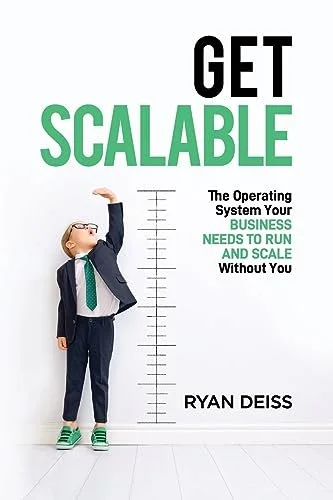
Get Scalable
The Operating System Your Business Needs to Run and Scale Without You
by Ryan Deiss
“Ryan Deiss is the real deal. He doesn’t just talk about building businesses; he’s done it over and over again. If you want to grow your business without losing your mind, you need the systems in Get Scalable.”
From Owner-Trap to Freedom: Building a Business That Doesn’t Need You
Imagine it’s Tuesday morning at 10:00 AM. You’re sitting on a beach, or perhaps just at a quiet coffee shop, and your phone hasn't buzzed once. No "quick questions" from your lead developer, no "emergency" client emails that only you can handle, and no Slack notifications about a broken process in the warehouse. For most founders, this isn't a dream—it feels like a fantasy. Instead, they are stuck in the "Owner Trap," a gilded cage where the business only grows if the founder works harder, sleeps less, and touches every single decision.
In Get Scalable, Ryan Deiss—the entrepreneur behind DigitalMarketer and Scalable.co—offers the blueprint to escape this cycle. He argues that most businesses don't have a "people problem" or a "product problem"; they have an "Operating System problem." Without a clear, documented way of doing things, the founder becomes the bottleneck. This summary is about shifting your role from the high-performing "Player" to the strategic "Architect," building a scalable machine that can run, grow, and even thrive without your constant intervention.
What You'll Learn
The Owner Trap: Why your "heroism" is actually the biggest obstacle to your company’s growth.
The 1:8:10 Rule: A framework for determining exactly where your time should be spent as a leader.
Standard Operating Procedures (SOPs) That Work: How to document processes without creating a mountain of useless paperwork.
The Scalable Operating System: The four core "circuits" that power a business capable of independent flight.
The Freedom Metric: How to measure your success based on how little the business needs you.
The Hero’s Downfall: Escaping the Owner Trap
Most entrepreneurs start their journey as a "MacGyver." They are scrappy, they can fix anything with a paperclip and duct tape, and they pride themselves on being the smartest person in the room. In the early days, this is a superpower. But as the company grows, this "heroism" becomes a liability. If you are the only one who can close the big deal or fix the technical glitch, you have created a job for yourself, not a scalable business.
Ryan Deiss identifies this as the Owner Trap. It occurs when the founder's intuition is the only source of truth. Because there are no documented systems, employees are forced to come to the founder for every minor decision. This creates a feedback loop: the founder gets overwhelmed, the employees feel disempowered, and the business plateaus because it can only move as fast as the founder can think.
To break free, you must stop being the "Chief Everything Officer" and start building a Scalable OS. This isn't about working more; it’s about working differently. It’s moving from doing the work to defining how the work is done.
Core Concepts Defined
The Owner Trap: A state where the business is entirely dependent on the founder’s daily involvement and decision-making.
Scalable Operating System (OS): The set of documented processes, tools, and rhythms that allow a business to function predictably.
The Architect Mindset: Shifting from "How do I do this?" to "How should this be done by someone else?"
Documentation Debt: The accumulated "cost" of not having systems, which results in repeated mistakes and wasted time.
The 1:8:10 Rule: Reclaiming Your Calendar
One of the most practical tools in Get Scalable is Deiss's framework for executive time management. He argues that a leader’s time should be split into three distinct buckets to ensure the business stays healthy and scalable:
1 Part Innovation: This is "Future You" time. It’s spent on high-level strategy, new product ideas, and identifying the next big mountain to climb.
8 Parts Management/Leadership: This is "Current You" time. It’s spent hiring, coaching, and ensuring the team has the resources they need to follow the Operating System.
10 Parts Operations (The Work): This is "Past You" time. This is the actual execution—writing the copy, coding the app, or selling the service.
The goal of scaling is to systematically eliminate the "10". You want to delegate the operational tasks so you can spend more time in the "1" and "8" buckets. If you find yourself spending 90% of your time on operations, you aren't scaling; you’re just staying busy.
The Four Circuits of a Scalable Business
Deiss breaks down the "Operating System" into four primary circuits. If any one of these is broken, the business will eventually stall.
The Strategy Circuit: This defines where the company is going. It includes your mission, values, and 1-year/3-year goals. Without this, the team is moving fast but in different directions.
The People Circuit: This defines who is doing the work. It’s not just about hiring; it’s about having a clear organizational chart where everyone knows exactly what they are responsible for (and what they are not).
The Process Circuit: This defines how the work gets done. This is where your SOPs live. A good process is simple enough that a new hire can follow it with 80% accuracy on their first day.
The Acceleration Circuit: This is how you measure and improve. It involves your "Scorecard"—the 5 to 15 key metrics that tell you the health of the business at a glance.
By treating these as actual "circuits," you can diagnose where the power is failing. If you have great people but things are still messy, your Process Circuit is likely "shorted out."
Key Terms at a Glance
SOP (Standard Operating Procedure): A step-by-step guide for a recurring task.
The Scorecard: A weekly report of high-level KPIs that allows the founder to manage by exception rather than by hovering.
Level 10 Meetings: A structured weekly meeting format (popularized by EOS but adapted here) to solve issues and keep the team aligned.
The Freedom Score: An internal metric that ranks how many consecutive days the business can run without the founder's input.
The "Good Enough" SOP: Overcoming Perfectionism
Many leaders fail at scaling because they try to document everything perfectly. They spend weeks writing a 50-page manual that no one ever reads. Deiss advocates for the "Minimum Viable Process." An SOP should be a "checklist for a pro," not an "instruction manual for an alien." Use Loom videos, bulleted lists, and simple diagrams. The goal is to capture the "how" so that if a key employee leaves, the knowledge doesn't leave with them. Deiss suggests a simple three-step process for documentation:
I Do It: Perform the task yourself.
We Do It: Have an employee help you while you document the steps together.
You Do It: The employee performs the task using the documentation while you watch for gaps.
Strategic Delegation: The Art of Letting Go
Scaling requires a psychological shift. You have to be okay with someone else doing a task at 80% of your quality level. If you insist on 100%, you will never scale. The "80% rule" is the price of freedom.
To delegate effectively, Deiss recommends the "Outcome-Based" approach. Instead of telling someone how to do every tiny step, tell them what the successful outcome looks like. If they know the goal (The Strategy) and have the tools (The Process), they can often find a better way to do it than you did. This empowers the team and frees the founder to focus on the next level of growth.
Quick-Reference Checklist: Your Scalable Start
Identify Your "Hero" Tasks: What are the top three things that only you can do? Make these the first priority for documentation.
Calculate Your Freedom Score: How many days could you turn off your phone right now before the business breaks? That is your starting line.
Build Your Scorecard: Identify the 5 metrics that represent the "pulse" of your business. If you only saw these 5 numbers, would you know if you were winning?
Record Your First SOP: Tomorrow, the first time you do a repetitive task, record your screen using Loom. Share that link with a team member. You’ve just started your Scalable OS.
Audit Your 1:8:10: Look at your calendar for the last week. Were you an Architect (1), a Leader (8), or a Player (10)?
Final Reflections
Get Scalable is more than a business book; it is a manifesto for professional liberation. Ryan Deiss successfully deconstructs the myth that growth requires more "hustle" from the founder. Instead, he proves that true scale comes from the discipline of systems. By shifting your mindset from "doing" to "designing," you transform your business from a chaotic, owner-dependent job into a valuable, independent asset. The core takeaway is that your business’s value is inversely proportional to how much it needs you. Master the Scalable OS, and you won't just build a bigger company—you’ll build a better life.
Business Floss is reader-supported. When you use our links we may earn an affiliate commission that helps us keep the site running. Thank you for your support!


