
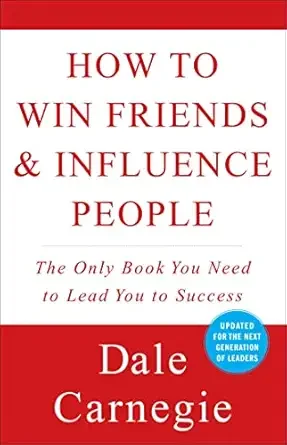
How to Win Friends & Influence People
The Only Book You Need to Lead You to Success
by Dale Carnegie
The 60-Second Take
In How to Win Friends and Influence People, Dale Carnegie codified the modern rules of human relations. Drawing on history, psychology, and his own corporate training courses, he proves that financial success and personal happiness rely far less on technical knowledge than on the ability to handle people. By mastering the art of sincere appreciation, active listening, and avoiding arguments, readers learn to navigate social friction and build immense, lasting influence.
The Ultimate Currency in Business is Human Ego
In the early twentieth century, the Carnegie Institute of Technology conducted a study that uncovered a startling statistic. Even in highly technical fields like engineering, roughly 15 percent of a person's financial success is due to their technical knowledge. The other 85 percent is due to human engineering—their personality and their ability to lead people.
Dale Carnegie, who was teaching public speaking courses in New York at the time, realized there was no practical textbook on human relations available for his adult students. So, he wrote one. Published during the Great Depression, How to Win Friends and Influence People became one of the most successful books in publishing history. It laid the foundation for the entire modern self-improvement industry.
The book's longevity is not an accident. Technological platforms change, but human nature remains completely static. We are creatures of emotion, motivated by pride and crippled by vanity. Carnegie’s genius was ignoring abstract psychological theory and focusing entirely on immediate, practical application. He built a framework for dealing with people exactly as they are, rather than how logic dictates they should be.
What You'll Learn
Why criticizing another person is mathematically useless for changing their behavior
The deepest urge in human nature and how to fulfill it for others
Why the best way to win an argument is to walk away from it
How to correct a subordinate's mistakes without destroying their morale
The critical difference between cheap flattery and sincere appreciation
The Futility of Criticism
The most common reaction to someone doing something wrong is to criticize them. We complain, we condemn, and we explain exactly why they failed. Carnegie argues that this is the absolute worst strategy you can employ. Criticism is futile because it puts the other person on the defensive and immediately forces them to justify their actions. It wounds their precious pride and arouses permanent resentment.
To illustrate this, Carnegie points to notorious criminals like Al Capone. Even Capone, a ruthless mobster, did not view himself as a villain; he saw himself as a public benefactor who was unfairly persecuted. If the most violent criminals in the country can justify their behavior and refuse to blame themselves, ordinary people in an office will certainly do the same.
When you criticize an employee or a partner, they will not absorb the lesson. They will only absorb the attack. They will blame the circumstances, or worse, they will blame you. The first fundamental technique of handling people is to completely abandon criticism, condemnation, and complaining. Instead of condemning people, you must try to understand why they do what they do. This breeds sympathy and tolerance, which are the only environments where actual change can occur.
The Craving to Be Important
If you cannot force people to do what you want through criticism, how do you move them? You make them want to do it. And the only way to make someone want to do something is to give them what they crave.
Carnegie leans on the philosopher John Dewey, who stated that the deepest urge in human nature is "the desire to be important." We all want health, food, sleep, and money. But the craving for a feeling of importance is a gnawing, unwavering hunger that is almost never fully satisfied. People will build massive houses they do not need, buy cars they cannot afford, and boast about their children just to secure a fleeting sense of importance.
The secret to winning friends is to feed this hunger in others. You do this through sincere, unselfish appreciation. Carnegie is very careful to draw a hard line between appreciation and flattery. Flattery is shallow, selfish, and easily detected; it is telling the other person exactly what they already think about themselves. Sincere appreciation requires you to actually stop thinking about yourself, look at the other person, and recognize their genuine strengths. When you leave a trail of sincere gratitude, you make people feel deeply valued. They will remember your words and work tirelessly to help you long after you have forgotten the interaction.
Winning the Argument by Avoiding It
Business culture often glorifies the debate. We are taught to gather our facts, present our logic, and demolish the opposing viewpoint. Carnegie views this as a fatal tactical error. You cannot win an argument. If you lose it, you lose it. If you win it, you still lose it.
When you triumph over someone in an argument and shoot their logic full of holes, you make them feel inferior. You have hurt their pride. A person convinced against their will is of the same opinion still. Even if they concede the point in the meeting room, they will resent you in the hallway, and they will never willingly cooperate with you in the future. The only way to get the best of an argument is to avoid it entirely.
If you know the other person is wrong, telling them so is a direct blow to their intelligence. Instead, Carnegie advises leading with humility. Say, "I may be wrong. I frequently am. Let's examine the facts." This approach disarms them. It removes the friction and opens the door to actual collaboration. Furthermore, if you realize that you are the one in the wrong, you must admit it quickly and emphatically. Condemning yourself aloud leaves the other person with only one way to nourish their own ego: by taking the magnanimous role and forgiving you.
Leadership Without Resentment
The final section of the book addresses the reality of management: eventually, you have to correct people and change their behavior. The challenge is doing so without causing offense.
Carnegie provides a specific sequence for this. You must always begin with praise and honest appreciation. This acts like a dentist's novocaine; it numbs the pain before the drilling starts. When you need to call attention to a mistake, do it indirectly. Never follow the praise with the word "but" (e.g., "You did a great job, but the report was late"). The word "but" instantly negates the praise. Replace it with "and" (e.g., "You did a great job, and if we can get the report in earlier next time, it will be perfect").
You must also talk about your own mistakes before criticizing the other person. Admitting that you struggled with the exact same issue when you were younger removes the sting of superiority. Instead of giving direct orders—which humans naturally rebel against—ask questions. "Do you think we could do it this way?" allows the employee to feel a sense of ownership over the solution. Above all, you must let the other person save face. Stripping a person of their dignity achieves nothing but making you a permanent enemy.
Carnegie's Rules at a Glance
Don't criticize, condemn, or complain. It puts people on the defensive and destroys goodwill.
Give honest and sincere appreciation. Feed the universal human craving to feel important.
Arouse an eager want. Stop talking about what you want; speak entirely in terms of what the other person desires.
Become genuinely interested in others. You make friends by listening, not by talking about yourself.
The power of a name. A person's name is to that person the sweetest and most important sound in any language.
The only way to win an argument is to avoid it. Winning a debate costs you the relationship.
A Quick Start Guide to Better Human Relations
Go 24 hours without complaining. Test your discipline. For one full day, refuse to criticize any person or situation. Notice how heavily you usually rely on negativity to communicate.
Remember and use their name. When you meet someone new, repeat their name back to them. Use it naturally in the conversation to prove you value them as an individual.
Praise something specific today. Find one colleague or family member and give them a highly specific piece of positive feedback. General praise is flattery; specific praise is appreciation.
Admit a fault immediately. The next time you make a mistake, do not defend it. Loudly and quickly agree that you were completely in the wrong.
Ask a question instead of giving an order. The next time you need someone to do a task, frame it as a request for their expertise: "What do you think is the best way to handle this?"
Who Should Read How to Win Friends and Influence People (and Who Can Skip It)
Read it if you are entering your first management role and realize that your technical skills are no longer enough to get the job done.
Read it if you work in sales, customer service, or any client-facing role where removing social friction is the key to closing the deal.
Read it if your personal relationships suffer from constant, exhausting arguments and you want a structural way to defuse tension.
Skip it if you are looking for advanced, tactical negotiation strategies. This is a book about foundational human psychology, not high-stakes contract leverage.
Skip it if you view every interaction as a zero-sum game of dominance. Carnegie's methods require a genuine surrender of ego; if you cannot be sincere, these techniques will just look like manipulative flattery.
Final Reflections
How to Win Friends and Influence People can occasionally feel like a relic of the 1930s. The prose is folksy, and the examples rely heavily on historical figures like Abraham Lincoln, Charles Schwab, and Theodore Roosevelt. Yet, if you look past the dated vocabulary, the underlying architecture of the book is flawless. It is a masterclass in emotional intelligence written decades before that term existed. The true challenge of the book is not understanding its rules—they are incredibly simple—but rather having the discipline to actually execute them. Suppressing your own ego enough to genuinely elevate someone else is exceptionally difficult, which is exactly why the few people who master it wield such massive influence.
The Bottom Line
The fastest way to gain influence is to completely abandon your own ego, refuse to criticize others, and focus entirely on making the people around you feel deeply, genuinely important.
Frequently Asked Questions
Is this book just about manipulating people?
This is the most common criticism of the book, but Carnegie explicitly addresses it. He insists that his principles only work when they come from the heart. If you try to use his rules as a cynical toolkit for manipulation, people will detect the insincerity and resent you. It requires a genuine paradigm shift in how you view others.
Why does Carnegie hate arguments so much?
Because he prioritizes the long-term relationship over the short-term victory of being "right." In business and in life, proving someone wrong with facts rarely changes their behavior; it usually just makes them double down out of spite. Avoiding the argument preserves the trust needed to actually influence their actions later.
Is the book still relevant today?
Absolutely. While we communicate differently now—via email and slack rather than letters and telegraphs—the people typing those messages still have the exact same craving for appreciation and the exact same hatred of criticism that they had in 1936.
Business Floss is reader-supported. When you use our links we may earn an affiliate commission that helps us keep the site running. Thank you for your support!


