
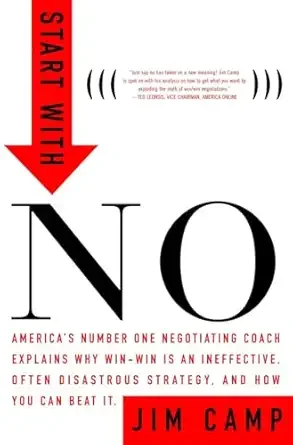
Start With No
The Negotiating Tools that the Pros Don't Want You to Know
by Jim Camp
The 60-Second Take
In Start with No, expert negotiator Jim Camp completely dismantles the popular "win-win" philosophy. He argues that chasing compromise turns negotiators into needy targets. Instead, Camp provides a system for maintaining emotional control, using open-ended questions to uncover the other party's true pain, and giving them the safety to reject you. By removing the pressure to agree, you build the foundation for a highly profitable, permanent decision.
The "Win-Win" Compromise Is Costing You Money
The prevailing wisdom in modern business is that every negotiation should end in a "win-win." We are taught to look for mutual gains, prioritize the relationship, and compromise so that everyone leaves the table feeling satisfied. It sounds wonderful in theory. According to the late Jim Camp, a legendary negotiation coach who brokered billions of dollars in deals, it is a catastrophic mistake in practice.
In Start with No, Camp argues that "win-win" is largely a trap set by aggressive negotiators to exploit nice people. When your primary goal is mutual satisfaction, you signal that you are desperate for a deal. You make unforced concessions just to keep the peace. Camp proposes a completely different system. You must kill your neediness, clear your mind of expectations, and actively encourage the other party to reject you.
The book strips away the pleasantries of corporate dealmaking and replaces them with a ruthless, behavior-driven framework. It is not about talking people into a corner; it is about managing your own emotions so perfectly that the other party feels completely safe telling you the truth.
What You'll Learn
Why the desire for a "win-win" outcome makes you an easy target
The absolute necessity of eliminating neediness from your behavior
How to use the Blank Slate to strip away dangerous assumptions
The mechanics of using interrogative questions to guide the other party's vision
Why you must focus entirely on behavior rather than the final outcome
The Danger of Neediness and the Safety of "No"
Neediness is the single greatest point of failure in any negotiation. When you need the commission, need the prestige of the client, or need the deal to close by Friday, the other side will sense it instantly. They will use that desperation to extract brutal concessions. Camp draws a hard line: you do not need any deal. You might want it, but your survival does not depend on it.
To neutralize this neediness, Camp insists you must stop chasing the word "yes." A quick "yes" is often counterfeit. It is a defensive move designed to get a pushy salesperson out of the room or to feign agreement while hiding true intentions. "Maybe" is even worse. It is a purgatory that drains your time, your resources, and your emotional energy.
"No" is the only safe harbor. When a negotiator tells the other side early in the process, "If at any point this doesn't make sense, just tell me no," the entire atmosphere changes. The pressure evaporates. The other party stops worrying about being manipulated and actually starts listening. Camp teaches that "no" is not a rejection; it is simply a decision that maintains the other party's right to veto. By giving them that power, you earn the right to actually negotiate.
Building a Valid Mission and Purpose
Most people enter a room with a mission focused entirely on themselves. They think, "I want to sell this software for a million dollars." That is not a mission. That is a quota. The buyer could not care less about your internal sales goals.
A valid Mission and Purpose must be firmly rooted in the other party's world. Your goal is not to close a deal; your goal is to help the other side see and solve a problem they are currently facing. If your mission is to help a client reduce their manufacturing downtime by twenty percent, every question you ask and every feature you present will be aligned with their pain. When you negotiate strictly within the other party's world, you stop sounding like a typical vendor and start acting like a trusted consultant. You stop pushing a product and start building a shared vision of a better reality for them.
The Blank Slate and Interrogative Questions
We walk into meetings carrying incredibly heavy baggage. We assume we know what the client wants, we anticipate their objections, and we worry about our own deadlines. Camp calls this baggage, and it completely deafens you to what the other party is actually saying.
You must learn to create a "Blank Slate." This is the mental discipline of clearing your mind of all expectations and biases before the conversation begins. When your mind is blank, you are not busy formulating your next argument while the other person is talking. Instead, you can observe the subtle shifts in their tone, their posture, and their word choice. You can hear the actual pain they are trying to hide.
Once your slate is clean, you guide the conversation using interrogative questions. These are open-ended questions that start with who, what, where, when, why, and how. They cannot be answered with a simple yes or no. A question like, "How does this supply chain issue affect your profit margins?" forces the other party to think critically about their own business. You do not tell them they have a problem. You ask questions that paint a vision in their mind, allowing them to discover the problem themselves.
Focus on Behavior, Not Outcomes
One of the most anxiety-inducing aspects of negotiation is trying to force a specific result. Camp highlights a brutal reality: you have absolutely no control over the outcome. You cannot control what the other person decides. You cannot control the economy, the competitor's pricing, or the client's internal politics.
Because you cannot control the outcome, worrying about it is a massive waste of energy. You can only control your own behavior. You can control how thoroughly you research their industry, how well you maintain a Blank Slate, how carefully you construct your interrogative questions, and how strictly you manage your own neediness. By shifting your focus from the final signature to your immediate, controllable actions, the crippling fear of failure vanishes. You evaluate a negotiation not by whether the deal closed, but by whether you executed your behavioral goals flawlessly.
Start with No at a Glance
Neediness. The most dangerous emotion in a negotiation. You want the deal, but you must never act like you need it.
The trap of "Yes". Early agreement is often a fake pleasantry to end the conversation or hide a trap.
The safety of "No". Inviting rejection removes pressure, drops the other side's defenses, and opens genuine dialogue.
Blank Slate. The practice of clearing your mind of assumptions so you can actually hear what the other party is communicating.
Interrogative questions. Using how and what queries to guide the conversation and help the other party discover their own problem.
A Quick Start Guide to Negotiating the Camp Way
Give them the right to veto. Open your next high-stakes conversation by explicitly telling the other person they can say "no" at any time. Watch how quickly they relax.
Write down your mission. Before the meeting, write out a purpose statement that focuses entirely on fixing a problem in their world, not hitting a metric in yours.
Kill the assumptions. Spend five minutes before stepping into the room intentionally erasing any expectations of how the meeting will go. Let the blank slate do the work.
Stop pitching. Replace your rehearsed feature list with a list of interrogative questions designed to expose their specific operational pain. Let them do the talking.
Check your pulse. If you feel yourself getting anxious about losing the deal, remind yourself that you only control your behavior, not their final decision.
Who Should Read Start with No (and Who Can Skip It)
Read it if you routinely give away your margins at the end of a sales cycle just to get the contract signed.
Read it if you are terrified of conflict and use the concept of "win-win" as an excuse to avoid asking for what your product is actually worth.
Read it if you manage a sales team that suffers from commission breath and needs a framework for building long-term client trust.
Skip it if you strongly prefer highly collaborative, emotionally driven negotiation styles like those taught in the Harvard Project on Negotiation (Getting to Yes).
Skip it if you are looking for short-term haggling tactics to buy a used car. This is a behavioral system built for complex, high-stakes, long-term business deals.
Final Reflections
Start with No is a polarizing book, and it is meant to be. By attacking the sacred cow of "win-win," Jim Camp forces the reader to confront their own professional insecurities. The writing can occasionally feel repetitive and self-promotional, as Camp frequently references his own high-dollar consulting victories to prove his points. However, the core system he outlines is remarkably sound. It is a philosophy of extreme emotional discipline. By detaching yourself from the outcome, killing your own neediness, and respecting the other party's right to reject you, you stop being a beggar and become a peer. It provides a necessary, hardened counterbalance to the softer negotiation literature on the market.
The Bottom Line
Neediness destroys leverage; the moment you stop chasing a weak compromise and make it safe for the other party to reject you, you gain the emotional control required to broker a truly profitable deal.
Frequently Asked Questions
What is the main idea of Start with No? That traditional "win-win" negotiation tactics encourage weak compromises and desperate behavior. Jim Camp argues that you should encourage the other party to say "no" early on to relieve tension, allowing you to use open-ended questions to discover their actual problems without sounding needy.
Is Start with No the opposite of Getting to Yes? In many ways, yes. Getting to Yes focuses on finding mutual gains and objective criteria to reach a friendly agreement. Start with No treats mutual gain as a dangerous distraction and focuses entirely on managing your own behavior, eliminating neediness, and retaining structural control of the process.
What does it mean to "pay in your own world"? It means you must experience your own pain and responsibility rather than projecting it onto others. In the context of the book, it is a reminder that you cannot control the outcome or the other party's decisions; you can only take responsibility for your own preparation and behavior.
Business Floss is reader-supported. When you use our links we may earn an affiliate commission that helps us keep the site running. Thank you for your support!


