
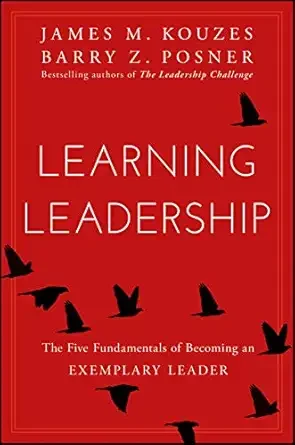
Learning Leadership
The Five Fundamentals of Becoming an Exemplary Leader
by James M. Kouzes & Barry Z. Posner
The 60-Second Take
In Learning Leadership, legendary researchers James M. Kouzes and Barry Z. Posner dismantle the myth of the born leader. Drawing on decades of global data, they prove that leadership is an observable, learnable skill requiring daily, deliberate effort. By mastering five fundamental practices—belief, aspiration, challenge, support, and deliberate practice—anyone can develop the competence and character required to guide others and achieve extraordinary results.
The Myth of the Born Leader
When we watch a master at work—a brilliant CEO guiding a company through a crisis, or an exceptional manager turning a group of disgruntled employees into a cohesive unit—we tend to reach for the easiest explanation. We tell ourselves they are just a "natural." We assume they possess some elusive combination of charisma, extroversion, and instinct that simply cannot be taught. This assumption is comforting because it lets the rest of us off the hook. If leadership is genetic, we do not have to put in the grueling work required to learn it.
James M. Kouzes and Barry Z. Posner have spent their entire careers aggressively fighting this myth. As the authors of the classic textbook The Leadership Challenge, they analyzed millions of data points from leaders around the globe and isolated exactly what the best executives actually do. Learning Leadership is the tactical companion to that research. It shifts the focus from what leadership is, to exactly how a normal person can acquire it.
The authors argue that leadership is an observable pattern of practices and behaviors. It is a discipline. Like playing the violin or mastering martial arts, anyone can learn it, but very few people are willing to endure the discomfort required to achieve mastery. This summary outlines their framework for transforming yourself from an accidental manager into an intentional leader.
What You'll Learn
Why the belief that leaders are born actively destroys your career trajectory
The Five Fundamentals of Becoming an Exemplary Leader
How to define a compelling vision that makes the difficult work worth doing
Why you must construct a rigid network for honest feedback
The mechanics of applying deliberate practice to your daily management habits
Believe You Can and Aspire to Excel
The framework begins entirely inside your own head. Kouzes and Posner outline the Five Fundamentals of Becoming an Exemplary Leader, and the first two are strictly foundational: you must Believe You Can, and you must Aspire to Excel.
Before you can learn a single management technique, you have to adopt a growth mindset. You must genuinely believe that your capacity to lead is malleable. If you walk into a management role believing that your current level of emotional intelligence and strategic thinking is fixed, you will never improve. You will interpret every failure as permanent proof of your inadequacy. Believing you can improve allows you to view failure as temporary, educational data.
But belief is just the engine; you also need fuel. The second fundamental, Aspire to Excel, requires you to care deeply about the work. Leadership is inherently frustrating. You will face resistance, interpersonal conflict, and exhausting setbacks. If you do not have a clear, fiercely held set of values, you will simply quit when the friction gets too high. You have to know exactly why you are leading. When your internal values align with a compelling vision of the future, you generate the massive emotional stamina required to drag yourself and your team through difficult transitions.
Challenge Yourself
Growth only happens at the outer edge of your competence. The third fundamental is Challenge Yourself.
Most professionals reach a point where they figure out how to do their job fairly well, and then they stop growing. They coast. They build a comfortable routine and aggressively protect it. Kouzes and Posner insist that exemplary leaders are constantly looking for ways to break their own routines. They volunteer for projects outside their expertise. They embrace the awkward, highly uncomfortable feeling of being a beginner again.
This requires a total reframing of risk. When you challenge yourself, you are going to make mistakes. Your early attempts at public speaking, resolving a massive team conflict, or pitching a new strategy will likely be clumsy. You have to accept that clumsiness as a required feature of the learning process, not a bug. If you are not occasionally embarrassed by your own performance, you are not pushing yourself hard enough to actually grow.
Engage Support
The image of the solitary, heroic leader making brilliant decisions in a vacuum is pure fiction. The fourth fundamental is Engage Support. You cannot learn leadership alone.
You need a network of mentors, coaches, and peers who can guide you. More importantly, you need a mechanism for discovering the truth about your own performance. The authors point out a terrifying reality of corporate life: the higher you climb in an organization, the less honest feedback you receive. People become afraid to tell you when you are acting arrogant, communicating poorly, or making a strategic error.
To counteract this, you have to actively and aggressively solicit criticism. You cannot wait for the annual performance review. You must look your colleagues and direct reports in the eye and ask, "What is one thing I could do differently to make your job easier?" When they answer, you cannot defend yourself or explain your reasoning. You simply say thank you, and you adjust your behavior. When you prove that you can absorb criticism without punishing the person who delivered it, you build an invaluable culture of trust.
Practice Deliberately
The fifth fundamental is the core of the entire book: Practice Deliberately.
Kouzes and Posner lean heavily on the research of psychologist Anders Ericsson, who proved that elite performance in any field is the result of deliberate practice. It is not enough to just show up to work for ten years. Driving a car for ten years does not make you a professional race car driver; it just makes you deeply entrenched in your existing driving habits.
Deliberate practice means setting a highly specific goal, breaking a skill down into tiny components, executing it, getting immediate feedback, and doing it again. You must apply this exact same rigor to leadership. If your goal is to become a better listener, you do not just tell yourself to "listen more." You set a specific, measurable drill. You decide that in the next hour-long meeting, you will ask three open-ended questions and you will not interrupt a single person while they answer. You execute the drill. You evaluate your performance afterward. Then you run the drill again tomorrow.
By turning vague leadership concepts into concrete, daily behavioral drills, you physically rewire your habits. Mastery is simply the accumulation of thousands of these tiny, deliberate repetitions.
Learning Leadership at a Glance
Believe You Can. Reject the fixed mindset; accept that influence and emotional intelligence are highly learnable skills.
Aspire to Excel. Identify your core values. You must care deeply enough about the outcome to endure the inevitable friction.
Challenge Yourself. Seek out the discomfort of being a beginner. True growth only happens outside your established routine.
Engage Support. Build a network of truth-tellers. Actively solicit painful, honest feedback because your title prevents people from volunteering it.
Practice Deliberately. Turn abstract goals into specific, measurable daily drills. Repetition with focused feedback is the only path to mastery.
A Quick Start Guide to Deliberate Leadership Practice
Isolate one behavior. Do not try to overhaul your entire management style at once. Pick one highly specific skill to improve this week, such as running more efficient meetings or giving better positive reinforcement.
Design a daily drill. Create a measurable action. If your goal is positive reinforcement, commit to sending two highly specific thank-you emails to your team before noon every day.
Ask for the brutal truth. Find a trusted peer and give them explicit permission to critique your chosen behavior. Ask them to watch you in a meeting and point out exactly where you failed.
Kill your defensiveness. When you receive the feedback, bite your tongue. Do not explain your intentions or justify your actions. Thank them, process the data, and adjust.
Embrace the awkwardness. Accept that deliberately practicing a new behavior will feel incredibly forced and unnatural at first. Push through the clumsy phase until it becomes automatic.
Who Should Read Learning Leadership (and Who Can Skip It)
Read it if you recently transitioned from an individual contributor to a management role and feel entirely overwhelmed by the "soft skills" required to do the job.
Read it if you have read countless theoretical books on management strategy but struggle to translate those grand ideas into actual daily habits.
Read it if you believe you lack natural charisma and want a scientific, behavioral approach to building massive influence.
Skip it if you are looking for the raw data on what makes a great organization tick. The authors cover that exact data heavily in their primary text, The Leadership Challenge. This book is strictly about the mechanics of personal learning.
Skip it if you want Machiavellian tactics for surviving toxic office politics. This text operates entirely on the assumption that you want to build a healthy, highly ethical team culture.
Final Reflections
Learning Leadership is a profoundly optimistic book that carries a heavy, demanding caveat. Kouzes and Posner strip away the excuses that hold most professionals back. By proving that anyone can learn to lead, they remove the safety net of claiming you just were not born with the right personality. The challenge lies in the execution. The concept of deliberate practice is incredibly simple to understand, yet brutally difficult to maintain in a corporate environment that rewards putting out immediate fires rather than engaging in slow, clumsy skill acquisition. It is a mandatory read for anyone willing to treat their own character development with the exact same rigor they apply to their company's profit margins.
The Bottom Line
Leadership is not a magical genetic trait you either possess or lack; it is a highly observable set of behaviors that anyone can master through daily, deliberate, and often uncomfortable practice.
Frequently Asked Questions
What is the difference between this book and The Leadership Challenge?
The Leadership Challenge focuses on what exemplary leaders actually do (the Five Practices of Exemplary Leadership, such as "Model the Way" and "Inspire a Shared Vision"). Learning Leadership focuses entirely on how you can learn those skills. It is the instructional manual for acquiring the traits outlined in the first book.
What does deliberate practice actually look like in an office?
It looks like treating interpersonal interactions as drills. It means going into a one-on-one meeting with a specific, isolated goal—like practicing extreme active listening or testing a new framework for delivering constructive criticism—and then scoring your own performance immediately after the meeting ends.
Business Floss is reader-supported. When you use our links we may earn an affiliate commission that helps us keep the site running. Thank you for your support!


