
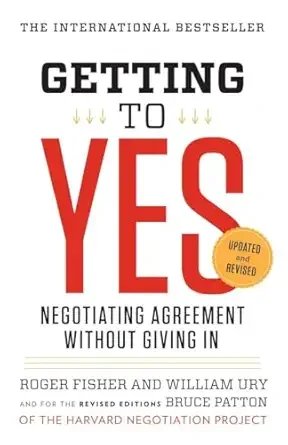
Getting to Yes
Negotiating Agreement Without Giving In
by Roger Fisher and William Ury
The 60-Second Take
In Getting to Yes, Roger Fisher and William Ury present the definitive guide to reaching fair agreements without resorting to adversarial posturing or passive surrender. Drawing from the Harvard Negotiation Project, they introduce principled negotiation—a framework built on separating people from the problem, focusing on underlying interests, generating creative options, and relying on objective criteria. It is a timeless blueprint for resolving conflict while preserving valuable relationships.
You Do Not Have to Choose Between Being Nice and Being Tough
For most of us, negotiation feels like a trap with only two ways out, and neither is particularly appealing. You can be a "soft" negotiator, prioritizing the relationship, yielding to pressure, and ultimately feeling exploited when you walk away with a bad deal. Or you can be a "hard" negotiator, seeing every interaction as a contest of wills, making extreme demands, and exhausting yourself and the other party until a relationship is fractured.
In Getting to Yes, Roger Fisher, William Ury, and Bruce Patton argue that this is a false dichotomy. You do not have to choose between your goals and your relationships. Drawing on their work at the Harvard Negotiation Project, the authors propose a third path: principled negotiation. Rather than haggling over arbitrary demands, principled negotiation teaches you to decide issues on their merits. You are hard on the substantive problem but soft on the people involved.
Since its publication, the book has become the foundational text for modern conflict resolution. Whether you are negotiating a peace treaty, buying a house, or trying to agree on a marketing budget with a stubborn colleague, the underlying mechanics of human disagreement are exactly the same. This summary breaks down the core pillars of the method and how to put them to work.
What You'll Learn
Why traditional haggling consistently produces terrible outcomes
How to detach emotional reactions from the actual problem to be solved
The crucial distinction between what someone demands and what they actually need
How to use objective standards to neutralize stubbornness
How to identify and strengthen your BATNA, the ultimate source of negotiation power
The Trap of Positional Bargaining
The most common way people negotiate is through positional bargaining. You see it at every flea market and in countless corporate boardrooms. One side takes an extreme position (demanding $1,000). The other side takes a counter-position (offering $200). They argue, they make minor concessions, and eventually, they meet somewhere in the middle.
Fisher and Ury argue that this method is fundamentally flawed. When you negotiate over positions, your ego becomes identified with your demand. Your primary goal shifts from solving a problem to simply not backing down, which makes you increasingly stubborn. You end up rewarding extreme posturing and deception, as both sides know they have to start with an absurd number just to end up somewhere reasonable.
Even when positional bargaining works and a deal is struck, it is incredibly inefficient. It takes hours of posturing to find the middle ground. Worse, it damages relationships. The process inherently turns the two parties into adversaries. Every dollar you gain feels like a dollar stolen from the other side, leaving everyone frustrated and resentful even if the final number is fair.
Separate the People From the Problem
Negotiators are human beings first. They have emotions, deeply held values, blind spots, and egos. The primary mistake we make in conflict is entangling our relationship with the other person and the substance of the problem. If a colleague criticizes a project plan you drafted, it is incredibly easy to hear that criticism as a personal attack on your competence.
To negotiate effectively, you must separate the people from the problem. The authors insist that you have to deal with people problems using people tools, and substantive problems using substantive tools. If the other side is angry or feels unheard, you cannot solve that with a logical compromise on the price. You solve it by listening actively, acknowledging their emotions, and allowing them to let off steam without reacting defensively.
The physical posture of a negotiation often dictates its psychological tone. If you are sitting across a table from someone, it feels like an interrogation or a battle. Fisher and Ury suggest reframing the dynamic. You are not two opponents staring each other down; you are two partners sitting side-by-side, staring at a shared problem on the wall in front of you. When you direct your collective energy at the issue rather than at each other, the tension dissipates.
Focus on Interests, Not Positions
If there is a single most important rule in Getting to Yes, it is this: do not argue over positions. Look behind them for the underlying interests. A position is what you have decided upon; an interest is what caused you to so decide.
The authors use the historic 1978 Camp David peace accords between Egypt and Israel to illustrate this. The positions were entirely incompatible. Israel occupied the Sinai Peninsula and refused to give it back. Egypt demanded the return of every inch of the Sinai. If they had bargained over positions, they would have just drawn a line down the middle of the desert, leaving both nations furious.
Instead, mediators looked at the interests. Why did Egypt want the land? Sovereignty. It had been theirs since the time of the Pharaohs, and national pride demanded its return. Why did Israel want the land? Security. They did not care about the desert sand; they cared about having a buffer zone so Egyptian tanks could not park directly on their border. Once the interests were exposed—sovereignty versus security—the solution became clear. The Sinai was returned entirely to Egypt, satisfying their interest in sovereignty, but it was heavily demilitarized, satisfying Israel's interest in security.
Whenever you face an intractable demand, ask "Why?" or "Why not?" Discover the basic human needs driving the demand—usually things like security, economic well-being, a sense of belonging, or control over one's life. When you negotiate at the level of interests, the number of possible solutions expands exponentially.
Insist on Objective Criteria
Even when you understand the other side's interests, you will inevitably hit points where your desires directly conflict. The seller wants the highest price for the car; you want the lowest. If you try to resolve this by seeing who is more stubborn, the negotiation turns into a destructive contest of wills.
The antidote to stubbornness is objective criteria. Instead of arguing based on what the parties are willing to do, you argue based on an independent standard of fairness.
If you are buying a used car, do not argue over the seller's asking price. Bring out the Kelley Blue Book value, or a list of recent sale prices for identical models in the same city. If you are negotiating a contractor's fee, look at standard industry rates. When you introduce an objective standard, you are no longer saying, "You must lower your price because I refuse to pay it." You are saying, "Let's figure out what is fair based on market data." It is very difficult for a rational person to argue against an independent, verifiable standard, making it much easier for them to yield without feeling like they have lost face.
Know Your BATNA
People often assume that negotiation power comes from wealth, size, or political connections. The reality is much simpler. Your power in a negotiation is entirely determined by how good your alternatives are if the negotiation fails. Fisher and Ury formalized this concept into the most famous acronym in business: BATNA, or Best Alternative to a Negotiated Agreement.
Your BATNA is your walk-away plan. If you are negotiating a salary for a new job, your BATNA might be a competing job offer, or it might be staying at your current job. If your current job is miserable and you have no other offers, your BATNA is weak, meaning you will likely have to accept whatever salary the new company offers. If you have three other lucrative offers, your BATNA is incredibly strong, giving you the power to push for top dollar.
The biggest mistake negotiators make is going into a room without defining their BATNA. If you do not know what you will do if you fail to reach a deal, you are negotiating blindly. You risk accepting an agreement that is worse than what you could get elsewhere, or rejecting an agreement that is actually your best option.
Developing your BATNA is an active process. You must invent a list of actions you could take if no agreement is reached, improve the most promising ideas to make them realistic, and then select the single best one. The stronger you make your BATNA before you sit down at the table, the more confident and powerful you will be when the talking starts.
Principled Negotiation at a Glance
Positions vs. Interests. A position is the specific outcome you demand. An interest is the underlying fear, desire, or need driving that demand.
People vs. Problem. Substantive issues must be separated from personal relationships. Attack the problem, not the person.
Objective criteria. Independent standards—like market value, expert opinion, or legal precedent—that settle disagreements fairly, bypassing battles of stubbornness.
BATNA. Best Alternative to a Negotiated Agreement. Your backup plan if the deal falls through, and your ultimate source of leverage.
Mutual gain. The mindset of expanding the pie before dividing it, searching for solutions that satisfy the core interests of both parties.
A Quick Start Guide to Preparing for a Negotiation
Calculate your BATNA. Before you make a single demand, write down exactly what you will do if you cannot reach a deal. Strengthen that alternative as much as possible.
Estimate their BATNA. Try to figure out the other side's walk-away plan. If their alternative is terrible, you have more leverage than you think.
List the hidden interests. Write down your core needs (not your requested price), and then write down your best guess at the other party's core needs, fears, and motivations.
Gather objective standards. Find data, industry benchmarks, or precedents that prove your proposed solution is independently fair. Bring this data to the table.
Set the stage for partnership. Sit next to them rather than across from them if possible. Frame the conversation early as "us trying to solve this problem together" rather than "me trying to get a concession from you."
Who Should Read Getting to Yes (and Who Can Skip It)
Read it if you view negotiation as an uncomfortable, adversarial conflict and want a rational, step-by-step method to navigate it without burning bridges.
Read it if you are a manager, lawyer, or salesperson who regularly has to reach agreements with internal teams or external vendors where the long-term relationship matters.
Read it if you are preparing for a major life event, like negotiating a salary, buying a home, or navigating a difficult divorce.
Skip it if you are looking for psychological manipulation tactics, extreme anchoring techniques, or hostage-negotiation style empathy tools. This book is heavily focused on logic and structure.
Skip it if you are negotiating a one-off transaction where you will never see the other person again and you simply want to extract maximum monetary value without concern for fairness.
Final Reflections
Getting to Yes changed the way the world thinks about conflict because it exposed the sheer inefficiency of traditional bargaining. It proves that being a "tough" negotiator does not require being loud, aggressive, or stubborn; it simply requires being fiercely dedicated to your underlying interests and holding the line on objective fairness. The book's heavy reliance on rationality is sometimes cited as a limitation—real people are highly emotional and irrational—but the authors address this by explicitly demanding that we deal with the human element before moving to the logic. It remains the mandatory foundation for anyone who wants to resolve disputes efficiently, fairly, and permanently.
The Bottom Line
Negotiation is not a tug-of-war over rigid demands; it is a joint problem-solving exercise where understanding the other side's underlying motives is your greatest source of leverage.
Frequently Asked Questions
What is the difference between Getting to Yes and Never Split the Difference?
Chris Voss wrote Never Split the Difference partly as a tactical counterpoint to Getting to Yes. Voss, a former hostage negotiator, focuses heavily on human irrationality, emotional intelligence, and specific psychological tactics (like mirroring and tactical empathy). Getting to Yes focuses on building a rational, structural framework for mutual gain. They are highly complementary; read Getting to Yes for the strategy and Never Split the Difference for the conversational tactics.
What exactly does BATNA stand for and why is it important?
BATNA stands for Best Alternative to a Negotiated Agreement. It is the action you will take if the current negotiation fails entirely. It is critical because it dictates your leverage: you should never accept a deal that is worse than your BATNA, and you should never reject a deal that is better than your BATNA.
Does principled negotiation work if the other side is being aggressive?
Yes, but it requires discipline. The authors call this "negotiation jujitsu." When the other side attacks you or asserts a rigid position, you do not attack back. Instead, you sidestep their attack and direct it at the problem. You ask questions to uncover the interests behind their aggressive demand, and you insist that their demands be justified by objective criteria.
Business Floss is reader-supported. When you use our links we may earn an affiliate commission that helps us keep the site running. Thank you for your support!


