
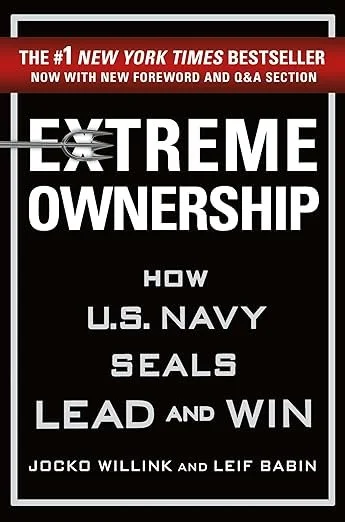
How U.S. Navy Seals Lead and Win
by Jocko Willink & Leif Babin
The 60-Second Take
In Extreme Ownership, former Navy SEAL officers Jocko Willink and Leif Babin argue that leaders must own everything in their world, with no excuses and no one else to blame. Drawing on brutal combat in Ramadi, they show that there are no bad teams, only bad leaders, and that humility, clear priorities, and decentralized command win in business just as surely as they do on the battlefield.
Extreme Ownership: The Navy SEAL Mindset That Transforms Leaders
Leadership books often drown in theory. Extreme Ownership takes the opposite approach. Jocko Willink and Leif Babin led SEAL Task Unit Bruiser through some of the most intense fighting of the Iraq War in Ramadi, and they built their leadership philosophy out of life-and-death decisions. Each chapter pairs a combat story with a single principle, then shows how that same principle plays out in a business meeting or a struggling team.
The central idea sounds almost too simple. The leader owns everything. Not most things, not the things that go well, but everything in their world, including the failures of the people they lead. This summary walks through the core principles and the surprisingly practical way they translate from the battlefield to the office.
What You'll Learn
What extreme ownership means and why excuses quietly destroy teams
Why there are no bad teams, only bad leaders
How to prioritize and execute when everything feels urgent at once
The logic of decentralized command and pushing decisions downward
Why a leader's job is to make the mission believable to everyone
Extreme Ownership: The Leader Owns Everything
The book's foundation comes from a tragedy. During a chaotic firefight in Ramadi, a friendly fire incident occurred under Willink's command. In the aftermath, with careers and reputations on the line, he could have spread the blame across the many people and failures involved. Instead, he stood in front of his superiors and took full ownership of the entire event. It was his operation, so it was his responsibility.
That moment defines the book. When a leader takes ownership, they earn the standing to fix the problem and the trust of the people they lead. When a leader points fingers, they signal that everyone else is free to do the same, and accountability evaporates. For managers, the principle is direct. If your team underperforms, the first place to look is the mirror.
There Are No Bad Teams, Only Bad Leaders
Babin illustrates this with a SEAL training story about boat crews paddling through freezing surf. One crew dominated. One came in last every time. When the leaders of the two crews were swapped, the losing crew suddenly began to win. The people had not changed. The leadership had.
The lesson is that performance follows leadership more than talent. A leader who sets a high standard, holds the line on it, and refuses to accept mediocrity can transform an average group. Blaming the team is almost always a way of avoiding the harder work of leading it better.
Core Combat-Tested Principles at a Glance
Check the ego. Ego clouds judgment and blocks ownership. The best leaders are confident but humble enough to admit mistakes.
Cover and move. Teamwork is everything. Departments that compete against each other instead of supporting the mission all lose together.
Keep it simple. Plans and orders must be simple enough for everyone to understand. Complexity causes failure under pressure.
Prioritize and execute. When overwhelmed, relax, look around, determine the highest priority, and attack it first.
Decentralize command. No single leader can manage every detail. Empower people to make decisions within a clear intent.
Prioritize and Execute Under Pressure
One of the most useful chapters describes what to do when everything goes wrong at once, a situation any operator or manager recognizes. The SEAL mantra is to relax, look around, and make a call. Panic comes from trying to solve every problem simultaneously. Calm comes from naming the single highest priority, directing the team's full energy at it, and then moving to the next one.
Willink and Babin stress that leaders must avoid getting sucked into the tactical weeds. If you drop your head to solve one urgent problem yourself, you stop leading the whole effort. The discipline is to stay one level above the chaos, set the priority, and let the team execute.
Decentralized Command and the Power of Why
No leader can make every decision, especially under stress. Decentralized command means breaking teams into manageable units, each with a leader who understands the overall intent and is empowered to act. This only works if people genuinely understand the why behind the mission. A team that knows the purpose can adapt when the plan changes. A team that only follows orders freezes the moment reality deviates from the script.
This places a clear duty on senior leaders. If the frontline does not understand the reason for a decision, that is a failure of leadership communication, not a failure of the frontline. The leader must explain the why until it is genuinely understood.
A Quick Start Guide to Leading With Ownership
Own the next failure. The next time something goes wrong on your watch, lead by taking responsibility before assigning blame.
Raise the standard. Pick one area where you have tolerated mediocrity and hold a firm, clear line.
Name the top priority. When overwhelmed, write down the single most important task and direct the team there first.
Explain the why. Make sure every person can state the purpose of what they are doing, not just the task.
Push decisions down. Give your people clear intent and the authority to act without waiting on you.
Final Reflections
Extreme Ownership is powerful because its principles were forged where the stakes could not be higher, then proven again in ordinary companies. The throughline is accountability. Leaders who own everything, check their egos, simplify the plan, prioritize ruthlessly, and trust their people to execute will build teams that win. The ideas are not complicated, and that is the point. They are hard to live, but any leader willing to look in the mirror first can start applying them immediately, on any team, in any field.
The Bottom Line
When something goes wrong, the most powerful move a leader can make is to own it completely — no excuses, no blaming the team or the circumstances — because the moment you take full responsibility for a problem is the moment you gain the power to solve it.
Business Floss is reader-supported. When you use our links we may earn an affiliate commission that helps us keep the site running. Thank you for your support!