
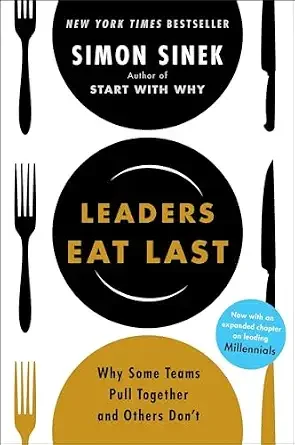
Leaders Eat Last
Why Some Teams Pull Together and Others Don’t
by Simon Sinek
The 60-Second Take
Simon Sinek's argument starts with a Marine Corps custom, officers eating after their troops, and builds it into a theory of why some workplaces produce loyalty and others produce quiet self-protection. His central idea is the Circle of Safety: when people trust that leadership will absorb risk on their behalf, they stop guarding against threats from inside the organization and turn their energy outward. Sinek grounds this in the neurochemistry of endorphins, dopamine, serotonin and oxytocin, argues that most modern workplaces have become dopamine-heavy and trust-poor, and names the imbalance Destructive Abundance. The conclusion is that protecting people is not the reward for performance but the precondition for it.
Why People Will Follow Someone Who Makes Their Life Harder
The title comes from a conversation Simon Sinek had with a Marine Corps general. In the chow line, the most junior members eat first and the most senior eat last. There is no rule requiring it and no one polices it. It is simply what is done, because in that culture rank is understood as a responsibility to the people below you rather than a set of privileges extracted from them.
Published in 2014 after Start With Why, Leaders Eat Last takes that observation and asks why the same instinct is so rare in ordinary workplaces, where formal authority is abundant and genuine willingness to follow is not. Sinek's answer is biological, which is both the most interesting thing about the book and the part most worth reading carefully. This summary covers the Circle of Safety, the neurochemical account underneath it, the failure mode he calls Destructive Abundance, and an honest assessment of how strong the science actually is.
What You'll Learn
What the Circle of Safety is and why internal threats are more expensive than external ones
The four chemicals Sinek uses to explain achievement, bonding, and trust
Why cortisol makes cooperation biologically harder, not just emotionally harder
What Destructive Abundance is and how organizations drift into it
Why abstraction at scale lets decent people make harmful decisions
The Circle of Safety: Where People Turn Their Attention
Sinek's organizing idea is that every organization faces threats from two directions. External threats are the ones everyone acknowledges: competitors, market shifts, technological change, economic conditions. Internal threats are the ones nobody puts on a slide: the possibility of being laid off without warning, humiliated in a meeting, undercut by a colleague competing for the same promotion, or blamed for a decision you did not make.
The insight is that human attention and energy are finite, and defending against internal threats consumes both. A person spending real cognitive effort on managing their standing, covering themselves in writing, and reading the political weather is not spending that effort on customers or competitors. The organization is paying full salary for partial engagement, and the shortfall is invisible on any report.
The Circle of Safety is what a leader draws around the people they are responsible for. Inside it, threats from within are removed, so everyone can direct their attention outward at the things that actually endanger the group. Sinek's argument is that this is the substance of leadership rather than a soft accompaniment to it. Widen the circle so that everyone is inside, and you get cooperation for free. Draw it narrowly, around the executive team or the top performers, and everyone excluded correctly concludes they are on their own.
The Chemistry of Achievement and Belonging
Sinek grounds the argument in four chemicals, which he groups into two pairs.
The selfish chemicals reward individual progress. Endorphins mask physical pain, which is what let our ancestors keep hunting past the point of exhaustion, and which shows up now as the runner's high. Dopamine delivers the hit of satisfaction when you accomplish something specific and measurable, which is why hitting a target feels so good and why the feeling fades so fast. Dopamine is goal-directed and, importantly for the argument, it is the chemical most easily made addictive.
The selfless chemicals reward belonging. Serotonin is the feeling of pride and status, and Sinek's treatment of it is the most useful part of this section: it is relational, produced when someone whose opinion matters recognizes you, and it flows both ways between a person and whoever they feel accountable to. Oxytocin is the chemical of trust, friendship, and safety, released by generosity, physical proximity, and time spent together. It is slow to build and cannot be rushed.
Against these sits cortisol, the stress chemical. Cortisol is the body's threat response, useful in short bursts and corrosive when constant. Sinek's key claim is that cortisol actively inhibits oxytocin. An organization that keeps its people in a chronic low-grade state of threat is not merely making them uncomfortable; it is chemically suppressing the conditions under which trust and cooperation become possible. Empathy becomes harder to feel, not just harder to choose.
The practical translation is that the two selfless chemicals are slow, relational, and produced by exactly the things quarterly management tends to squeeze: time together, recognition from people who matter, and the visible willingness of leaders to absorb cost on your behalf.
Destructive Abundance and the Problem of Scale
Sinek's name for the imbalance is Destructive Abundance: an organization running heavy on dopamine and light on oxytocin, chasing measurable achievement while starving the relationships that make achievement sustainable. It is getting the results without caring about the people who produce them, and then being surprised when those people stop producing.
He traces how organizations drift there, and abstraction does most of the work. When a leader knows the people affected by a decision, the decision is constrained by that knowledge. When those people become a headcount number in a spreadsheet, a region on a map, or a line item in a restructuring plan, the constraint disappears. Sinek's point is not that such leaders are villains. It is that distance does the damage on its own, and that decent people at sufficient remove will authorize things they would never do to a face they recognized.
The remedies he offers follow from the diagnosis. Keep groups small enough that people actually know each other. Get leaders physically among the people they affect. Manage by relationship rather than exclusively by metric. And accept that trust runs on a timescale management cadences do not respect: he puts the interval for building real bonds at somewhere beyond seven days and short of seven years, which is deliberately imprecise and honestly so.
What Leadership Actually Costs
The book's throughline is that leadership is defined by what you are willing to give up. Sinek's examples turn on this repeatedly: leaders who cut their own pay before cutting staff, who take furloughs across the whole company rather than laying off a portion of it, who stand between their people and pressure from above rather than transmitting it downward at full force.
The reason these gestures produce disproportionate loyalty is that they are costly and therefore credible. Anyone can say people are our greatest asset. Very few will absorb a personal loss to demonstrate it, which is exactly why the ones who do get believed. Sinek's framing is that this is an exchange rather than altruism: people give their leaders authority, and in return expect protection. Where the protection does not arrive, the authority remains on the org chart but the followership quietly evaporates.
It is worth being clear-eyed about the limits. The book is stronger on why protection works than on how to extend it when the money genuinely is not there, and a leader facing a real solvency crisis will find inspiration here but not much guidance.
The Core Ideas at a Glance
Circle of Safety. Remove threats from inside the organization so people can direct their energy at threats from outside it.
Endorphins and dopamine. The selfish chemicals: they mask pain and reward individual goal achievement, and dopamine is the one that becomes addictive.
Serotonin and oxytocin. The selfless chemicals: pride from recognition, and trust built slowly through generosity and time.
Cortisol. The threat chemical, which suppresses oxytocin, so chronic workplace stress makes cooperation biologically harder.
Destructive Abundance. Too much dopamine-driven achievement and too little trust, producing results without the people who sustain them.
Abstraction. At scale, people become numbers, and decent leaders authorize things they would never do to someone they knew.
A Quick Start Guide to Widening the Circle of Safety
Name who is currently outside your circle. Contractors, night shift, remote staff, the newest hires. Whoever is excluded already knows it.
Absorb one cost publicly. Take the hit on a deadline, a budget, or a mistake instead of passing it down, since credibility here comes from the cost.
Recognize people specifically and by name. Serotonin is relational, so vague praise to a group does almost nothing that individual recognition does.
Protect unstructured time together. Trust is built by proximity and repetition, not by an offsite, and it cannot be compressed into a quarter.
Reintroduce the faces behind the numbers. Before any decision that affects headcount, make yourself state who specifically it affects.
Who Should Read Leaders Eat Last (and Who Can Skip It)
Read it if you lead a team and want a clear argument for why protecting people is a performance strategy rather than a soft indulgence.
Read it if your organization is metric-driven and you are watching engagement erode without being able to explain why to leadership.
Read it if you need language for something you already sense, since the Circle of Safety is a genuinely useful phrase for arguing a case upward.
Skip it if you have read Start With Why and want substantially new material. The style, structure, and reliance on extended anecdote are much the same.
Skip it if you want rigorous science. The neurochemistry is a simplified narrative rather than a careful account, and the book is best treated as a persuasive framework, not a literature review.
Final Reflections
The central argument is sound and worth taking seriously. Internal threat really does consume the attention that external competition requires, and leaders who absorb cost on behalf of their people really do earn a kind of commitment that no incentive structure reproduces. The Marine Corps framing makes the point unforgettable, and the Circle of Safety has stuck around because it names something people recognize immediately from their own working lives.
The honest caveat concerns the science. Sinek's four-chemical model is a tidy story told about a messy field, and terms like the selfish and selfless chemicals are his organizing device rather than established neuroscience. Serotonin and oxytocin in particular do considerably more, and considerably more contested, work in the actual literature than the book suggests, and some of the findings underpinning popular oxytocin claims have not replicated well. This does not sink the argument, because the behavioral observations mostly stand on their own without the chemistry. But readers should hold the biology as a memorable metaphor rather than as proof, and be careful about repeating the specifics as settled fact. The book is also long for its content, with the same points arriving several times in different anecdotal clothing.
The Bottom Line
People spend their energy either defending against the organization or competing outside it, and they cannot do both. A leader's real job is to make the first unnecessary.
Frequently Asked Questions
What is the Circle of Safety?
Sinek's term for the protected space a leader creates around their people. Inside it, threats from within the organization are removed, so employees can stop guarding against colleagues and internal politics and direct their energy at genuine external challenges.
What are the four chemicals in Leaders Eat Last?
Endorphins and dopamine, which Sinek calls selfish because they reward individual effort and achievement, and serotonin and oxytocin, which he calls selfless because they produce pride, bonding, and trust. Cortisol, the stress chemical, suppresses oxytocin and works against all of it.
Is Leaders Eat Last worth reading?
Yes for the leadership argument, with reservations about the science. The case that protection precedes performance is well made and practically useful, while the neurochemistry is simplified enough that it should be read as a framework rather than as evidence.
Business Floss is reader-supported. When you use our links we may earn an affiliate commission that helps us keep the site running. Thank you for your support!


