
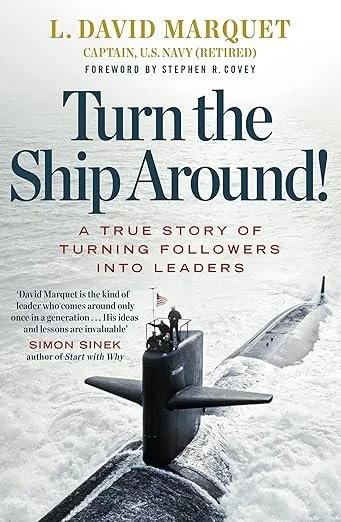
Turn the Ship Around!
A True Story of Turning Followers Into Leaders
by L. David Marquet
The 60-Second Take
In Turn the Ship Around!, former Navy Captain L. David Marquet shares how he transformed the worst-performing submarine in the fleet into its absolute best. By abandoning the traditional top-down chain of command for a "leader-leader" model, he proves that true excellence comes from pushing decision-making power down the ranks. It is a practical, brilliant blueprint for replacing passive compliance with active, intent-based ownership.
The Danger of a Team That Only Follows Orders
The United States Navy operates on one of the oldest, most rigid management structures in human history: the leader-follower model. The captain gives an order, the officers pass it down, and the crew executes it without question. It is designed to ensure perfect compliance. When Captain L. David Marquet was assigned to command the USS Santa Fe, a nuclear-powered submarine with the worst retention and operational records in the fleet, he assumed he would use that exact model to whip the crew into shape.
There was only one problem. Marquet had spent a year training to command a completely different class of submarine. At the last minute, he was reassigned to the Santa Fe. He did not know the specific technical limits of the ship, the layout of the valves, or the capabilities of the crew. If he tried to lead by giving highly specific, top-down orders, he was going to make a catastrophic mistake.
In Turn the Ship Around!, Marquet explains how this terrifying lack of technical knowledge forced him to fundamentally rewrite the rules of leadership. He realized that a culture of compliance is inherently fragile. If the person at the top is wrong, the entire organization fails, because no one below them is authorized to think. To save the Santa Fe, Marquet had to strip away his own authority and push it down to the crew, creating an environment where every single sailor acted like a captain.
What You'll Learn
The fundamental flaw in the traditional leader-follower dynamic
How the phrase "I intend to" creates a massive shift in psychological ownership
Why delegating control will result in chaos unless you also build technical competence
How organizational clarity aligns a decentralized team
Practical mechanisms for eliminating top-down monitoring and encouraging self-reporting
The Trap of the Leader-Follower Model
The defining moment of Marquet’s command happened early in his tenure. During a simulated drill, he ordered his Officer of the Deck to shift the ship’s engines to "two-thirds ahead." The officer loudly repeated the order. Nothing happened.
When Marquet asked the helmsman why the ship was not accelerating, the helmsman informed him that the Santa Fe did not have a two-thirds speed gear. Marquet turned to his officer and asked if he knew the order was impossible. The officer admitted he did. When Marquet asked why he issued the order anyway, the officer gave a chilling response: "Because you ordered it, sir."
That is the ultimate failure of the leader-follower model. It creates an organization of passive observers. The crew was so thoroughly trained to wait for instructions that they completely shut off their own critical thinking. They were perfectly willing to drive a multi-billion-dollar nuclear submarine into a disaster simply because the man with the highest rank told them to. Marquet knew that to survive the deployment, he had to stop treating his crew like followers and start treating them like leaders.
Pushing Control Down: Intent-Based Leadership
The core mechanism Marquet used to destroy the leader-follower model was a simple change in vocabulary. He banned his officers from asking for permission.
In a traditional setup, a subordinate comes to the boss and asks, "What should I do about this problem?" or "Request permission to submerge the ship." This forces the leader to process the information, make the decision, and issue the order. It keeps the psychological burden of ownership squarely on the leader's shoulders.
Marquet replaced requests with "I intend to." When an officer wanted to submerge the ship, they had to walk up to Marquet and state, "Captain, I intend to submerge the ship to periscope depth."
This minor linguistic shift changes everything. Before an officer can say "I intend to," they have to do the mental work of researching the problem, evaluating the safety protocols, checking the sonar, and making a concrete decision. The psychological ownership shifts entirely to the subordinate. They are not asking the captain to do their thinking for them; they are presenting a fully baked plan. If the plan is sound, the captain simply replies, "Very well."
By forcing his crew to lead with their intent, Marquet pushed control out of the captain's quarters and down to the specific individuals who had the most direct, accurate information about the ship.
The Two Prerequisites: Competence and Clarity
You cannot simply walk into an office, tell a passive team that they are now empowered to make decisions, and walk away. If you give people control over a nuclear reactor without ensuring they know what they are doing, you will create a disaster. Pushing control down only works if it is supported by two massive pillars: Competence and Clarity.
Competence means the team actually possesses the technical skills to make the right decisions. As Marquet pushed control down the ranks, he simultaneously had to dramatically increase the rigor of their training. They instituted a policy of "taking deliberate action." Before a sailor flipped a switch or turned a valve, they had to pause, physically point at the valve, and state out loud exactly what they were about to do and what the expected outcome was. This forced mindfulness prevented automatic, thoughtless mistakes and ensured the crew was technically sound enough to handle their new authority.
Clarity means the team deeply understands the organization's goals. If you empower a highly competent team, but they do not know what the ultimate objective is, they will execute brilliantly in entirely the wrong direction. The captain's job shifts from giving technical orders to constantly communicating the mission. If every sailor understands the exact goal of the deployment, they can evaluate their own "I intend to" statements against that goal before they even speak to the captain.
When you combine Control, Competence, and Clarity, you achieve the "Leader-Leader" model. The organization becomes resilient, agile, and completely unreliant on a single genius at the top.
Turn the Ship Around at a Glance
Leader-Follower. The traditional model that breeds passive compliance and limits the organization's intelligence to the brainpower of the boss.
Leader-Leader. A model that treats every employee as an independent thinker capable of owning their specific domain.
Control. Pushing decision-making authority down to the level where the actual information resides.
"I intend to..." The linguistic tool that shifts psychological ownership from the boss to the subordinate.
Competence. Ensuring the team has the rigorous technical training required to handle their delegated authority safely.
Clarity. Relentlessly communicating the "why" so that independent decisions naturally align with the organization's overarching mission.
A Quick Start Guide to Intent-Based Leadership
Ban the phrase "What should I do?" When an employee brings you a problem, refuse to solve it for them. Ask them to return with a proposed course of action starting with "I intend to."
Push the decision down. Identify one specific, recurring decision you make every week that could be handled by a subordinate. Give them the authority to make it without consulting you.
Point and call. For highly critical, repetitive tasks, have your team physically point to the object or data and state out loud what they are about to do before doing it to reduce automatic errors.
Resist the urge to rescue. When a team member proposes an intent that is slightly flawed but not dangerous, let them execute it. They will learn more from a minor failure than from your immediate correction.
Preach the clarity. Spend the beginning of every meeting explicitly stating the ultimate goal of the current project, ensuring everyone's daily decisions have a shared compass.
Who Should Read Turn the Ship Around (and Who Can Skip It)
Read it if you are a manager who feels completely overwhelmed because every single minor decision in your department has to cross your desk for approval.
Read it if you work in a highly regulated, process-heavy industry (like manufacturing, aviation, or healthcare) and want to build a culture of safety without relying on constant top-down inspections.
Read it if you are transitioning from a military career into the corporate world; Marquet perfectly bridges the gap between rigid hierarchy and agile management.
Skip it if you are looking for advanced marketing strategy or product development frameworks. This is strictly a book about internal team operations and culture.
Skip it if you easily tire of heavy military analogies. The entire narrative is structured around the daily operations of a nuclear submarine, which involves a lot of naval terminology.
Final Reflections
Turn the Ship Around! is one of the most effective leadership books of the last decade precisely because it offers a mechanical solution to a psychological problem. Most business literature tells leaders to "empower their people," which usually results in vague motivational speeches that change nothing. Marquet offers a tangible, behavioral mechanism: stop giving orders and make them state their intent. While the submarine stories can occasionally feel repetitive, the environment serves as the perfect crucible for his theory. If you can dismantle top-down management on a nuclear warship without causing a disaster, you can certainly do it in a modern office.
The Bottom Line
You do not empower a team by giving them better instructions; you empower them by giving them absolute control over their work, backed by the technical competence to execute it and the clarity to align it with the mission.
Frequently Asked Questions
What is the Leader-Leader model?
It is a management philosophy that assumes everyone in the organization is capable of leading within their own sphere of influence. It completely replaces the traditional Leader-Follower model, which relies on a few people at the top doing the thinking while the majority at the bottom simply comply with orders.
What is the significance of "I intend to"?
It is the primary tool for creating a Leader-Leader culture. When an employee says "I intend to," they are asserting ownership of a problem and presenting a solution. It prevents them from passively waiting for the boss to tell them what to do.
Is this model safe for high-stakes environments?
Yes. In fact, Marquet argues it is the only safe model for high-stakes environments. The USS Santa Fe was a nuclear submarine where a single mistake could be fatal. Pushing control down makes the ship safer because the people actually touching the equipment are the ones making the decisions, provided management has ensured they possess total competence and clarity.
Business Floss is reader-supported. When you use our links we may earn an affiliate commission that helps us keep the site running. Thank you for your support!


