
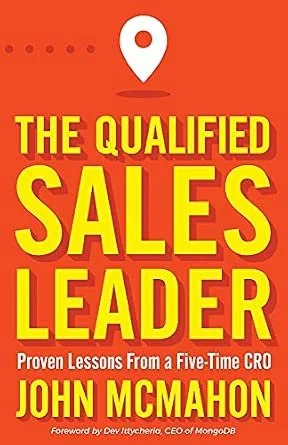
The Qualified Sales Leader
Proven Lessons from a Five-Time CRO
by John McMahon
The 60-Second Take
In The Qualified Sales Leader, five-time CRO John McMahon distills decades of enterprise software experience into a masterclass on B2B selling. Using a fictional narrative, he reveals why sales teams consistently miss quotas and how leaders can fix it. By enforcing rigorous qualification through the MEDDPICC framework, shifting focus from technical features to quantifiable business pain, and moving from spreadsheet management to active coaching, leaders can build highly predictable, revenue-generating teams.
Hope Is Not a Sales Strategy
There is a massive difference between a sales representative who is busy and a sales representative who is closing. In the world of complex B2B enterprise sales, reps often confuse activity with accomplishment. They fly across the country, perform flawless product demonstrations, send dozens of follow-up emails, and proudly forecast a deal to close by the end of the quarter. Then, the quarter ends, the deal slips, and the rep blames the competition, the economy, or the product team.
John McMahon has seen this pattern thousands of times. As a highly decorated five-time Chief Revenue Officer (CRO) for public companies like PTC, Ariba, Bladelogic, and BMC, McMahon has built some of the most formidable and successful sales organizations in the software industry. In The Qualified Sales Leader, he argues that deals rarely die at the last minute; they die in the very first meetings because the rep failed to qualify the opportunity.
Using a fictionalized consulting engagement featuring characters named Andy and Jim, McMahon diagnoses the common illnesses of modern sales teams. He strips away the fluff and insists on relentless, objective qualification. This summary explores his frameworks for identifying real pain, navigating complex organizational charts, and transforming managers into elite sales coaches.
What You'll Learn
Why selling technical features instead of business value destroys your win rate
The critical difference between a Technical Buyer and an Economic Buyer
How to identify a true Champion versus an internal coach
The components of the MEDDPICC qualification framework
How sales leaders can improve forecasting accuracy through active coaching
Stop Pitching Features and Start Solving Pain
A persistent trap for B2B sales professionals is the "feature dump." A rep secures a meeting, opens their laptop, and spends forty-five minutes demonstrating the beautiful user interface, the fast processing speeds, and the innovative reporting dashboards of their software. They assume that if the product looks impressive, the prospect will buy it.
McMahon makes it clear that no executive buys enterprise software because of a shiny interface. They buy software to fix a specific, agonizing business problem. To close large deals, a rep must understand the fundamental difference between technical pain and business pain.
Technical pain sounds like this: "Our legacy servers are slow and keep crashing." A weak sales rep hears that and immediately pitches their cloud-based, high-speed servers. A qualified sales rep digs deeper to uncover the business pain. They ask what happens to the company when the servers crash. The business pain sounds like this: "When our servers crash, our e-commerce checkout goes down, and we lose $100,000 an hour in revenue. If this continues, we will miss our quarterly earnings target, our stock will drop, and the VP of Operations will be fired."
When you uncover the business pain, the entire dynamic of the sale shifts. You are no longer selling a technical server upgrade that costs $500,000; you are selling the preservation of millions of dollars in revenue and the protection of an executive's career. You have to ask the right, probing questions to connect technical deficiencies to tangible, measurable financial losses. If you cannot quantify the pain, you cannot justify the price of your solution.
The Economic Buyer and the Real Champion
Deals are overwhelmingly lost because reps spend their time talking to the wrong people. McMahon is ruthless about defining who actually has the power to sign a check. Reps frequently spend months courting a "Technical Buyer." This is usually an end-user or a mid-level manager who evaluates the product, loves the features, and tells the rep they desperately want to buy it. The rep gets "happy ears," assumes the deal is done, and forecasts it as a win.
However, the Technical Buyer does not hold the budget. The budget is held by the "Economic Buyer," a senior executive who often does not care about the technical features and only cares about the financial return on investment. If you never meet the Economic Buyer, you do not have a real deal.
To gain access to the Economic Buyer, you need an internal "Champion." McMahon clarifies a massive misconception regarding this role. A Champion is not just someone who likes you and prefers your product. That person is a coach. A true Champion has actual power and influence within their organization. They have a vested, personal interest in solving the business pain because it directly impacts their own success and compensation. Most importantly, a Champion will fight for your solution and sell it internally to the Economic Buyer when you are not in the room. If your contact cannot or will not secure a meeting with the Economic Buyer on your behalf, they are not a Champion.
MEDDPICC: The Anatomy of a Qualified Deal
To bring structure and discipline to the chaos of enterprise sales, McMahon relies heavily on the MEDDPICC framework (an expanded version of the original MEDDICC methodology). It is a rigorous, objective checklist designed to ensure a deal is actually viable before a rep wastes valuable time pursuing it.
If a rep cannot confidently answer the questions posed by each letter of the acronym, the deal is highly vulnerable:
Metrics: What is the quantifiable economic benefit of your solution? You must prove exactly how much money you will save or make the customer.
Economic Buyer: Who is the ultimate decision-maker with discretionary access to funds? Have you met them, and do they agree with your metrics?
Decision Criteria: What specific technical, business, and financial requirements must be met for the company to choose a vendor?
Decision Process: What are the exact chronological steps, meetings, and approvals required for the buyer to make a decision?
Paper Process: What is the specific legal, security, and procurement workflow required to get the actual contract signed? (Many reps lose deals at the end of the quarter because they completely ignore the legal review timeline).
Identify Pain: What is the severe business problem driving the urgency to buy right now? If there is no urgent pain, there is no sale.
Champion: Who is your powerful internal advocate actively selling on your behalf?
Competition: Who else is the buyer evaluating? This includes direct competitors, internal workarounds, and the status quo of doing nothing.
Through the fictional consulting narrative in the book, McMahon shows what happens when sales leaders, like characters Andy and Jim, interrogate their reps during a Quarterly Business Review (QBR). They realize that deals are slipping precisely because the reps are guessing. They do not know the exact paper process, and they have not identified a true Champion. MEDDPICC eliminates this guesswork. It forces reps to confront the reality of their pipeline and stops them from confusing hope with strategy.
From Spreadsheet Manager to Sales Coach
The book serves as a vital manual for leadership just as much as it does for selling. McMahon draws a hard, uncomfortable line between a sales manager and a sales leader. A sales manager sits behind a desk, stares at a CRM dashboard, and simply demands to know when a deal is going to close. They interrogate their team without offering any strategic help.
A sales leader, by contrast, acts as a coach. They roll up their sleeves, get into the granular details of the deal, and help the rep strategize. Instead of lazily asking "Is this closing this month?", a qualified sales leader asks, "Who exactly is our Champion, and what did the Economic Buyer say when you presented the ROI metrics?"
True leaders conduct rigorous win/loss analyses to understand why deals succeed or fail. They role-play difficult conversations and objection handling with their reps before a high-stakes meeting. McMahon argues that long-term success comes entirely from developing your people, not just driving them to hit an arbitrary quota. If a leader focuses on coaching the fundamentals, instilling curiosity, and enforcing MEDDPICC discipline, accurate forecasting and revenue growth will naturally follow.
Enterprise Sales at a Glance
Business pain over features. Stop pitching technical capabilities. Connect your solution directly to a severe, quantifiable financial loss.
The Economic Buyer. The person who evaluates the software is rarely the person who writes the check. You must gain access to the ultimate budget authority.
The Champion. An internal coach likes your product; an internal Champion has the political capital to force the purchase through the organization.
MEDDPICC. A rigorous diagnostic framework (Metrics, Economic Buyer, Decision Criteria, Decision Process, Paper Process, Identify Pain, Champion, Competition) that prevents reps from guessing about a deal's status.
Coaching over managing. The best sales leaders do not just track numbers on a spreadsheet; they actively role-play, review pipelines, and develop their team's strategic skills.
A Quick Start Guide to Qualifying Your Pipeline
Identify the actual pain. Do not accept surface-level complaints. Ask your prospect "what happens next?" until you uncover the financial or strategic impact of their problem.
Find the Economic Buyer. Ask your current contact, "Who typically signs off on a project of this magnitude, and what metrics do they care about?"
Test your Champion. Ask your primary contact to set up a meeting for you with the Economic Buyer. If they refuse or cannot make it happen, they do not have the power of a true Champion.
Map the paper process. Do not wait until the final week of the quarter to talk to legal. Ask procurement on day one exactly how long their vendor review process takes.
Stop hoping and start qualifying. Run every deal in your pipeline through the MEDDPICC framework today. If a deal is missing three or more letters, move it out of your forecast immediately.
Who Should Read The Qualified Sales Leader (and Who Can Skip It)
Read it if you are an Account Executive (AE) in B2B enterprise sales who is tired of deals stalling at the finish line and wants a highly structured approach to closing complex accounts.
Read it if you are a newly promoted sales manager or CRO who needs to implement a standardized, measurable qualification process across your entire team.
Read it if you sell highly technical products (like SaaS, data infrastructure, or cybersecurity) and struggle to communicate your value to non-technical executives.
Skip it if you operate in high-volume, transactional B2C sales or retail environments. The heavy qualification frameworks here are designed for long, complex sales cycles, not one-call closes.
Skip it if you are looking for a marketing book on how to generate inbound leads or run cold-email campaigns. This book focuses entirely on managing and closing the deal once the pipeline is already generated.
Final Reflections
The Qualified Sales Leader is not a theoretical academic text; it is a battle-tested playbook written from the trenches of enterprise software. McMahon's primary contribution to the field is the absolute eradication of guesswork in the sales process. The fictional narrative structure—following characters as they stumble through QBRs and learn to coach their reps—can occasionally feel a bit stylized, but it is highly effective at illustrating the real-world dynamics of a dysfunctional sales floor.
The book is undeniably demanding. Implementing MEDDPICC requires rigorous discipline, and it forces sales professionals to have uncomfortable conversations with prospects early in the cycle. It is emotionally difficult to disqualify a friendly prospect because they lack budget authority, but McMahon proves that doing so is the only way to protect your time and your quota. For anyone willing to abandon the comfort of "happy ears" and embrace the hard work of objective qualification, this book is essential reading.
The Bottom Line
If you cannot measure, understand, and control the specific qualification criteria of a deal, you are not selling—you are just hoping.
Frequently Asked Questions
What is the main idea of The Qualified Sales Leader? The core concept is that complex B2B sales are lost due to poor qualification and a focus on technical features rather than business pain. By using structured qualification frameworks and shifting from managing numbers to actively coaching reps, leaders can dramatically improve win rates and forecasting accuracy.
What does MEDDPICC stand for? It is an acronym for a sales qualification methodology: Metrics, Economic Buyer, Decision Criteria, Decision Process, Paper Process, Identify Pain, Champion, and Competition. It is used to objectively evaluate the health and viability of a sales opportunity.
Is this book only for sales managers and CROs? No. While the title focuses on leadership and a significant portion covers coaching and team building, the core lessons on navigating corporate buying committees and executing the MEDDPICC framework are equally vital for individual Account Executives who want to close larger deals.
Business Floss is reader-supported. When you use our links we may earn an affiliate commission that helps us keep the site running. Thank you for your support!


