
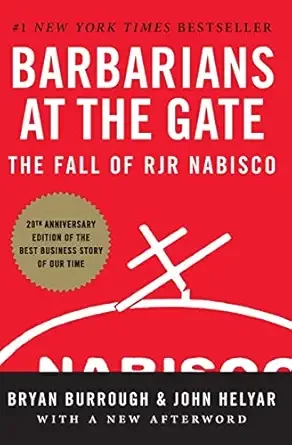
Barbarians at the Gate
The Fall of RJR Nabisco
by Bryan Burrough & John Helyar
The 60-Second Take
In Barbarians at the Gate, journalists Bryan Burrough and John Helyar tell the definitive story of the 1988 battle for RJR Nabisco, the largest leveraged buyout of its era. What began as CEO Ross Johnson's management buyout exploded into a bidding war won by private equity firm KKR. It is an unforgettable portrait of Wall Street ego, greed, and the dealmaking that drove a 25 billion dollar takeover.
Barbarians at the Gate: Anatomy of the Greatest Buyout Ever
In the fall of 1988, the business world watched a single deal turn into a spectacle. A bidding war erupted over RJR Nabisco, the tobacco and food conglomerate behind Oreos and Winston cigarettes, and by the time the dust settled the company had been bought for roughly 25 billion dollars, the largest leveraged buyout in history at that point. Bryan Burrough and John Helyar turned the saga into Barbarians at the Gate, widely regarded as the finest book ever written about Wall Street dealmaking.
It reads like a thriller, but it is reported fact. The book is a window into how massive deals actually get done, driven less by spreadsheets than by ego, ambition, and fees. This summary pulls out what happened and what any finance or strategy professional can learn from the chaos.
What You'll Learn
How a leveraged buyout actually works and who profits from it
Why CEO ego and incentives can override shareholder interests
How investment banks earn enormous fees driving deals forward
The role of junk bonds in financing the 1980s buyout boom
Why the highest bid does not always reflect the best business logic
The Deal That Started It All
The story centers on F. Ross Johnson, the charismatic and free-spending CEO of RJR Nabisco. Johnson embodied 1980s corporate excess. He kept a fleet of corporate jets that insiders nicknamed the RJR Air Force, lavished money on celebrities and perks, and ran the company with the swagger of a man who never expected to be questioned.
Frustrated that the stock market undervalued his company, Johnson decided to take it private through a management buyout, partnering with the investment bank Shearson Lehman Hutton. The plan would have handed his management team an enormous payday. Instead of a quiet transaction, the proposal rang a dinner bell across Wall Street and invited every shark in the water.
Cover and Move: The Bidding War Erupts
The most feared name in buyouts, the private equity firm Kohlberg Kravis Roberts, led by Henry Kravis and George Roberts, entered the fray. What followed was a frantic, weeks-long auction featuring competing bids, leaked information, shifting alliances, and bruised egos. Johnson's once-friendly relationship with Kravis curdled into open warfare.
A crucial turning point was public perception. Details of Johnson's management agreement, which could have paid his small team hundreds of millions of dollars, leaked to the press and made him look greedy. The narrative shifted, and the board grew wary of handing the company to its own CEO. In the end KKR won with a bid around 109 dollars per share, even though Johnson's group arguably offered slightly more value, because the board trusted KKR's package and had soured on Johnson.
Key Deal Lessons at a Glance
The agency problem is real. Managers do not always act in shareholders' interests. Johnson's buyout was as much about his payday as the company's future.
Incentives drive behavior. Bankers, lawyers, and advisers earned staggering fees that gave them every reason to keep the deal escalating.
Leverage powers buyouts. LBOs use mostly borrowed money, loading the target company with debt that must be repaid from its cash flow.
Perception shapes outcomes. The board's decision turned partly on optics and trust, not purely on the highest number.
Ego is expensive. Personal rivalries and pride pushed the price far beyond what cold analysis alone would justify.
What the Numbers Hid
For a finance professional, the most instructive thread is how little the final stages had to do with rigorous valuation. The bids climbed into territory that required heroic assumptions about RJR's future cash flow and asset sales. The company would be saddled with mountains of debt, financed in part by the junk bonds that defined the era. The buyers were betting they could cut costs, sell divisions, and service that debt fast enough to profit.
The human drama, the rivalries, the leaks, the all-night negotiating sessions, ultimately determined who won. The lesson is not that analysis does not matter, but that in the real world it competes with personality and politics, and often loses.
A Quick Start Guide for Reading Deals
Follow the incentives. Ask who gets paid and how, and you will understand why a deal moves the way it does.
Separate value from price. A winning bid reflects competition and ego as much as underlying worth.
Scrutinize management motives. When insiders want to buy the company, ask whether shareholders are getting a fair shake.
Respect the debt load. In a leveraged deal, the target carries the borrowing. Stress test whether its cash flow can cover it.
Watch the optics. Reputation and perception can swing a board more than a marginal difference in the offer.
Final Reflections
Barbarians at the Gate remains the definitive account of the leveraged buyout boom and a masterclass in how high finance really operates. Its enduring power comes from showing that a 25 billion dollar transaction came down to human beings, their ambitions, their grudges, and their appetites, as much as to any model. For anyone in finance, strategy, or corporate development, it is both wildly entertaining and quietly educational, a reminder that behind every clean deal memo sits a very messy story. Decades later, its portrait of ego and excess still rings true.
In a Nutshell
In Barbarians at the Gate, journalists Bryan Burrough and John Helyar tell the definitive story of the 1988 battle for RJR Nabisco, the largest leveraged buyout of its era. What began as CEO Ross Johnson's management buyout exploded into a bidding war won by private equity firm KKR. It is an unforgettable portrait of Wall Street ego, greed, and the dealmaking that drove a 25 billion dollar takeover.
Business Floss is reader-supported. When you use our links we may earn an affiliate commission that helps us keep the site running. Thank you for your support!


