
Turn Your Business Into a Sales Machine with the $100 Million Best Practices of Salesforce.com
by Aaron Ross and Marylou Tyler
The 60-Second Take
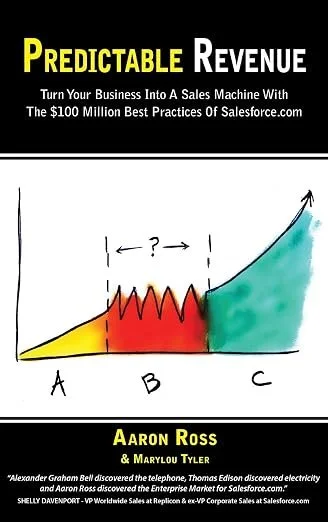
Predictable Revenue is the book that gave B2B software its standard sales structure: separate prospecting from closing, build a dedicated outbound team, and treat pipeline as an engineered output. Aaron Ross built it at Salesforce and it became the default across the industry. The structural insight holds up; the tactics were destroyed by their own success.
Everyone Adopted This Playbook, Which Is Why It Stopped Working
If you've ever received an email from a stranger asking who at your company handles a particular thing, you've been on the receiving end of this book.
Aaron Ross built the outbound machine at Salesforce that the company credits with generating around $100 million in recurring revenue, then wrote down how it worked. Predictable Revenue became the default operating manual for B2B software sales, and the roles it invented — the SDR handing qualified meetings to an AE — are now so standard that most people in the industry assume they always existed.
The irony is that the book's specific tactics worked partly because almost nobody was doing them. Then everybody did, inboxes filled with identical emails, and response rates collapsed. The playbook was consumed by its own adoption.
What survives is the structural argument underneath, which is more valuable than the tactics ever were and gets much less attention.
What You'll Learn
Why hiring more salespeople usually doesn't increase sales
How specializing sales roles changes what each person can be good at
What Cold Calling 2.0 actually asked for, and why that mattered
The difference between seeds, nets, and spears
Which parts of this playbook still work in a saturated market
Lead Generation Is the Constraint
The reframe that carries the book: salespeople don't drive revenue, lead generation does. Salespeople convert pipeline into revenue, which is a different job.
This explains a pattern most sales leaders have lived through. A company misses target, concludes it needs more capacity, hires three more closers, and watches all of them miss quota. The new hires weren't the problem. Conversion capacity was added to a system constrained upstream, so the same insufficient pipeline now gets divided more ways.
Once you accept that, pipeline stops being something that happens to you and becomes something you engineer, with its own headcount, process, and metrics.
Specialized Roles
The structural intervention, and the book's real legacy.
The traditional model asks one person to prospect, qualify, close, and manage the account. Ross's argument is that these require different temperaments and skills, and that combining them means everyone does the uncomfortable parts badly. Given a choice between cold prospecting and working a warm deal, every rep works the warm deal, which is why prospecting silently disappears from the calendar of anyone who also carries a quota.
The split he proposes:
Market Response Reps qualify inbound leads generated by marketing. Sales Development Reps do outbound prospecting into cold accounts and hand over qualified opportunities. Account Executives close, and do nothing else. Customer Success Managers own the relationship after the sale.
He includes working ratios, roughly one SDR supporting two to five account executives depending on deal size, and treats the SDR path as a career ladder into closing roles.
The advantage beyond focus is measurement. When one person does everything, a bad quarter is uninterpretable. When the functions are separated, you can see exactly which stage is failing.
Cold Calling 2.0
The method the book is named for, and the part that has aged hardest.
Instead of calling strangers to pitch, you send a very short email to a senior person asking who the right person would be to talk to about a specific problem. No pitch, no attachment, no deck. Just a referral request.
The design was clever for its moment. It's easy to answer, it costs the recipient nothing, and a reply forwards you downward with implied endorsement rather than arriving cold. Ross reports response rates in the high single digits, which were extraordinary.
Two supporting ideas hold up better than the tactic. The first is that outbound should target a defined ideal customer profile rather than a large purchased list. The second is that the metrics that matter are qualified opportunities created and new pipeline generated per month, not activity counts. Measuring calls made rewards motion; measuring qualified opportunities rewards outcomes.
Seeds, Nets, and Spears
The taxonomy for where pipeline comes from.
Seeds grow from relationships and satisfied customers: word of mouth, referrals, and the compounding effect of customer success. Slow to develop, highest conversion, hardest to force.
Nets are broad marketing programs: content, events, advertising, anything cast wide to catch whoever is already looking.
Spears are targeted outbound aimed at specific named accounts, which is what SDRs do.
The value of the split is that each has a different time horizon and requires different capabilities, and companies routinely mistake one for another. Expecting outbound to deliver seed-quality conversion, or expecting seeds to scale on a quarterly timeline, produces predictable disappointment. A healthy business runs all three, and knows which is which.
Predictable Pipeline at a Glance
The constraint. Lead generation drives growth; salespeople convert what already exists.
Specialization. Prospecting, closing, and account management are different jobs requiring different people.
Cold Calling 2.0. Short referral-request emails to senior contacts rather than pitches to strangers.
Seeds, nets, spears. Referrals and customer success, broad marketing, and targeted outbound.
The right metrics. Qualified opportunities and new pipeline per month, not activity volume.
Ratios. Roughly one SDR per two to five account executives, varying with deal size.
A Quick Start Guide to Building Predictable Pipeline
Find your actual constraint. Look at whether deals are being lost or never created. Hiring closers to fix a pipeline problem is the most expensive common mistake in sales.
Separate one role. Even one person dedicated solely to prospecting reveals how little of it was happening before.
Define the ideal customer profile tightly. Outbound to a broad list is what turned this playbook into spam.
Change the metric. Track qualified opportunities created per month rather than emails sent or calls made.
Audit your three sources. Categorize last quarter's pipeline as seeds, nets, or spears. Most companies discover they're overwhelmingly dependent on one.
Who Should Read Predictable Revenue (and Who Can Skip It)
Read it if you're building a B2B sales function from scratch and need a structure that has been tested at scale.
Read it if your reps are missing quota and you're about to hire more of them. The constraint argument may save you the money.
Read it if you want to understand why your industry is organized this way. Almost every SDR job posting descends from this book.
Skip it if you're looking for outbound tactics that work now. The email approach was effective because it was novel, and it isn't novel anymore.
Skip it if you sell very high-value enterprise deals or run a self-serve product-led motion. The model assumes mid-market deal sizes and a large addressable list of identifiable companies.
Final Reflections
The structural contribution is real and durable. Treating pipeline as an engineered system with its own function, separating prospecting from closing, and measuring qualified opportunities rather than activity are all sound, and companies that ignore them tend to relearn it expensively.
Three things to weigh.
The tactics are dead, and their death was caused by this book. Cold Calling 2.0 worked because inboxes weren't yet full of near-identical referral requests, and a decade of faithful implementation saturated the channel. Anyone reading the specific email templates as a current playbook will be disappointed, and the reported response rates are not a benchmark for today.
The specialization model has costs the book underplays. Handoffs lose information and momentum. SDRs are separated from customer outcomes, which makes the role hard to do well and harder to stay in, and turnover in those seats is notoriously high. Since the market shifted in 2022, plenty of companies have shrunk or dismantled SDR teams in favour of account executives who prospect for themselves, or product-led motions that bypass the question. The structure is a tool with tradeoffs, not a law.
Finally, it functions as an extended Salesforce case study, which several readers have noted more bluntly than that. The results are real; the sample is one company, in one market, at one moment, and the confidence with which it generalizes exceeds what a single case supports.
Take the diagnosis of the constraint and the discipline about metrics. Build your own outbound motion for the market that exists now.
The Bottom Line
More salespeople don't produce more sales when the shortage is upstream. Build the pipeline engine first, then hire people to convert what it produces.
Frequently Asked Questions
What is Cold Calling 2.0?
An outbound method that replaces pitching strangers with sending very short emails to senior people asking who the right contact would be for a specific problem. The referral request is easy to answer and produces a warm internal introduction rather than a cold approach.
What are seeds, nets, and spears?
Three sources of pipeline. Seeds come from referrals, word of mouth, and customer success; nets from broad marketing programs; spears from targeted outbound to named accounts. They have different time horizons and conversion rates, and confusing one for another causes most misplaced expectations about pipeline.
Does Predictable Revenue still work?
The structure does, the tactics largely don't. Separating prospecting from closing and treating lead generation as its own engineered function remain sound. The specific email approach lost effectiveness as the whole industry adopted it, so treat the outbound chapters as historically important rather than as a current playbook.
Business Floss is reader-supported. When you use our links we may earn an affiliate commission that helps us keep the site running. Thank you for your support!